 World
World

ECO Expo Asia opens at Hong Kong AsiaWorld-Expo in late October
1.
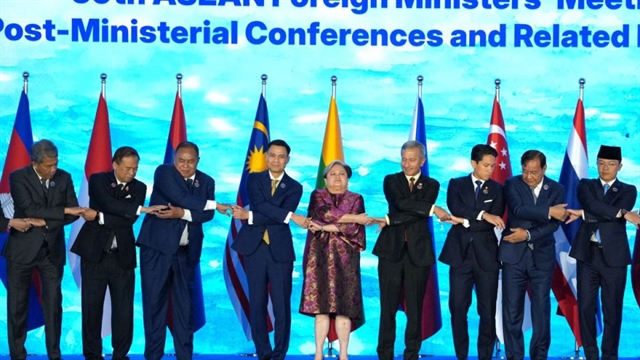 |
| Philippine Foreign Secretary Theresa Lazaro (C) and foreign ministers from the Association of Southeast Asian Nations (ASEAN) countries pose for a group photo during the opening ceremony of the ASEAN Foreign Ministers' Meeting in Pasay, Metro Manila on July 21, 2026. — AFP/ANN Photo |
MANILA — ASEAN foreign ministers agreed on July 21 to develop benchmarks for measuring progress in Myanmar and began discussing appointing a longer-term special envoy, as the regional grouping sought to strengthen implementation of its long-stalled Five-Point Consensus peace plan.
The proposals, discussed during an extended informal consultation on Myanmar on the sidelines of the 59th ASEAN Foreign Ministers’ Meeting in Manila, will now be refined by senior officials before going to ASEAN leaders at their November summit, said Philippine Foreign Secretary Ma. Theresa Lazaro.
The discussions followed an informal meeting in Bangkok on July 12 that brought together nearly all ASEAN foreign ministers and Myanmar’s foreign minister for the first time since the military seized power in 2021.
In Manila, ministers revisited proposals from the Bangkok meeting, including creating an ASEAN framework to assess progress in Myanmar and exploring a longer-term special envoy instead of rotating the role annually.
“We have tasked the senior officials to really give meat and discuss this carefully because this is an input to the leaders’ meeting in November,” Lazaro, who also serves as the ASEAN chair’s special envoy to Myanmar, told reporters.
She said that Brunei had proposed establishing a unit within the ASEAN Secretariat to support the envoy’s work, although issues such as funding and operational arrangements still needed to be resolved.
The discussions took place as ASEAN foreign ministers gathered in Manila ahead of meetings this week with major dialogue partners including the United States, China and Russia, against a backdrop of intensifying geopolitical rivalry, South China Sea tensions and conflicts stretching from Myanmar to the Middle East.
The Bangkok meeting had prompted speculation that ASEAN might be softening its approach towards Myanmar’s military rulers after years of diplomatic stalemate.
Lazaro, however, reiterated in a July 19 statement that the discussions should not be interpreted as a departure from the Five-Point Consensus, adopted by ASEAN leaders in 2021 following the Myanmar military coup.
Asked whether ASEAN still believed the Five-Point Consensus remained viable after Myanmar’s Parliament had rejected it, Lazaro said Myanmar Foreign Minister Than Swe had disputed that characterisation during the Bangkok meeting.
“He defended that the Five-Point Consensus still exists, so whatever resolution was passed in Parliament then is practically negated, because he mentioned to us that it’s no longer there,” Lazaro said.
Instead, she said ASEAN is now working on a “non-paper” that would help define how ministers should assess “demonstrable progress” in Myanmar, with senior officials tasked to flesh out the proposal.
Singapore’s Foreign Minister Vivian Balakrishnan had a wide-ranging discussion with his ASEAN counterparts in Manila, the Ministry of Foreign Affairs said in a July 21 statement.
According to the statement, the ministers reaffirmed the Five-Point Consensus on Myanmar and called for concrete and measurable steps towards its implementation, including the permanent cessation of violence, release of all political prisoners, as well as safe and unimpeded delivery of humanitarian aid across Myanmar.
The ministers also stressed the importance of constructive dialogue among all of Myanmar’s key stakeholders to achieve a peaceful and durable resolution of the crisis.
In addition, the ministers discussed the implications of the unfolding situation in the Middle East and reaffirmed the importance of upholding international law, particularly the 1982 United Nations Convention on the Law of the Sea.
This included safeguarding freedom of navigation and overflight and ensuring the safe, unimpeded, and continuous transit passage of vessels in straits used for international navigation, such as the Straits of Malacca and Singapore, the statement noted.
The Five-Point Consensus calls for an immediate cessation of violence, dialogue among all parties, the appointment of a special envoy to facilitate mediation, the provision of humanitarian assistance, and the envoy’s access to all parties concerned.
Beyond Myanmar, ASEAN foreign ministers also discussed regional security issues on July 21, including the Middle East. They issued a statement expressing concern over renewed hostilities and called for the reopening of the Strait of Hormuz.
On July 24, the ministers will gather to commemorate the 50th anniversary of the Treaty of Amity and Cooperation, the landmark pact that enshrined ASEAN’s principles of mutual respect, non-interference and the peaceful settlement of disputes. — THE STRAITS TIMES
World
 World
World
 World
World
 World
World
 World
World
 World
World
 World
World
 World
World
 World
World
 World
World
 World
World
 World
World
 World
World