 World
World
Việt Nam, Google seek closer cooperation on AI, digital economy
1.
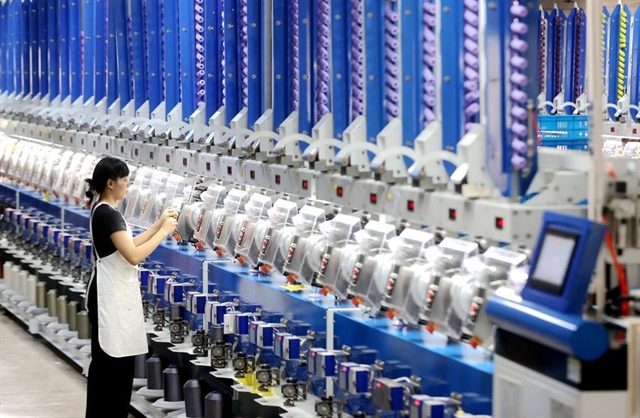 |
| A worker checks automatic spool winders at a smart factory of a company in Xin'an Town of Deqing County, Huzhou City of east China's Zhejiang Province, June 15, 2026. — XINHUA/VNA Photo |
BEIJING — Trade between China and ASEAN expanded strongly in the first half of 2026, underscoring the resilience and dynamism of regional economic-trade ties, according to Xu Ningning, Chairman of the Regional Comprehensive Economic Partnership (RCEP) Industry Cooperation Committee.
Latest figures from China's General Administration of Customs showed that bilateral trade reached 4.34 trillion RMB (about US$641 billion) in the January-June period, up 18.2 per cent from a year earlier.
The data reaffirmed ASEAN's position as China's largest trading partner for several consecutive years. Within the RCEP framework, China's trade with the Republic of Korea jumped 42.3 per cent year-on-year, while trade with Japan rose 13.8 per cent. Trade with Australia and New Zealand also remained on a steady upward trajectory. Xu said the China–ASEAN Free Trade Area continues to serve as a cornerstone of regional integration, while RCEP has further expanded the scope of economic cooperation, with the two mechanisms reinforcing each other to boost regional trade.
Xu noted that trade performance differed across ASEAN member states. Indonesia, Việt Nam, and Thailand emerged as the strongest contributors to bilateral trade growth, each posting increases of more than 20 per cent, led by electronic products and components, as well as electrical machinery and equipment. Trade with Singapore and the Philippines also maintained solid growth, driven by rising exchanges in machinery, electrical products, minerals and other commodities.
He attributed the sustained expansion in bilateral trade to increasingly integrated regional supply chains and a well-established division of labour. China's broad manufacturing base continues to supply ASEAN with key industrial inputs, including electromechanical equipment, photovoltaic products and automotive components, while ASEAN exports minerals, speciality agricultural products and electronic materials, with intermediate goods making up a significant share of two-way trade.
Trade in new energy-related products is also gathering pace. Meanwhile, deeper integration under the China–ASEAN Free Trade Area and RCEP is creating fresh momentum through cross-border logistics and e-commerce.
Looking ahead, Xu said there remains substantial room to strengthen regional economic cooperation. He called for implementation of RCEP through streamlined customs procedures and lower trade barriers, faster rollout of the China-ASEAN FTA Version 3.0 to support higher-level market opening, and closer cooperation in digital trade, the green economy and new energy, alongside stronger support services to help small and medium-sized enterprises (SMEs) integrate into regional industrial chains. — VNA/VNS
World
 World
World
 World
World
 World
World
 World
World
 World
World
 World
World
 World
World
 World
World
 World
World
 World
World
 World
World
 World
World
 World
World
 World
World