 Features
Việt Nam, Republic of Korea partner in medical innovation
1.
By Ngọc Ý
At just 21, Bùi Thịnh Đa is chasing a fiery passion -- crafting ball-jointed dolls that proudly bear the label of “Made in Việt Nam” and bringing them onto the global stage.
When he was six, Đa first saw an intricate ball-jointed doll by Russian artist Marina Bychkova on social media.
He was fascinated by the complex faces and realistic movements of those dolls, but their price tags made them completely out of reach for a child.
Unfazed, he bought a block of clay and began shaping his own dolls -- a simple pastime that soon deepened into a quiet and consuming passion.
 |
| Bùi Thịnh Đa from HCM City is one of the youngest to bring the art of making ball-jointed doll to Việt Nam. VNS Photo Hồng Linh |
Finding identity
Đa now works under two distinct labels: Da Dad Doll and Bùi Thịnh Đa.
Under Da Dad Doll, a name he explains as “I’m the father of these dolls,” Đa creates shadowed, introspective figures that carry a haunting emotional depth, inspired by Tim Burton films—works that, he says, are “filled with an inner world beneath their dark whimsy”.
The Bùi Thịnh Đa brand stands in sharp contrast to Da Dad Doll with bright, playful dolls infused with the spirit of Vietnamese culture.
At first, Đa only intended to build his brand within the gothic, mysterious world of Da Dad Doll.
However, one of his foreign friends asked a simple question: “Does Việt Nam have its own traditional doll?”
 |
| Under Da Dad Doll, Đa's figures carry a haunting emotional depth, filled with an inner world beneath their dark whimsy. VNS Photo Xuân Đăng |
The query struck a chord. The question went beyond toys.
It exposed a cultural gap: while children across the world grow up with dolls that mirror their heritage, Việt Nam has long lacked a figure to represent its own people and traditions.
At that moment, Đa realised how little presence Vietnamese dolls had on the cultural stage -- and wondered, why not create one that truly reflects the face and spirit of Việt Nam?
From that spark, the Bùi Thịnh Đa brand was born, fused with a mission to celebrate and share Vietnamese culture globally.
“I hope Vietnamese dolls can go further,” he says with the quiet pride of someone who has shaped them from clay and spirit alike. “In the future, I’ll create more collections that carry the essence of Vietnamese culture.”
Stories in clay
Creating a ball-jointed doll requires patience and precision -- skills that took the young man many years to master.
“I always start with a sketch,” he explains. From there, he sculpts the figure in clay, carefully cutting it into pieces so the joints can move.
Once the form is ready, he paints the face, reassembles the body, and completes the doll with handmade clothes and styled hair.
 |
| The young artist refuses to let his dolls become soulless figures; each one is crafted as if alive, carrying its own story to tell. VNS Photo Hồng Linh |
Step by step, what begins as raw clay becomes, in his words, “a character with its own story”.
When it comes to materials, Đa turns to clay, sometimes porcelain clay, which he fires at around 120 to 150 degrees Celsius.
But for porcelain clay, the process becomes much more complicated, as he cannot just do it at home.
“I have to take the pieces to ceramic kilns, and let the artisans fire them at high temperatures. It’s demanding, but it gives the dolls their durability, strength, and delicacy,” he tells Việt Nam News.
Each doll usually takes him two to three months to complete, but one special porcelain doll took over three years of patience and dedication.
A doll he is most proud of is one dressed in the traditional costume of the Nguyễn Dynasty.
To capture its authenticity, Đa spent weeks visiting museums, poring over archival images, and studying every stitch of the royal garments to create the most faithful miniature version of the Nguyễn costume.
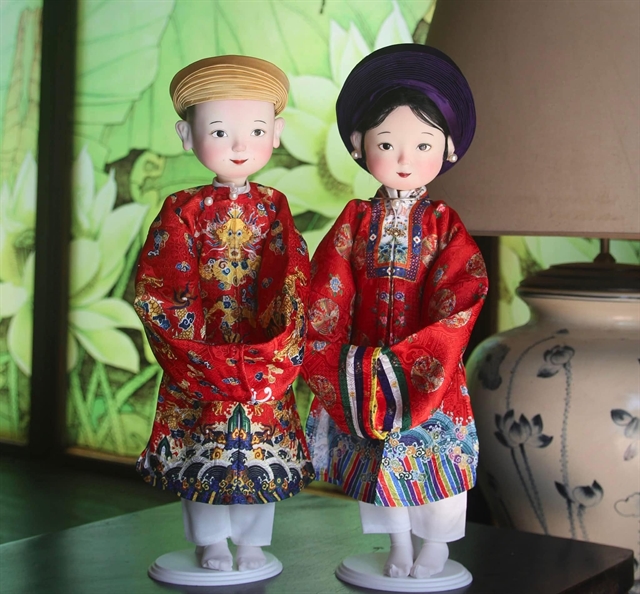 |
| Đa's other label, Bùi Thịnh Đa, amplifies the image of Vietnamese culture globally. Photo courtesy of Bùi Thịnh Đa |
Soulful creations
Đa admits that one of the most challenging parts is always the clothing.
“Human clothes are larger and made of thicker fabric,” he explains, “but for dolls, the fabric has to be thinner and softer so it fits naturally without bunching up.”
Growing up in Sóc Trăng (now part of Cần Thơ Province), Đa had no community, no peers, and no environment to nurture his unusual passion -- books and the internet became his only teachers.
“At first, all I had were books and the internet. I didn't attend any courses. I spent one or two years experimenting and learning human anatomy on my own before I finally created a doll that looked somewhat human-like,” he recalls.
For Đa, that long journey of trial and error shaped not just his skills, but his belief that every doll should carry a soul of its own.
He refuses to let his dolls become mass-produced, soulless. Instead, each one is crafted as if alive, carrying its own story to tell.
One of Đa’s most recognised creations is a doll with vitiligo, its skin marked with depigmented patches. He designed it, he explains, to share a simple message: everyone has their own kind of beauty.
“When I posted her online, I just wanted to tell a story,” Đa says, “But then people with vitiligo in Việt Nam began reaching out, saying they felt comforted and seen.”
Đa also runs a small workshop in Hồ Chí Minh City -- a cosy space where visitors can gather, share ideas, and create their own dolls.
Tô Yến Nhi, a student at Đa’s workshop, says that the ball-jointed dolls workshop has been an eye-opener, as the practice barely exists in Việt Nam.
What struck her most was how alive the dolls felt -- “soulful, very lively, as if they had emotions inside”.
The doll she made in Đa’s workshop, she adds proudly, “feels truly one-of-a-kind, because I made it with my own hands”.
For Đa, dollmaking is no longer just a quiet passion -- it has become a heartfelt mission to breathe life into Vietnamese culture through every delicate figure he shapes. VNS
Features
 Features
 Features
 Features
 Features
 Features
 Features
 Features
 Features
 Features
 Features
 Features
 Features
.jpg) Features
Features
 Features