 Sports

SMS Tan Kiat How, Rosianna Silalahi and Glenda Gloria to speak at PRISM Summit 2026
1.
Athletics
HÀ NỘI — Việt Nam’s athletics team is ramping up preparations for the 2026 Asian Games in Japan this September, as athletes intensify training in pursuit of a place on the ASIAD squad.
A total of 49 athletes are training diligently, sweating through daily sessions and following individual training plans for each event category, in hopes of being selected to compete in Japan.
ASIAD does not require qualification based on performance. However, Việt Nam's coaching staff applies its own set of criteria, maintaining high expectations for professional standards.
“ASIAD is a fierce competition. We will carefully assess the team, and whoever is in the best form will be given a chance,” coach Vũ Ngọc Lợi said.
For middle- and long-distance events, training focuses on improving the ability to maintain speed throughout the race. Meanwhile, speed and technique events require near-perfect precision in every movement, from the start to sustaining maximum speed throughout.
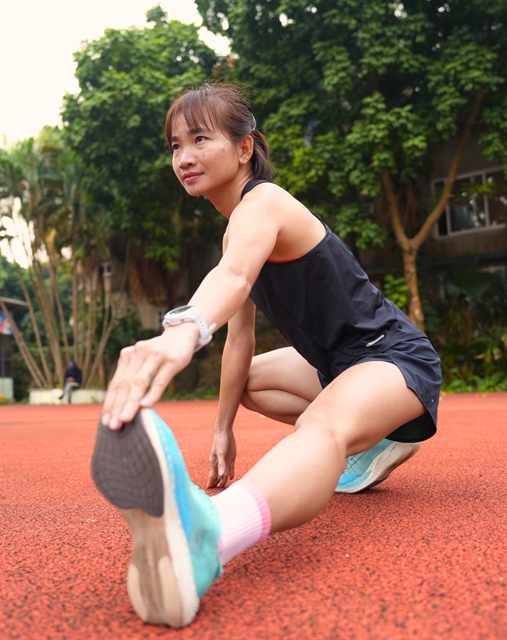 |
| Runner Nguyễn Thị Oanh warms up ahead of a training session as she prepares for the Asian Games (ASIAD). — Photo courtesy of Oanh Nguyễn |
Runner Nguyễn Thị Oanh said: “I am entering a phase of physical preparation and technical refinement. ASIAD is a crucial target, so I must maintain the highest level of concentration.”
Hurdler Huỳnh Thị Mỹ Tiên said she is focusing on improving her mid-distance speed technique to enhance her performance.
Clear progress is also visible across events. The steady running rhythm of Quách Thị Lan and rapid acceleration shown by Trần Thị Nhi Yến reflect thorough preparation in both fitness and mental fortitude.
According to coach Trần Văn Sỹ, this year’s training programme emphasises speed and endurance.
“The SEA Games 33 last year was a notable success for the Vietnamese athletics team, but ASIAD is different," Sỹ said. "We must raise our performance standards to a new level if we want to compete.”
Meanwhile, coach Nguyễn Mạnh Hiếu stressed that success depends on small details.
“In continental competitions, even delays of a few hundredths of a second can cost you an opportunity. Every starting movement and every acceleration must therefore be perfected to the maximum,” Hiếu said.
Team selection for the ASIAD is based not on quantity, but on quality. The official list will be refined based on international achievements, consistent performance and the ability to meet training requirements.
Some young athletes have made significant progress. Twenty-year-old athlete Lê Thị Cẩm Tú recently broke the 15-year-old 200m record held by "speed queen" Vũ Thị Hương, winning a silver medal at the SEA Games 33 with a time of 23.14 seconds. Tú's achievement demonstrates the potential of the next generation of young athletes.
Alongside domestic training, the team is competitiveness. Athletes will participate in the Asian Beach Games at the end of April and the Asian Championships in June. These events are important milestones for evaluating training effectiveness and adjusting plans ahead of the Asian Games.
Hiếu said: “We have high expectations for our female athletes, including runner Oanh, who won a bronze medal in the 3,000m steeplechase at the 2018 Asian Games. We hope Oanh will continue to draw on her experience and strengths.”
 |
| The Vietnamese athletics team trains ahead of the 20th Asian Games (ASIAD). — Photo nhandan.vn |
Medal goals
The Việt Nam Athletics Federation (VAF) has set goals for selecting key events based on the relative strength of competitors.
“Although the ASIAD organising committee does not set a performance standard for participation, we still establish our own criteria. Athletes must be able to reach the finals in their respective events to be considered for selection," VAF Secretary General Nguyễn Mạnh Hùng said.
"We will base decisions on relative skill levels to identify events in which we have the potential to compete, and then focus investment on key areas, including overseas training and participation in international competitions.”
Hùng added: "China, Japan and India are very strong countries and account for the majority of medals. This is a major challenge for teams in Southeast Asia.”
This year’s competition is expected to feature around 50 athletics events, including some new ones, such as the 21km half-marathon walk, the 42km marathon and the 4x100m mixed relay. The wide variety of categories creates more opportunities, while also requiring rapid adaptation from participating teams.
Under current plans, the Vietnamese athletics team will aim to win medals in about 20 events. Performance at this competition will reflect the team's professional ability and demonstrate Việt Nam’s adaptability to the increasingly high demands of continental sports. — VNS
Sports
 Sports
 Sports
 Sports
 Sports
 Sports
 Sports
 Sports
 Sports
 Sports
 Sports
 Sports
 Sports
 Sports
 Sports