 Sports

Lào Cai seeks breakthroughs with wellness tourism ecosystem
1.
|
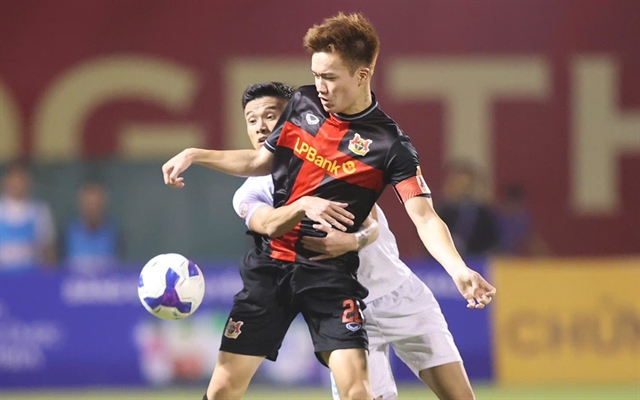
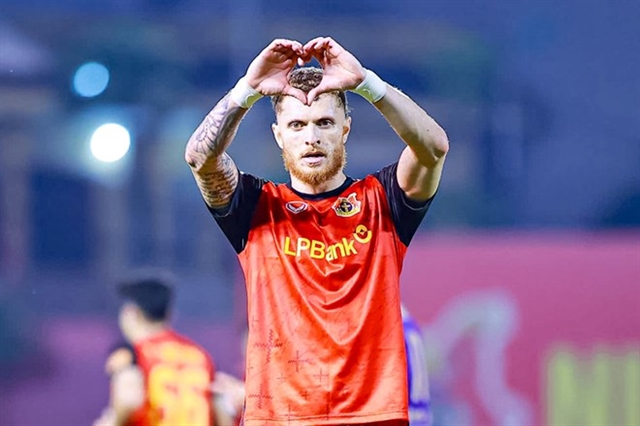
| Nguyễn Hoàng Đức (front), playing in a V.League match. A midfielder of Đức's quality, the reigning Vietnamese Golden Ball winner, exists to receive the ball, turn, dictate play and unlock defences and not just to play long balls. Photo sggp.vn |
Anh Đức
After Hà Nội FC's 2-1 victory against Ninh Bình FC, Hà Nội's captain Nguyễn Văn Quyết was asked about the absence of Nguyễn Hoàng Đức, Ninh Bình's core midfielder. Quyết's reply was a simple but highly combustible comment: "Even with three Hoàng Đức playing, it'd have made no difference."
Quyết's comment, despite its virality on social media, was not a direct jab at Đức, but rather a veteran's thorough observation on the opposing team.
"If a defender keeps pumping up balls to the front for the forward, that's not how football is supposed to be played," Hà Nội's captain added.
To understand what Quyết meant, you have to look at how Ninh Bình actually played that night at the Ninh Bình Arena. Despite having creative midfielders capable of dictating tempo, the home side largely bypassed its own midfield. Centre-backs hoofed long balls towards their tall foreign forwards, hoping for a flick-on or a knockdown. Of the two goals Ninh Bình scored, one came from a Hà Nội defensive error, and the other from a deflected shot. Neither came from a sustained, structured attacking move through the middle of the pitch.
That, in essence, was Quyết's point. A midfielder of Hoàng Đức's quality, the reigning Vietnamese Golden Ball winner, exists to receive the ball, turn, dictate play and unlock defences. If your tactical setup tells your defenders to skip him entirely and go long, then it does not matter whether you have one Hoàng Đức on the pitch or, hypothetically, three. The system renders the talent redundant.
Now, I do think Quyết went a step too far when he suggested that Ninh Bình's approach was 'not football'. Long-ball football is a legitimate tactical school, with a long history of success at every level of the game. Direct play has won leagues, cups and World Cups. To dismiss it outright is to ignore how much of the modern game still relies on bypassing the press and exploiting space behind defensive lines. Quyết, a man who has played professional football for nearly two decades, surely knows this.
But strip away the rhetorical excess, and his underlying observation lands. This Ninh Bình side, despite their early-season title charge, have lost coherence. They have used three head coaches this season already. They have stars across every line, but no settled system to weave them together. After leading the V.League for much of the autumn, they have won just three of their last nine matches and now find themselves slipping out of the top-three race entirely. New coach Bae Ji-won, in charge for only a handful of matches, admitted after the Hà Nội match that Hoàng Đức was held back from the starting eleven because he is still recovering from injury. Even when Đức came on in the second half, his teammates often ignored his runs in favour of those long diagonal balls.
There is a wider lesson here for Vietnamese football. Talent alone does not win matches. Việt Nam has produced a generation of technically gifted players, both domestic and naturalised, who can compete with the best in Southeast Asia. But without a coherent tactical philosophy, that talent gets squandered.
Quyết has since been suspended after picking up his third yellow card of the season in that match, ruling him out of Hà Nội's next round. His comments, meanwhile, will probably attract their own form of disciplinary attention. But love him or hate him, the captain has done Vietnamese football a small service by saying out loud what many coaches and analysts have been thinking quietly: a club is more than the sum of its star names. Without a plan to use them, even three Hoàng Đức would not be enough. VNS
Sports
 Sports
 Sports
.jpg) Sports
Sports
 Sports
 Sports
 Sports
 Sports
 Sports
 Sports
 Sports
 Sports
 Sports
 Sports
 Sports