 Society

Classic romantic ballet Giselle returns to Saigon Opera House
1.
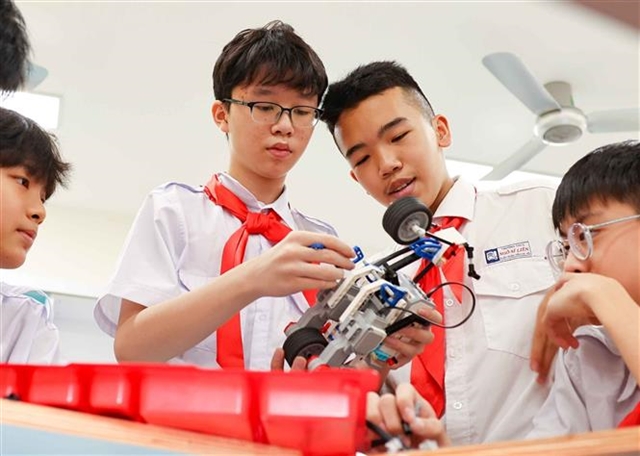 |
| Students at Ngô Sĩ Liên Secondary School in Hà Nội learn to design and assemble robots with support from AI and robotics experts. — VNA/VNS Photo Thanh Tùng |
By Mai Hương
HÀ NỘI — As artificial intelligence (AI) makes it easier for students to find answers and complete assignments, teachers face a growing challenge: how to know whether students truly understand what they submit.
AI can generate essays, solve exercises and prepare presentations in minutes. But a polished result does not always reflect a student’s actual ability. Education experts say schools need to rethink both teaching methods and assessment.
Đỗ Trần Đức, deputy general director of Hong Linh Education Investment and Development JSC, which runs AI training programmes with schools, said the role of teachers was changing as students gained easier access to information.
“Teachers can no longer stop at delivering knowledge. They need to guide students on how to think, ask questions, verify information and apply knowledge in practice,” he told Việt Nam News.
A student may use AI to solve a physics problem quickly. But the teacher still needs to help the student understand why a formula is used, whether the solution is reasonable and how the knowledge can be applied in daily life.
“In the AI era, greater attention should be given to guiding students’ thinking and helping them apply what they learn,” Đức said.
Teaching students to think
The shift does not mean subject knowledge is becoming less important. Students need a solid foundation to question AI-generated answers and identify mistakes.
James Moran, Academic Director at EMG Education, said schools were preparing students for jobs five, 10 or even 15 years into the future, when technology could be very different.
“Where does judgement come from? Knowledge, foundation,” he said during a recent panel discussion on AI and graduate readiness.
Students need to understand the context behind an answer, evaluate information and make decisions, rather than simply memorise facts or complete exercises.
For teachers, this means designing lessons that require students to explain their reasoning and apply knowledge to unfamiliar situations. It also means understanding how students use AI and helping them recognise its limitations.
Đức said teachers were moving from being mainly providers of knowledge to becoming guides who supported students throughout the learning process.
“The teacher should not only help students know the answer but also understand the nature of the problem and be able to find answers themselves when they face new situations,” he said.
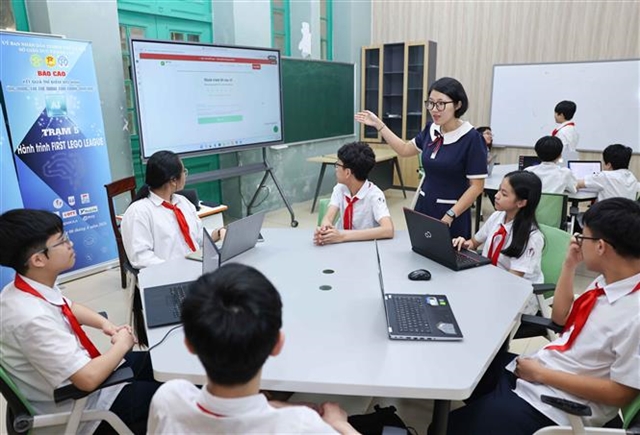 |
| A teacher guides students in using digital technology in the classroom. — VNA/VNS Photo Thanh Tùng |
Assessing more than the final answer
Assessment is another area where AI is creating pressure for change.
Students can use AI to write essays, solve exercises, produce computer code and prepare presentations quickly. A good final product, therefore, does not necessarily prove that a student understands the work or can complete it independently.
Dr Mai Ngọc Côi, director of Phương Đông Language Centre at Phương Đông University, said assessment needed to focus more on the learning process.
At his centre, a pilot approach asks students to use AI to help produce a piece of writing, identify what is missing or incorrect, revise the draft and submit three stages of their work. They then give an oral presentation to explain their thinking.
The process allows teachers to see how students evaluate AI-generated content and improve it.
Đức also said teachers should look beyond the finished product and examine how students arrive at their answers.
“Teachers need to assess the learning process, the way students think and their ability to solve problems independently, rather than focusing only on the final result,” he said.
For a presentation on environmental pollution, for example, teachers should consider how students collect information, check their sources and choose their proposed solutions.
“If students use AI, teachers should also assess how they ask questions, select information, identify inaccuracies and revise the content to produce a suitable result,” he said.
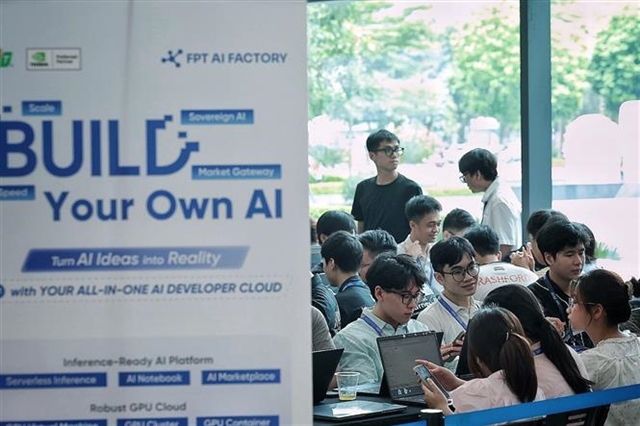 |
| Teams develop their products at the Vietnam AI Innovation Challenge 2026. — VNA/VNS Photo Phạm Tuấn Anh |
AI as an assistant, not a replacement
AI can also help teachers manage repetitive tasks that take up time. According to Đức, it can support lesson planning, prepare exercises at different levels, generate multiple-choice questions, mark tests with clear answers and summarise students’ learning results.
In a class of 40 students, for example, AI could identify questions that many students answered incorrectly and highlight topics that need more attention. Teachers could then adjust their lessons and prepare additional exercises.
But AI should not replace teachers in making broader assessments or decisions that require an understanding of individual students.
“The results of a test do not fully reflect a student’s ability or circumstances,” Đức said. “AI can identify signs from data, but it cannot completely replace teachers’ observation, understanding and flexible responses,” he said.
Teachers must also check the accuracy of AI-generated content, protect students’ personal information and remain responsible for assessment decisions.
Moran has also highlighted the potential for AI to support continuous assessment. By helping teachers track students’ progress during lessons, AI could provide a fuller picture of learning than end-of-semester results alone. The aim, he said, should be to improve learning outcomes and reduce teachers’ workload, rather than add to it.
The growing use of AI in education also calls for clear policies to guide its use by students and teachers. Resolution No 57-NQ/TW, which sets out Việt Nam’s priorities for science, technology, innovation and digital transformation, highlights the importance of developing high-quality human resources. However, translating these goals into practice requires clear rules at school and university level.
Dr Mai Ngọc Côi said research at seven universities had found that some institutions lacked AI policies, leaving students and teachers uncertain about what constitutes acceptable use. Without clear rules, practices accepted in one classroom could be considered misconduct in another.
Schools and universities need to communicate their policies clearly to both teachers and students. Assessment methods must also reflect what students are expected to learn.
The challenge is to distinguish between students using AI to support their learning and those relying on it to complete assignments without understanding the content.
Đức said the goal of education in the AI era should not be to train students to produce answers as quickly as possible.
“What matters most is developing students who can think independently, use AI responsibly, verify information and apply their knowledge to solve real problems,” he said. — VNS
Society
 Society
 Society
 Society
 Society
 Society
 Society
 Society
 Society
 Society
 Society
 Society
 Society
 Society
 Society