 Society
HCM City shifts focus to multi-value salt economy
1.
|
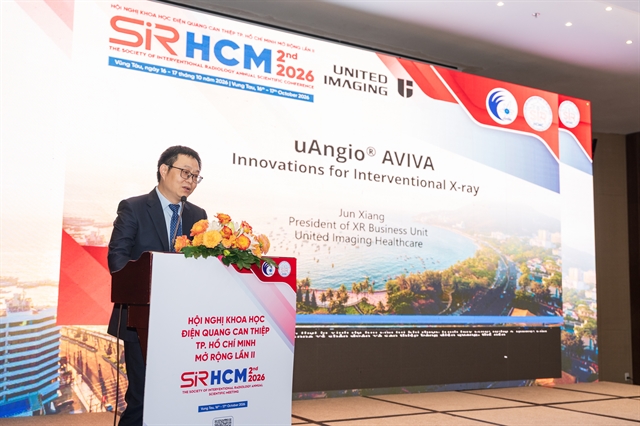
| An expert shares advanced techniques in the field of interventional radiology at the second Expanded Hồ Chí Minh City Interventional Radiology Scientific Conference. — Photo courtesy of the organiser |
HCM CITY — Leading domestic and international experts shared in-depth knowledge, advanced techniques and the latest materials in the field of interventional radiology at the second Expanded Hồ Chí Minh City Interventional Radiology Scientific Conference (SIRHCM 2026), on October 16–17.
This year’s symposium holds strategic significance in advancing a key trend in modern medicine: the use of minimally invasive treatment methods that deliver maximum efficacy for patients. Through in-depth lectures, the event fosters professional networking and technology transfer, enabling interventional radiologists and vascular specialists to implement these new techniques more broadly across all provinces and cities.
Speaking at the event, Dr Nguyễn Đình Luân, President of the Hồ Chi Minh City Society of Interventional Radiology, stated: "Our goal is to provide advanced knowledge and share the latest developments across various fields of interventional radiology—ranging from neuro-interventions to peripheral interventions.
“In the context of cancer care, the application of interventional radiology represents a fourth pillar of treatment—following surgery, chemotherapy, and radiotherapy—making treatment more effective and offering cancer patients a better chance of recovery or an improved quality of life with extended survival."
One of the key highlights of the event was the M&M session themed "UIH AVIVA," which focused on two specialised fields, including Oncological Intervention and Neurointervention.
During the presentations, the cutting-edge technology of the new-generation digital subtraction angiography (DSA) system made a strong impression on medical professionals. The system’s breakthrough lies in its flexible 8-axis design, its ability to produce images with minimal noise—revealing even the smallest blood vessels—and, most notably, its capacity to reduce radiation exposure by up to 70 per cent.
These advantages are highlighted through two key technological reports: the application of "Noise Free" technology in clinical practice for neurovascular and peripheral vascular interventions, and an interventional X-ray system integrated with Artificial Intelligence (AI) to optimise treatment precision. Both reports were presented by Dr Zhang Yi and Dr Zhu Dongliang, physicians from a leading hospital in China.
Prof. Thông, MD, PhD, President of the Vietnamese Society of Radiology and Nuclear Medicine, said: "The integration of AI into DSA systems allows for a reduction in radiation dosage, meaning patients are exposed to less radiation—a benefit that also ensures greater safety for medical staff. Furthermore, AI minimises image noise, resulting in significantly sharper, clearer images. This enhanced clarity enables physicians to navigate microcatheters with greater ease for selective procedures and embolisation, ultimately making interventions faster and more precise for patients."
|
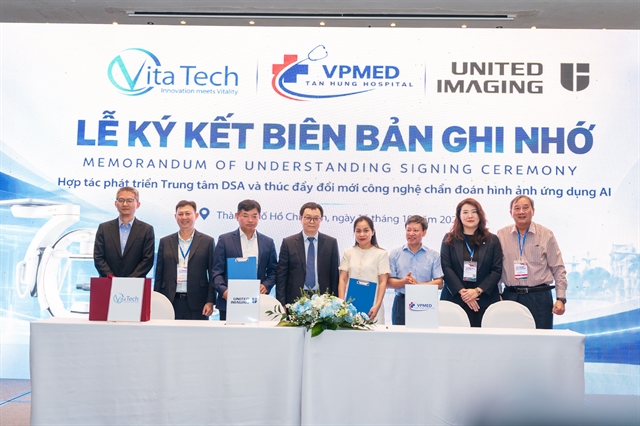
| Delegates sign a cooperation agreement to promote technological innovation in diagnostic imaging using AI. — Photo courtesy of the organiser |
President of the Vietnamese Association of Radiology and Nuclear Medicine (VART) Thái Văn Lộc said that the clinical application of AI yields tangible therapeutic benefits, such as reducing radiation doses and producing clearer images, while also enabling the identification and optimisation of operational and surgical workflows.
The conference also highlighted proud achievements resulting from the transfer of technical expertise to primary-level hospitals. A notable example is the report on the outcomes of endovascular interventions for arteriovenous fistula dysfunction, presented by a physician team from Châu Đốc General Hospital.
By mastering the use of a digital subtraction angiography system, Châu Đốc General Hospital has successfully performed interventions to preserve arteriovenous fistulas (AVF), achieving a technical success rate of 93.5 per cent. Notably, 93.5 per cent of the patients (29 cases) were able to undergo dialysis as early as the following day, with strong, palpable thrills—a testament to the procedure’s superior efficacy, minimally invasive nature, and rapid recovery time.
This achievement clearly demonstrates that when high-end medical technology is properly invested in and transferred, it can deliver powerful results at the local healthcare level, ensuring that patients have convenient access to advanced medical procedures right in their own community. — VNS
Society
 Society
 Society
 Society
 Society
 Society
 Society
 Society
 Society
 Society
 Society
 Society
 Society
 Society