 Politics & Law
Lawmakers call for fairer land tax policies, tighter controls on education tax incentives
1.
|
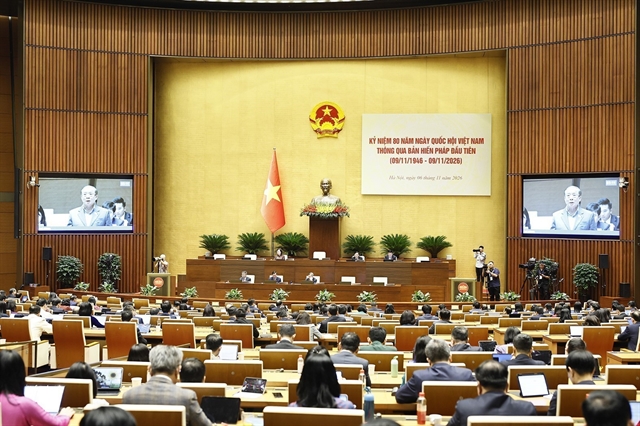
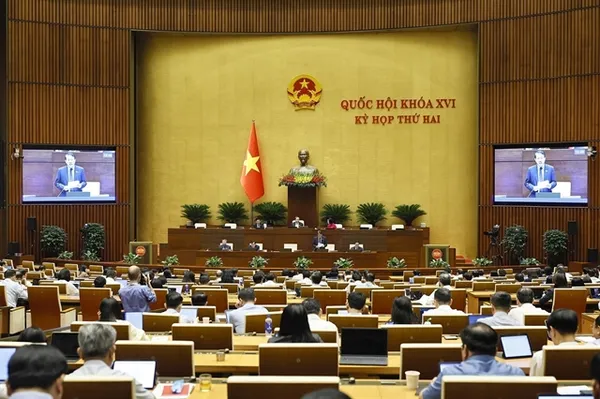
| National Assembly (NA) deputies discuss amendments to three laws on corporate income tax, non-agricultural land use tax and personal income tax on Friday. VNA/VNS Photo |
HÀ NỘI — Lawmakers on Friday called for more targeted and equitable tax policies as the National Assembly (NA) discussed amendments to three laws on corporate income tax, non-agricultural land use tax and personal income tax.
During the plenary session, NA deputies broadly agreed on the need to revise the laws, stressing that the proposed policies should benefit the intended groups, deliver practical benefits to citizens, ensure fairness and feasibility, and remain within the State budget’s capacity.
Much of the debate focused on a proposed 0.2 per cent tax rate on land left vacant, unused or put into use behind schedule, as well as tax incentives for educational institutions.
Deputy Nguyễn Văn Huy from Hưng Yên Province supported the proposed amendments to the Law on Non-Agricultural Land Use Tax, saying taxation could serve as an instrument to regulate land-use behaviour and encourage more efficient use of land resources.
He backed the proposed 0.2 per cent tax rate on vacant or delayed-use land without applying land-use quotas, describing it as a necessary measure to curb land speculation and hoarding, which waste social resources.
However, he warned that applying the rate to an entire land plot or project could unfairly penalise areas already being used for their intended purposes.
Some large plots contain both developed and unused sections, while projects are often implemented in phases, with certain components completed and others still under construction, he noted.
Huy proposed clarifying Article 7 to ensure that the 0.2 per cent rate applies only to the actual area left vacant or not put into use on schedule, while legally used areas remain subject to the corresponding tax rates under the law.
Such a distinction would help achieve the policy's goal of preventing land waste without treating effectively used land in the same way as abandoned land, he said.
Huy also welcomed the proposed tax exemption for land used for education and training, saying it would help reduce investment and operating costs for educational institutions and encourage private-sector participation in education.
He stressed that educational activities extended beyond classrooms to include libraries, laboratories, practical training facilities, playgrounds, sports grounds, dormitories and other supporting infrastructure.
He proposed explicitly including these facilities in the definition of land eligible for the exemption under Article 9. At the same time, the law should distinguish land directly serving educational purposes from areas used for independent commercial activities to ensure incentives reach the right beneficiaries and prevent abuse.
Deputy Tô Ái Vang from Cần Thơ City also raised concerns over the proposed 0.2 per cent tax rate, arguing that the draft did not distinguish between land left unused due to deliberate speculation and land affected by objective circumstances.
Treating all cases equally, without accounting for force majeure factors such as natural disasters, disease outbreaks and climate change, could undermine fairness, she said.
She proposed exempting land that could not be put into use due to natural disasters, epidemics, climate change or other force majeure circumstances, provided these were certified by commune-level People's Committees.
Drawing on conditions in the Mekong Delta, Vang warned that imposing the tax on land rendered unproductive by natural disasters could further undermine residents' ability to save and resume production.
She called on the Government to develop a separate mechanism for tax exemptions or reductions on non-agricultural land and abandoned agricultural land in areas directly affected by climate change in the Mekong Delta.
"Taxation should be a tool for regulation and revenue sustainability, not a burden that undermines people's livelihoods when they are already facing difficulties," she said.
Deputy Nguyễn Cao Sơn from Phú Thọ Province questioned whether the proposed incentive was sufficiently targeted and whether its beneficiaries had been clearly identified.
Based on local surveys, he said private educational institutions had generally encountered no major difficulties in paying taxes. According to available reports, there were currently no private educational institutions operating on a non-profit basis, while most private schools were concentrated in major cities.
He argued that the proposal could fail to ensure fairness and meet its intended objectives. Moreover, a non-profit commitment was only stated once in an institution's establishment decision, while profits could still be transferred to investors through related-party transactions. Existing education legislation also lacked clear mechanisms to monitor such arrangements, he said.
Sơn called on the drafting agency to reconsider the proposal and clearly stipulate in the law that the exemption should apply only to income generated directly from education and training activities, rather than interest income, financial investments or financial leasing.
Institutions found to have breached their non-profit commitments should be required to repay all tax previously exempted, together with late-payment interest, he added.
Responding to NA deputies' concerns, Minister of Finance Ngô Văn Tuấn said the proposed tax on vacant and unused land had been carefully considered by the drafting agency.
He explained that tax authorities were responsible for collecting taxes on taxable land, while the definition and identification of vacant land should be governed by land legislation.
Determining which plots and areas qualified as vacant land would require close coordination between tax authorities and agencies responsible for State management of natural resources and land, he said.
The process would be supported by the national land database. Strengthening the development, interconnection and use of databases would help authorities accurately identify eligible taxpayers and land areas, while preventing policy abuse, tax evasion and improper tax collection.
Regarding corporate income tax exemptions for public educational institutions and non-profit private schools, Tuấn said responsibilities should be clearly divided between tax authorities and education management agencies.
The criteria for identifying non-profit private educational institutions were already clearly stipulated in the Law on Education, he said. Competent authorities would determine an institution's non-profit status based on its investment and business registration certificates, after which tax authorities would process exemptions in accordance with the law.
He said this division of responsibilities would ensure that each agency performed its proper functions.
According to estimates by the drafting agency, the proposed corporate income tax exemption for educational institutions would reduce annual tax revenue by more than VNĐ2 trillion (US$76 million).
Tuấn stressed that supporting education was a shared responsibility of society and reflected the Party's commitment to a sector identified as a top national priority. He said further policies should be studied to promote the development of education. — VNS
Politics & Law
 Politics & Law
 Politics & Law
 Politics & Law
 Politics & Law
 Politics & Law
 Politics & Law
 Politics & Law
 Politics & Law
 Politics & Law
 Politics & Law
 Politics & Law
 Politics & Law
 Politics & Law
 Politics & Law