 Society
Swiss President Guy Parmelin arrives in Hà Nội, beginning official visit to Việt Nam
1.
|
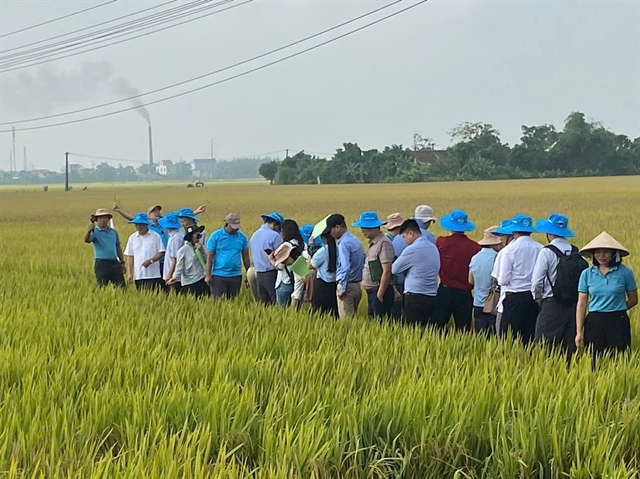
| Representatives of agencies, research institutions, businesses, cooperatives and farming communities observe new rice farming method in Nghĩa Sơn Commune, Ninh Bình Province. — VNS Photos Trà My |
NINH BÌNH — A green rice farming model in northern province of Ninh Bình has reduced production costs by an average of 23.6 per cent compared with conventional practices. The groundbreaking approach highlights the potential of mechanisation and rice straw recycling to make rice production more sustainable.
The model also increased net profit by about VNĐ5 million (over US$190) per hectare, according to preliminary results.
Implemented on 2.2 ha in Nghĩa Sơn Commune, the model combines mechanised sowing, more efficient fertiliser use and rice straw recycling.
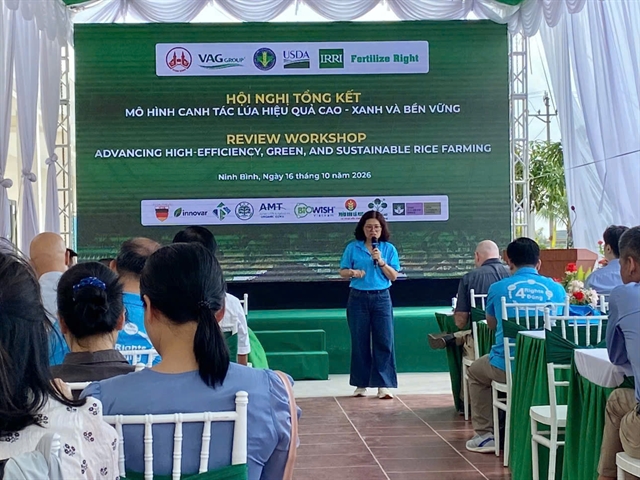
The International Rice Research Institute (IRRI), the Ninh Bình Department of Agriculture and Environment and Vietnamese agribusiness VAG Group presented the results at a conference on Friday.
The pilot used the LP5 rice variety and a mechanised row-sowing technique that places fertiliser directly into the soil during sowing, replacing conventional broadcasting and manual or machine transplanting.
Depending on the conventional method used for comparison, production costs fell by 8.6 per cent to 45.7 per cent. Sowing and transplanting costs dropped by 68-77 per cent, while fertiliser expenses declined by 29-58 per cent.
The approach combines mechanisation with four principles of nutrient management: applying the right fertiliser source at the right rate, at the right time and in the right place.
Further trials are needed to assess yields, grain quality and environmental impacts, and to determine whether the initial economic gains can be sustained across different growing seasons.
Recycling rice straw
The model also aims to turn rice straw into organic fertiliser instead of burning it or discarding it after harvest.
Returning organic matter to the soil could improve fertility while reducing agricultural pollution. However, wider adoption will depend on collection arrangements, transport costs, processing technology and market demand.
Nguyễn Văn Hùng, a senior scientist at IRRI, said the model integrated mechanised sowing, nutrient management and rice straw recycling into a system tailored to the farming conditions of the Red River Delta.
Deputy director of the Ninh Bình Department of Agriculture and Environment, Nguyễn Sinh Tiến, said the model's wider adoption would depend on its suitability for local conditions and its practicality for farmers.
Mark Petry, agricultural minister counsellor at the US Embassy in Hà Nội, representing the US Department of Agriculture, highlighted the role of private companies in turning agricultural research into practical solutions for farmers.
He said technologies such as improved fertilisers and mechanised sowing with fertiliser placement could help improve input-use efficiency, reduce production costs and increase farmers' incomes.
|
| Delegates attend a conference reviewing the results of a green rice farming model in Ninh Bình Province on Friday. |
Petry also encouraged stronger cooperation between US companies and Vietnamese partners to expand the application of proven agricultural innovations.
Agricultural technology companies, including MTK-Innova Ag, BioWish and BOF/AMT, are also involved in evaluating products and technologies under field conditions.
VAG Group general director Nguyễn Quang Trường said the company planned to work with IRRI and other partners to refine the model and conduct further trials during the 2027 spring crop.
The company also aims to cooperate with agricultural cooperatives in Ninh Bình Province to develop production areas for high-quality rice with traceable origins, with a view to expanding the model across the Red River Delta.
The next phase will focus on verifying the economic results, assessing technical and environmental impacts, and developing partnerships among farmers, cooperatives and businesses.
The model's long-term success will depend on whether it can deliver lasting benefits for farmers and remain economically viable at a larger scale, while helping Việt Nam's rice sector conserve resources and reduce environmental impacts. — VNS
Society
 Society
 Society
 Society
 Society
 Society
 Society
 Society
 Society
 Society
 Society
 Society
 Society
 Society
 Society