 Features
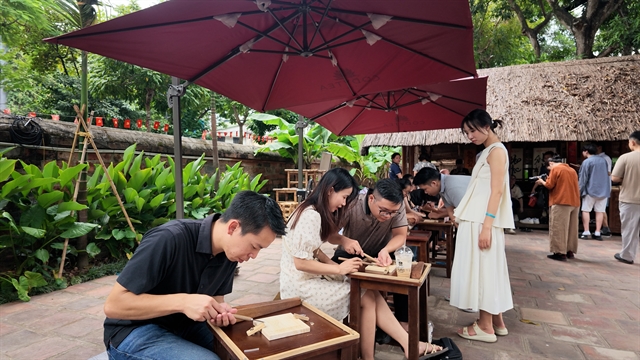
Woodcarving brings heritage to life at Hà Nội temple
1.
Lê Hương
A hands-on woodcarving workshop at Hà Nội’s Temple of Literature is giving visitors a chance to discover the stories behind traditional motifs while experiencing the patience and precision required to keep an age-old craft alive.
A small piece of wood, a carving tool and a steady hand are all visitors need to begin exploring one of Việt Nam’s traditional handicrafts.
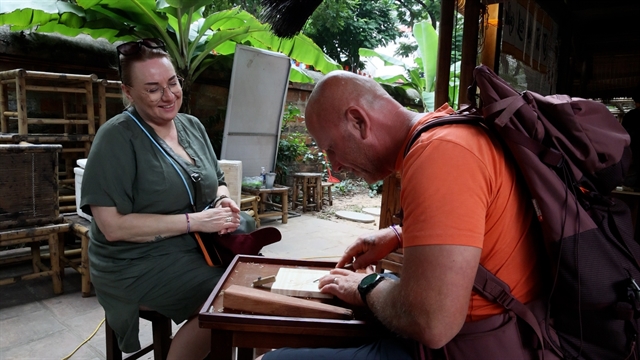 |
| Many foreign tourists enjoy trying their hand at woodcarving at Hà Nội’s Temple of Literature. — VNS Photo Lê Hương |
For many, the experience offers something unexpected during a visit to one of the capital’s best-known historical sites. Instead of simply admiring its ancient architecture and stone stelae, they can sit down, pick up a chisel and try creating a pattern themselves.
The activity is part of a workshop called Bringing Handicrafts to the Streets, organised by the Temple of Literature’s Centre for Cultural and Scientific Activities in collaboration with artisans from Ngọc Than woodcarving village on the western outskirts of Hà Nội.
Held at weekends, the programme introduces visitors to the history of woodcarving and the motifs found on doctoral laureate stelae and traditional architecture, while allowing them to practise the craft under the guidance of artisans.
The aim is to bring traditional handicrafts closer to the public, particularly younger generations, by turning cultural heritage from something to be observed into something people can experience first-hand.
For participants, the challenge begins with learning to control a carving tool. A slight change in pressure or direction can alter a line, while a momentary lapse in concentration may affect the entire pattern.
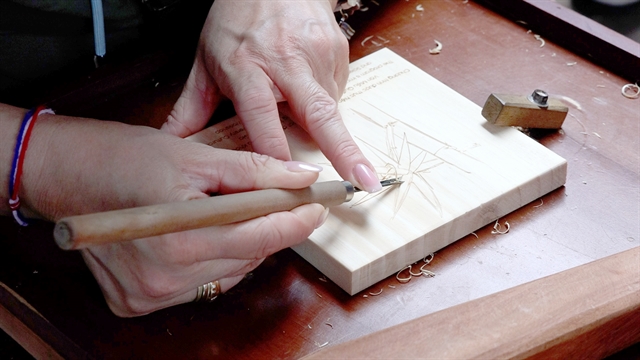 |
| The craft requires patience, precision and a high level of concentration. Photo Lê Hương |
Bryan Lew, a visitor from the United States who plays the viola, was drawn to the workshop partly because of his appreciation for wood.
“I play the viola and I like the sound of the wood,” he told Việt Nam News. After watching the artisans at work, he decided to give carving a try. He soon discovered that the process required more precision than he had expected.
“It's really sensitive. A slight touch will change things and you only get one try. If you carve it, then that's it,” he said, adding that having an instructor nearby made the experience more accessible to beginners.
Lew also saw value in the craft as a way of preserving cultural knowledge. According to him, wood can serve as a medium for preserving records and texts, while a hands-on activity allows people to understand the material in a more immediate way.
For Swiss visitor Erich Haldi, who also works with wood at home, the workshop offered a familiar but demanding experience. He described the work as beautiful, while acknowledging the effort involved in carving by hand.
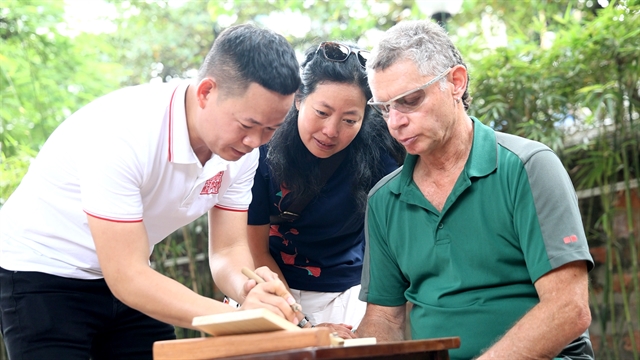 |
| Artisan Bùi Trọng Quân (left) guides visitors from Switzerland through the woodcarving process. VNS Photo Lê Hương |
“I think it's good for young people to learn to work with wood. It's very important, because the future of building is wood. And wood is the best material you can grow anywhere in the world. That's the future of construction,” he said.
Vietnamese visitors were equally enthusiastic about the activity, with many choosing patterns that reflected their personal interests or carried particular cultural meanings.
Dương Phú Cường, a visitor from Hồ Chí Minh City, chose what he considered the most difficult design available: a depiction of a candidate sitting an examination.
Although his eyesight is no longer as good as it once was, he was determined to complete the intricate pattern.
“The most important thing is to stay calm and focused. Even the slightest distraction can make the carving lose its spirit and character,” he said.
|
| Visitors practise woodcarving techniques to create their own pieces at the workshop. — VNS Photo Lê Hương |
Through carved lines
Hà Nội resident Mai Thục Anh chose a bamboo motif, explaining that bamboo represents qualities traditionally valued by Confucian scholars, including integrity, uprightness and incorruptibility.
For her, the exercise was not simply about producing a neat pattern. It was also an opportunity to learn more about the symbolism behind traditional designs.
The organisers say this connection between technique and cultural meaning is central to the programme.
Woodcarving has a long history in Việt Nam, with patterns and decorative details reflecting ideas about nature, daily life and cultural identity. Motifs that might appear purely ornamental to a casual observer can carry meanings accumulated and passed down through generations.
At the Temple of Literature, the designs used in the workshop are drawn from details found on doctoral laureate stelae and within the site's historic architecture. Participants can learn about their origins while seeing the original patterns in their historical setting.
Artisan Bùi Trọng Quân said the motifs include cloud patterns associated with good fortune, decorative designs from the Trần Dynasty and apricot blossom patterns. Some of the details were taken from stone stelae dating from the 15th to the 17th centuries.
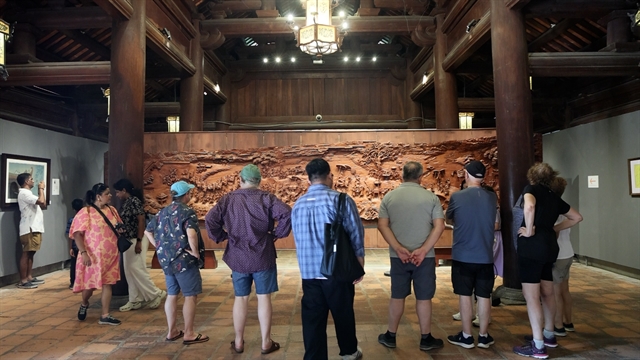 |
| Visitors admire 'Vinh Quy Bái Tổ', an 8.3m-long, 1.7m-high wooden bas-relief created by artisans from Ngọc Than Village and displayed at the Temple of Literature. — VNS Photo Lê Hương |
By explaining these origins, artisans hope to help visitors understand that a carved line is more than a decorative feature. It can also preserve knowledge about earlier generations, their beliefs and their artistic traditions.
The setting is therefore an important part of the experience. Visitors can move between observing the historic structures and trying their hand at the craft, making connections between the patterns preserved at the site and the skills required to reproduce them.
The workshop also offers a glimpse of the expertise behind wooden relief sculptures. Participants may see examples of elaborate carving and learn how much time and effort can go into producing a single piece.
A prominent highlight is Vinh Quy Bái Tổ (Returning in Glory to Pay Respects to Ancestors), a bas-relief carved by artisans Bùi Trọng Quân and Bùi Trọng Lăng from rosewood over more than two years. The piece, 8.3m long by 1.7m high, depicts around 350 figures and numerous other elements of Vietnamese cultural and social life, conveying messages about the value of education and respect for teachers.
Such works illustrate the difference between a brief introduction to carving and the years of practice needed to master the craft. While workshop participants can complete a small piece in a relatively short session, the skill behind intricate works is built through sustained effort and experience.
Quân said the programme was intended to create a bridge between visitors and traditional crafts, giving them an opportunity to slow down, reflect and create patterns inspired by the Temple of Literature and Việt Nam's scholarly learning traditions.
Ngọc Than Village has a population of around 10,000, with about 500 people still practising woodcarving, according to information shared at the workshop. Activities that bring the craft to a wider audience may help increase public understanding of the work and the people who sustain it.
Keeping tradition relevant
For Hà Nội resident Anh, the experience also prompted questions about the craft village itself. She said the organisers provided information about where it was located and how the craft was practised, leaving her interested in learning more.
The workshop's broader significance lies in the opportunity it creates for people to engage with heritage through direct experience. Rather than relying solely on narratives or displays, it allows visitors to understand some of the demands of traditional craftsmanship by using their own hands.
That approach also gives artisans an opportunity to share knowledge that might otherwise remain within workshops and craft villages. Their explanations connect practical skills with the history and symbolism embedded in traditional designs.
For younger participants in particular, the experience can offer a different perspective on familiar cultural sites. Ancient motifs become more than details on stone or wood when visitors learn how they were created and what they represent.
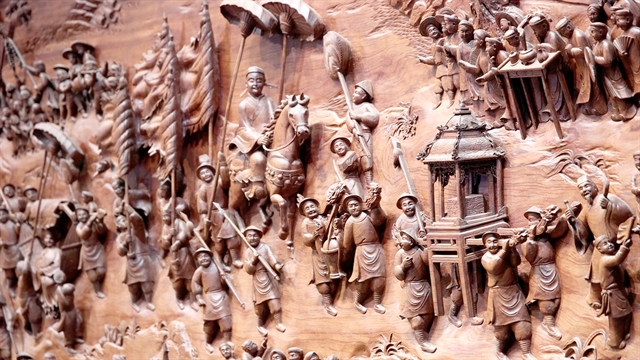 |
| Intricate details of the wooden bas-relief 'Vinh Quy Bái Tổ'. The sculpture depicts around 350 figures and numerous other elements of Vietnamese cultural and social life. — VNS Photo Lê Hương |
At the end of the session, participants can take home the wooden pieces they have carved themselves. The objects may be modest compared with the elaborate works produced by master artisans, but the process offers a tangible introduction to the craft.
The workshop is held at the Temple of Literature at weekends, with plans to expand the programme to two additional days during the week. — VNS
Features
 Features
 Features
 Features
 Features
 Features
 Features
 Features
 Features
 Features
 Features
 Features
 Features
 Features
 Features