 Society
HCM City shifts focus to multi-value salt economy
1.
|
|
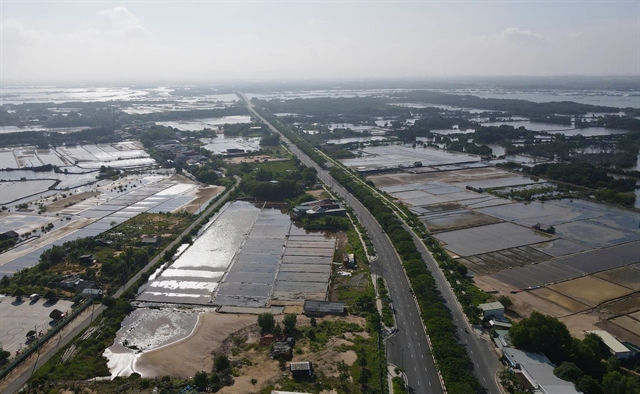
| HCM City ranks second nationwide in total salt production area with nearly 2,000 hectares of cultivated salt fields. — VNA/VNS Photos Huỳnh Sơn |
HCM CITY — HCM City is establishing a long-term strategy to restructure its salt industry by focusing on high-value processing, eco-tourism integration and sustainable livelihoods for local salt farmers.
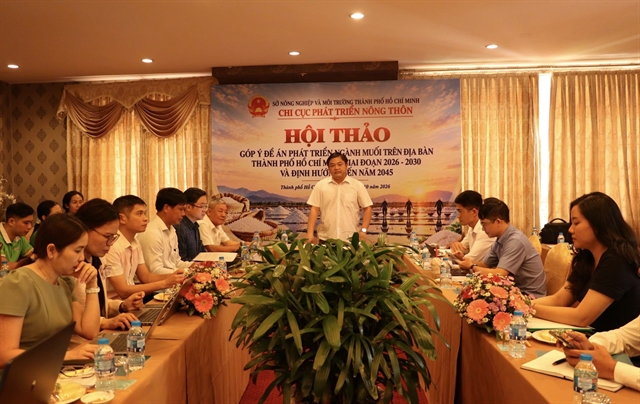
The city’s Department of Agriculture and Environment held a consultation workshop on October 16 to gather feedback on a new draft master plan for the local salt industry.
The scheme, which covers the 2026-30 period with a vision to 2045, was developed in collaboration with a joint consulting team from the Sub-Institute of Agricultural Planning and Design and the University of Finance and Marketing.
Speaking at the event, Vũ Ngọc Đăng, head of the city Sub-Department of Rural Development, said the city currently manages 1,953.9ha of salt fields, yielding over 134,500 tonnes annually, making it the second-largest salt-producing area in Việt Nam.
More than 81.7 per cent of local salt production currently uses HDPE geomembrane-lined pans.
However, the sector continues to face major challenges, including fragmented land holdings, erratic weather with unseasonal rains, price instability and an over-reliance on raw salt, which makes up more than 98 per cent of total output.
To address these issues, the draft plan proposes shifting away from unrestrained land expansion to establish a stable 1,000-ha concentrated salt production zone.
This zone will span three key communes, including 870ha in An Thới Đông, 80ha in Thạnh An and 50ha in Long Điền.
Within this zone, 730ha will be strictly protected as core production areas, targeting an annual output value of VNĐ200 billion to VNĐ250 billion (US$7.9 - 9.8 million) by 2030.
Enhancing value chains and technology
To modernise the sector, the draft targets 100 per cent application of HDPE sheeting, mechanised harvesting and transport, and a transition towards grid electricity and solar power.
Key targets set under the scheme include increasing the ratio of deep-processed salt to 40-45 per cent, developing seven to 10 “One commune, One product” (OCOP) salt products rated three to five stars, and building off-take supply chain linkages covering over 80 per cent of production output.
The city will also leverage the certified Geographical Indication brand to supply high-standard raw materials to prestigious national brands, such as Phú Quốc fish sauce.
A highlighted breakthrough in the draft plan is the functional zoning that connects traditional salt-making with eco-tourism and community-based tourism.
Under the proposal, traditional craft villages in Lý Nhơn and Long Điền will link up with the Thiềng Liềng community tourism site and the Cần Giờ Mangrove Biosphere Reserve.
|
| Delegates and experts propose piloting an integrated multi-value salt economy model at a workshop on the salt industry master plan for the 2026-30 period held in HCM City on October 16. |
Assoc Prof Dr Đỗ Phú Trần Tình, acting director of the Institute for Policy Development and Leadership Capacity under Việt Nam National University HCM City, proposed piloting an integrated multi-value salt economy model.
The proposal features experiential tourism, a salt industry museum and historical storytelling to help diversify revenue streams for salt farmers.
Delegates and local farmers urged municipal authorities to resolve land-use overlaps with protection forests and issue tailored land management policies.
They also called for preferential credit packages to support investment in storage warehouses and modern machinery.
Concluding the conference, Đăng said salt farmers remain a highly vulnerable group requiring practical support mechanisms.
He asked local authorities to secure long-term spatial planning for salt production zones.
The city Department of Agriculture and Environment will finalise the draft master plan for submission to the municipal People’s Committee for approval.
Once approved, it will serve as the framework to execute 11 priority projects during the 2026–30 period, with an estimated total investment of over VNĐ273 billion ($10.7 million). — VNS
Society
 Society
 Society
 Society
 Society
 Society
 Society
 Society
 Society
 Society
 Society
 Society
 Society
 Society