 Society

Green credit and carbon market critical to boosting climate finance
1.
|
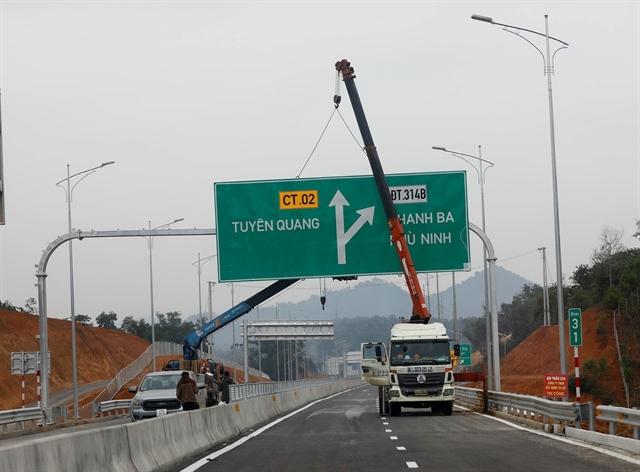
| A traffic sign being installed on the Tuyên Quang-Phú Thọ Expressway. — VNA/VNS Photo |
HÀ NỘI — The road authority has proposed a raft of changes to national road-sign rules, including setting warning-sign distances by road speed, adding an 'EV' symbol for electric vehicles, and posting emergency phone numbers on expressways.
The Vietnam Road Administration is drafting a new national technical regulation on road signs and signals that would replace the current standard, QCVN 41:2024/BGTVT.
The draft covers signs, traffic lights, road markings, and expressway guidance. The agency said the changes are meant to fix problems that have surfaced as the road network expands and to align the rules with 2024 road laws and local government legislation.
Under the proposal, hazard and warning signs would be placed according to road speed rather than fixed distances alone. A new table would set the distance for each speed band, based on the 85th-percentile operating speed where survey data exist, and on the road’s design speed where they do not.
Terrain, visibility and traffic management would still be factored in. The principle, the agency said, is that drivers need enough time to see a warning, react and act safely.
The same logic would apply to guide signs ahead of intersections on roads other than expressways, which are currently placed at a fixed distance of 20 to 50m.
The draft also clarifies that prohibition signs must stand where a ban takes effect. Where terrain or safety rules that out, they could be placed earlier, but only with a supplementary plate stating the distance to the start of the ban.
On expressways, guide signs would carry emergency phone numbers, including for rescue services and traffic police, and new signs would point to emergency stopping areas.
Rules for electronic variable-message signs would be clarified, and color codes showing traffic conditions would be added to interchange diagrams to help drivers choose routes.
Signs would also gain an 'EV' symbol to identify electric vehicles. For vehicles or road-user categories with no prescribed symbol, the draft spells out when abbreviations or text may be used instead.
Place names on signs would be updated to reflect the two-tier local government system that took effect nationwide on July 1, 2025, alongside a restructuring that cut the number of provincial-level units from 63 to 34.
The agency said some text and illustrations in the current standard still use administrative units, such as districts and provincial cities, that no longer match the new boundaries.
The draft would also revise traffic-light rules. It would bar sharing one countdown timer among several signal clusters where that could confuse road users, and it would clarify the meaning of arrow and vehicle-shaped signals.
The agency said the aim is to reduce hesitation at junctions where several signals face the same approach, or lights are set separately for individual lanes, directions or vehicle types.
Sign sizes would become more flexible. On lower-grade and rural roads, or in areas with special conditions, they would be chosen based on a road’s scale and actual use rather than a single rigid standard.
The draft also adds measures to make signposts more visible at collision-prone or poor-visibility spots, and clarifies the use of reflective materials and illuminated signs to improve visibility at night.
The agency said the draft has drawn more than 300 comments from 38 agencies and organisations, along with input from experts, regulators and traffic police. It expects the revisions to make signs easier for road users to recognise and to bring consistency to how road infrastructure is managed nationwide. — VNS
Society
 Society
 Society
 Society
 Society
 Society
 Society
 Society
 Society
 Society
 Society
 Society
 Society
 Society
 Society