 Society

VIS 2026 drives resource connectivity, tech commercialisation in HCM City
1.
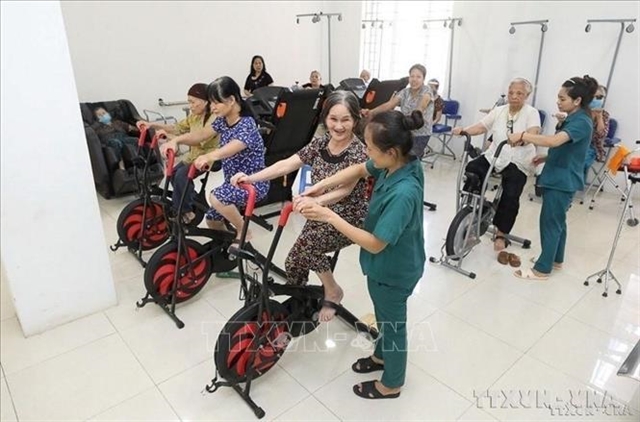 |
| Older people are guided through rehabilitation exercises to improve their health at the Yên Bái Social Work and Social Protection Centre. — VNA/VNS Photo Anh Tuấn |
HÀ NỘI — Việt Nam aims to establish a comprehensive, digitalised, multi-tier social security system that guarantees a minimum social protection floor for all citizens by 2030.
The target is set in Decision No. 1960/QĐ-TTg, which has been signed by Deputy Prime Minister Phạm Thị Thanh Trà.
The decision promulgates a plan to implement the conclusions of General Secretary and State President Tô Lâm on conducting social security policies and support for vulnerable people.
Under the plan, the system is expected to approach the standards of developed high-income countries with high-quality services, sustainable financing, transparent governance and the capacity to respond rapidly to risks by 2045.
The minimum social protection floor must ensure access to essential healthcare, basic income and development opportunities for children; support working-age people facing job loss, loss of livelihood, maternity, accidents or disability; and guarantee income and essential care for older people.
On this foundation, mandatory, voluntary, and supplementary insurance schemes will expand while mobilising participation from the State, businesses, communities, and families.
Social security must be viewed within the context of family and intergenerational relationships. Parents’ employment and income are directly tied to their children’s care, education, and overall living conditions.
The most critical breakthrough lies not merely in increasing benefits, but in strengthening the State’s capacity to actively listen to and support citizens in a timely manner. This requires implementing policies in a coordinated way, preventing risks effectively, and empowering people to improve their own lives.
Key tasks and solutions include raising awareness of social security's role within broader social policy, establishing universal social security records, and creating dedicated service points for citizens. Furthermore, the strategy outlines consolidating the social protection floor and reforming social assistance policies.
Efforts will also focus on expanding social insurance, building an inclusive labour market, developing a family- and intergenerational-based social security system, and promoting the care economy to proactively respond to population ageing.
Finally, the framework ensures equal development opportunities for children and vulnerable groups while strengthening resilience against natural disasters, epidemics, and the green transition. These objectives will be supported by reforming governance, financing, and social oversight, alongside establishing a national action program to modernise the social security system by 2030, with a vision extending to 2045.
Employing people with disabilities
To foster inclusive development and proactively manage demographic ageing, Vietnam is modernising its approach to employment support and long-term care. The following strategic pillars focus on enhancing livelihoods for vulnerable groups, standardising care occupations, and building robust social protection infrastructure to ensure long-term societal resilience.
Support policies for working-age individuals must be directly linked to skills training, employment counseling, credit access, and business connections. To ensure accountability, training outcomes will be evaluated on the basis of actual employment results rather than merely the number of participants enrolled.
Mechanisms will be introduced to encourage businesses to recruit people with disabilities, people who have completed drug rehabilitation, people who have served prison sentences, and older workers.
Job placement and career guidance services will be provided for vulnerable and disadvantaged groups.
Priority support will be given to people facing hardship, including pilot livelihood models for households with older members or people with disabilities. These households will also be given priority access to preferential loans to create jobs and increase income.
Việt Nam will develop the care economy and proactively respond to population ageing by formulating a national strategy on the care economy. This will integrate healthcare, rehabilitation, social work and care provided within families and communities.
The country will also develop networks offering day care, respite care, assistance for people with disabilities, palliative care and mental health support.
At the same time, the country will study pilot long-term care insurance schemes in selected localities, carefully assessing their financial impacts before wider rollout.
Care-related occupations will be standardised, and appropriate training and policies will be developed for social workers, carers and home-based caregivers.
Models of social housing for older people living alone, or isolated elderly people with no one to rely on, will also be developed, ensuring no older person has to live in temporary or dilapidated housing. — VNS
Society
 Society
 Society
 Society
 Society
 Society
 Society
 Society
 Society
 Society
 Society
 Society
 Society
 Society
 Society