 Society

Young people’s mental health: We need to listen – and act
1.
|
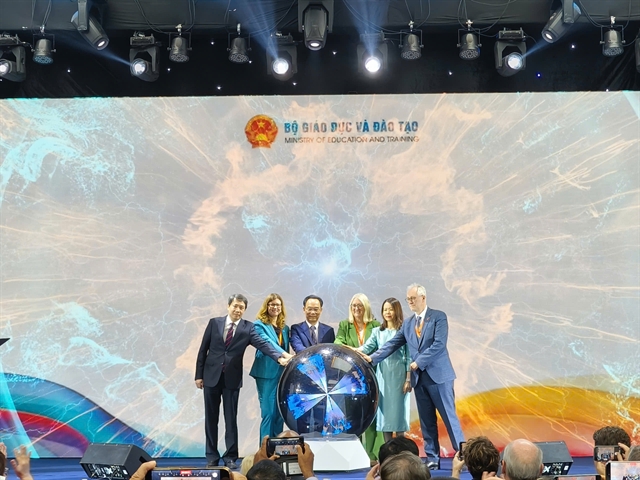
| Delegates press the button to officially open the Education and EdTech Exhibition held by the Ministry of Education and Training in Hà Nội on Thursday. VNS Photos Khánh Linh |
HÀ NỘI — Việt Nam needs to build a unified, secure and interoperable education data infrastructure and ecosystem, develop technology and AI solutions that address real educational challenges and strengthen human capacity to master and lead technology, Minister of Education and Training Hoàng Minh Sơn has said.
He made the remarks at the opening ceremony of an international conference on educational cooperation in the digital era, held alongside the Education and EdTech Exhibition launched by the Ministry of Education and Training in Hà Nội on Thursday.
The two-day event is being held to carry out major Party policies on breakthroughs in science and technology, innovation and national digital transformation under Resolution 57-NQ/TW, breakthroughs in education and training under Resolution 71-NQ/TW and international integration in the new era under Resolution 59-NQ/TW.
At the opening ceremony, Sơn said digital transformation and AI are creating major opportunities for education while posing new challenges related to information quality, ethics, copyright, data security and the digital divide.
|
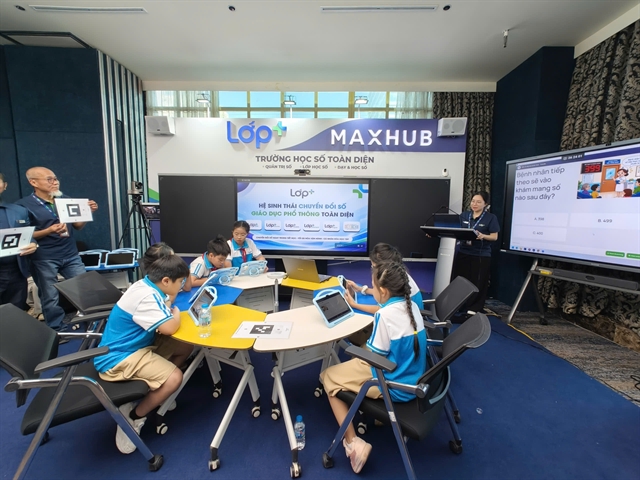
| Students attend a smart class with the support of AI and electronic devices. |
More importantly, education must answer how to prepare people to master AI and work effectively alongside it, rather than become dependent on the technology, he said.
“The entire education system must transform itself not only to adapt to technology, but also to gradually master technology and use AI safely, responsibly and for the development of people,” the minister said.
The opportunities and challenges posed by AI transcend national borders, requiring countries to strengthen cooperation in technology, data, ethical standards, labour and efforts to narrow the digital divide, he said.
“International cooperation in education and educational technology is more urgent than ever,” Sơn said.
Human-centred education goal
For Việt Nam, human development remains the overarching goal of educational reform, the minister said. He said technology's value lies not in how extensively it is used, but in its ability to help learners make progress, enable teachers to perform their roles more effectively, improve school management, and expand equitable access to learning opportunities.
Sơn said Việt Nam has identified four priorities for digital transformation in education.
|
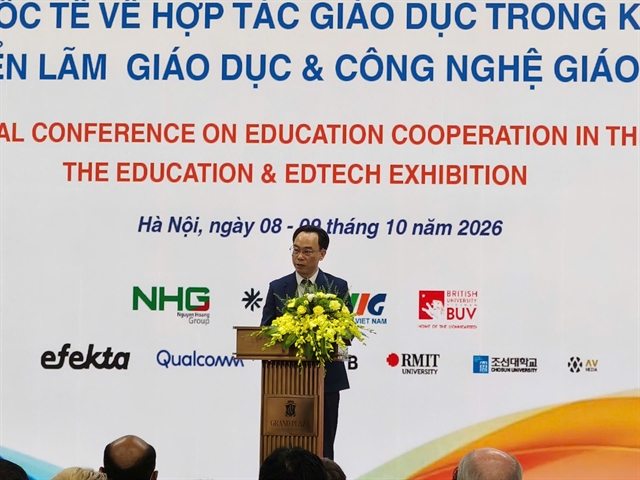
| Minister of Education and Training Hoàng Minh Sơn speaks at the opening ceremony. |
The first is to develop unified, secure and interoperable digital infrastructure and data platforms, making data a resource for learners, teachers and education management.
Next is to reform teaching and learning while strengthening learners' and teachers' technological capabilities. The goal is not to let AI think for people, but to use AI to help people learn better, become more creative and generate greater value. Digital and AI competencies should also become part of teachers’ continuing professional development.
Another priority is to reform education governance and promote the safe, transparent and responsible use of AI. This requires a clear understanding of the technology's capabilities and limitations, while safeguarding privacy, copyright, academic integrity, learners’ rights, and human responsibility.
Finally, the fourth is to strengthen international cooperation, particularly in applying digital technologies and AI. No education system can fully address challenges related to technology, data, ethical standards, personnel and the digital divide on its own, Sơn said.
He noted that Việt Nam wants to access the world’s knowledge, technologies and advanced education models while working with partners to research, develop and pilot solutions suited to the country’s conditions.
“These should be solutions that can also be shared with and contribute to the international community. We regard this as a two-way, mutually beneficial partnership that leverages each side’s strengths to create shared value,” the minister added.
Sơn called on universities, international organisations, technology companies and scientists to work together to address specific challenges facing education.
“We are ready to open our doors to cooperation, ready to pilot new approaches and eager to work with international partners to turn technological advances into substantive changes in education,” he said.
The Ministry of Education and Training is committed to working with educational institutions, partners, businesses and scientists to turn connections made at the event into substantive cooperation programmes and concrete outcomes benefiting learners, teachers and society, Sơn said.
Education technology on display
The Education and EdTech Exhibition, which also opened on Thursday, features more than 70 booths showcasing products and solutions from technology companies, universities, educational organisations and other providers serving the education sector.
The exhibits cover AI, digital learning platforms, personalised education, foreign language learning, STEM, education data, simulation technologies and solutions supporting teachers, schools and learners.
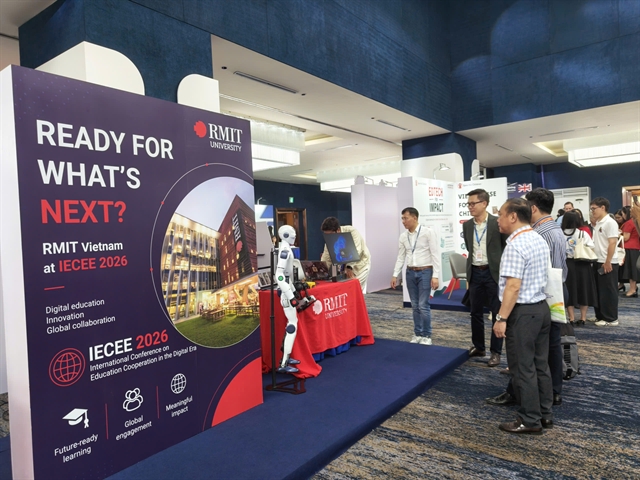
|
| Participants interact with an AI robot at the exhibition. |
Participating technology companies include Qualcomm, Amazon Web Services, Google, Meta, ELSA Corp, Khan Academy and MaxHub.
The event also brings together universities such as the Georgia Institute of Technology, the University of Illinois Urbana-Champaign, the University of Massachusetts Amherst and the University of London, along with other universities and educational organisations from the US, UK, Canada, the Republic of Korea and the European Union.
The exhibition offers visitors opportunities to explore and experience technologies firsthand, while creating a platform for educational institutions to seek suitable solutions, businesses to connect with potential partners and international organisations to expand their cooperation networks in Việt Nam.
Workshops held alongside the exhibition focus on AI, big data, personalised learning, digital school management, future classrooms, digital assessment and international professional certifications. Other topics include educational innovation, workforce development, links between training and employment, higher education, digital learning and school mental health.
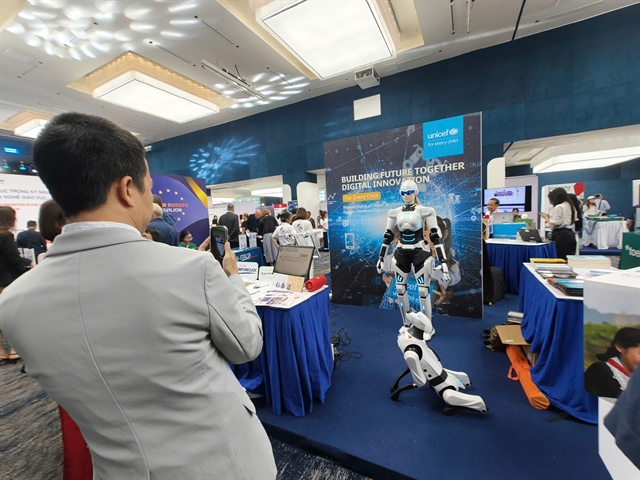
|
| Participants take photos of an AI-powered robot and robotic dog on display at the exhibition. |
International partners’ expectations
International partners also expressed expectations for stronger education cooperation with Việt Nam.
Ambassador Julien Guerrier, head of the Delegation of the European Union to Việt Nam, said he hoped Europe’s strengths in higher education, research and innovation could be brought into concrete cooperation with Việt Nam, particularly in joint research, AI and digital skills.
UNICEF Representative in Việt Nam Silvia Danailov said digital transformation should focus on improving learning outcomes, expanding access to education and safeguarding children’s safety and rights, while ensuring equity and inclusivity.
US Ambassador to Việt Nam Jennifer Wicks said US universities, technology companies and educational organisations are keen to strengthen connections with Vietnamese partners, share expertise and explore new opportunities for cooperation. She stressed the importance of collaboration between the Government, educational institutions and the private sector. — VNS
Society
 Society
 Society
 Society
 Society
 Society
 Society
 Society
 Society
 Society
 Society
 Society
 Society
 Society
 Society