 Politics & Law
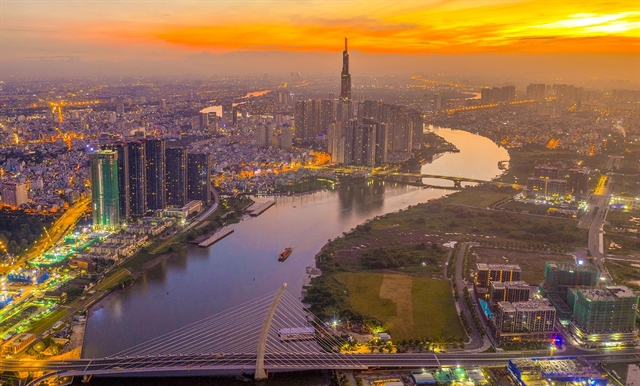
HCM City passes 100-year master plan to build global megacity
1.
|
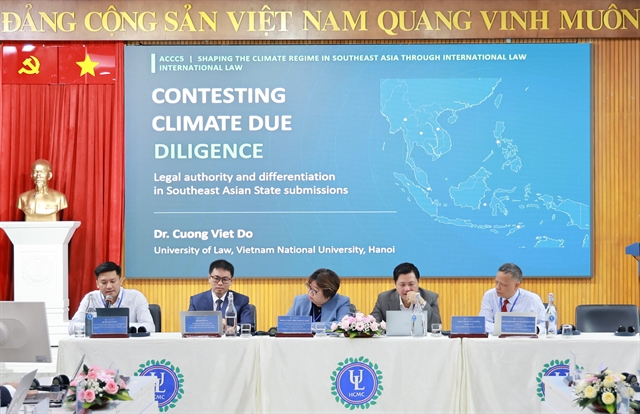
| Experts discuss international climate law and policy at the 5th annual ASEAN conference on climate change in HCM City on October 30. — Photos Courtesy of the organisers |
HCM CITY — International law must serve as a foundational tool to translate climate commitments into enforceable action while safeguarding vulnerable communities, legal experts and policymakers said at a regional conference in HCM City on Friday.
With the theme “Shaping the climate regime in Southeast Asia through international law,” the fifth annual ASEAN conference on climate change (ACCC5) was co-organised by the HCM City University of Law (ULAW) and the Center for International Law at the National University of Singapore (CIL-NUS).
The conference serves as a key regional academic and policy forum to foster multifaceted legal dialogue on climate governance and advance ASEAN cooperation in support of a just transition and sustainable development ahead of COP31 in Antalya, Türkiye.
It brought together nearly 300 legal experts and officials from across the region and internationally, including representatives from the Supreme Court of the Philippines, Singapore, Indonesia, Thailand, South Korea, India, Mongolia, Nigeria, Italy, Ireland, the UAE, and Việt Nam.
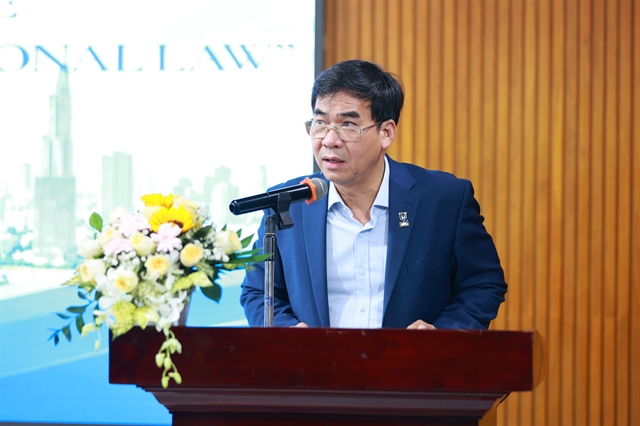
Speaking at the opening session, Associate Professor Lê Trường Sơn, rector of ULAW, said climate legislation must directly address real-world challenges and safeguard vulnerable populations.
Climate change poses immediate, tangible questions for daily life: How do we protect the livelihoods of coastal communities? How can businesses transition to green models? And how do we ensure today’s decisions do not constrain the opportunities of future generations?
“Behind each of these questions lie issues of rights, obligations, and equity. Law must create the foundation to transform climate targets into actionable, enforceable, and evaluable measures,” Sơn said.
The ultimate success of the green transition should not be measured solely by emission reduction metrics, but by its capacity to secure human livelihoods and development opportunities, particularly for communities with the fewest resources to adapt, he added.
|
| Associate Professor Lê Trường Sơn, Rector of the HCM City University of Law, delivers opening remarks at the 5th annual ASEAN conference on climate change on October 30. |
Ambassador Prof. Dr. Nguyễn Hồng Thao, a member of the United Nations International Law Commission for the 2023-27 tenure and lecturer at ULAW, emphasised the regional impact of emerging international judicial opinions.
Advisory opinions from the ICJ and ITLOS establish rigorous State due diligence obligations.
“These milestones require ASEAN coastal states to better manage maritime baselines, address sea-level rise, and enforce transboundary environmental accountability,” Thao said.
Associate Professor Trần Việt Dũng, vice rector of ULAW, highlighted key legal hurdles in carbon pricing and cross-border trade.
Research across Indonesia, Thailand, and Việt Nam shows that institutional fragmentation hinders regional integration.
To adapt to external pressures like the EU’s CBAM, Dũng urged ASEAN to harmonise legal frameworks for carbon verification and Article 6 mechanisms.
“Without robust and interoperable legal mechanisms, market integrity and investor confidence will be severely compromised,” Dũng said.
|
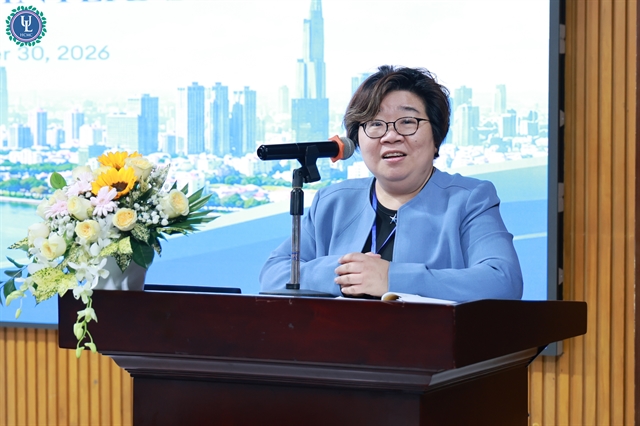
| Associate Professor Danielle Yeow from the Centre for International Law at National University of Singapore, speaks at the 5th annual ASEAN conference on climate change in HCM City on October 30. |
Associate Professor Danielle Yeow, Adjunct Senior Research Fellow and Lead of Climate Change Law and Policy at CIL-NUS, also highlighted the complex, polycentric nature of climate governance in an increasingly challenging global landscape.
“We meet today at a very challenging time in world affairs, particularly regarding the environment and climate. The time could not be more opportune to discuss these complex, polycentric issues connecting climate, oceans, investment, and trade,” she said.
She a urged delegates to drive practical impact beyond academic publishing by engaging directly with governments, businesses, and civil society, emphasising open dialogue and diverse perspectives across jurisdictions.
Out of nearly 300 submissions, 36 papers were presented across one plenary and seven panel sessions.
A central focus of the deliberations involved examining the legal implications of forthcoming advisory opinions from the ICJ and ITLOS regarding State due diligence obligations.
Experts paid particular attention to ASEAN coastal states dealing with sea-level rise, the preservation of maritime baselines, environmental rights, and the protection of future generations.
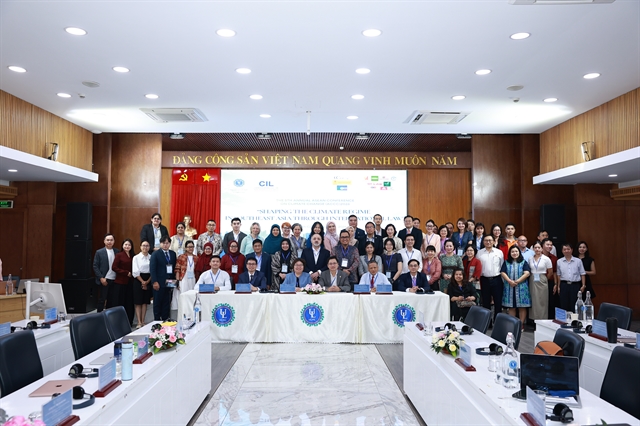
|
| Delegates and legal experts gather for the 5th annual ASEAN conference on climate change in HCM City on October 30. |
Panels also examined critical emerging legal and market issues, including transparency in carbon credit markets, the implementation of Article 6.2 of the Paris Agreement, and the adaptation of ASEAN businesses to the European Union’s Carbon Border Adjustment Mechanism.
Further sessions addressed investor-State dispute settlement risks, Virtual Power Purchase Agreements, rare earth governance, and global plastic treaty negotiations.
ACCC5 is supported by leading academic journals including the Carbon & Climate Law Review, the Indonesian Journal of International Law, and the Vietnamese Journal of Legal Sciences, alongside regional partners.
Hosting the event reinforces ULAW’s strategic vision to 2030, bridging academic research with governance practices to support sustainable development. — VNS
Politics & Law
 Politics & Law
 Politics & Law
 Politics & Law
 Politics & Law
 Politics & Law
 Politics & Law
 Politics & Law
 Politics & Law
 Politics & Law
 Politics & Law
 Politics & Law
 Politics & Law
 Politics & Law
 Politics & Law