 Politics & Law
HCM City passes 100-year master plan to build global megacity
1.
|
|
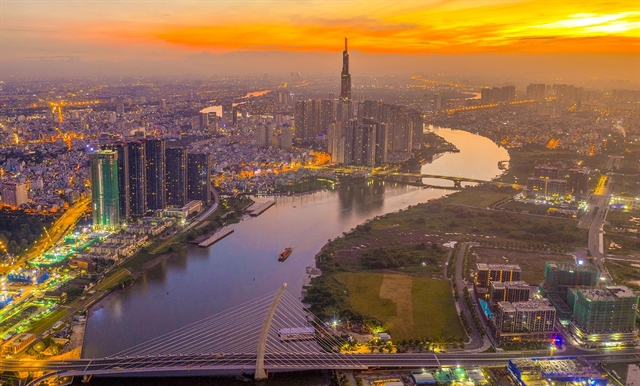
| A view of HCM City, which is set to transform into a polycentric megacity accommodating over 27 million residents by 2050. — VNA/VNS Photos |
HCM CITY — In a historic move toward becoming a world-class metropolis, the HCM City People’s Council on Friday officially approved a landmark master plan for 2025-50 with a 100-year vision, laying the groundwork for a polycentric megacity network built to house over 27 million people by mid-century.
The master plan covers the entire municipal administrative boundary of nearly 6,773sq.km across 168 administrative units.
The study scope encompasses HCM City and surrounding provinces, including Tây Ninh, Đồng Nai, Đồng Tháp, Lâm Đồng, along with related maritime spaces.
Under the official trajectory, the city's population is projected to reach approximately 18 million by 2030, 25 million by 2045, and over 27 million by 2050.
The workforce is expected to expand to 8.2 million people by 2030, 10.7 million by 2045, and 11.3 million by 2050.
Following council approval, the municipal People’s Committee chairman is expected to sign the executive approval in November to initiate formal implementation.
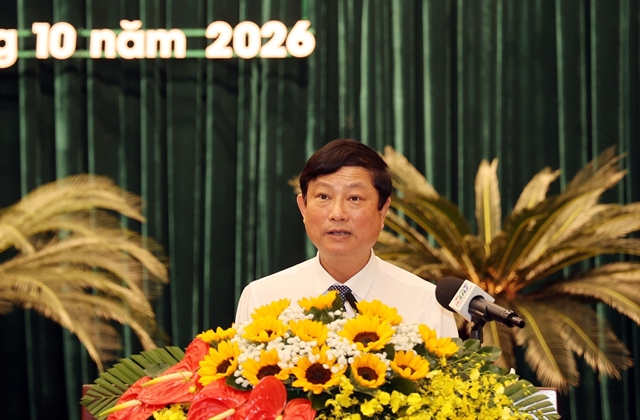
Addressing the council session, the Municipal People’s Committee Nguyễn Văn Được chairman said the plan must be swiftly translated into practice to guide long-term growth.
"The master plan, once approved, must quickly become operational as an effective tool for resource allocation and long-term development drivers," Được said.
The city administration will concrete the blueprint through specific programmes, action plans, and project portfolios, aligning closely with public investment plans while tapping private resources through public-private partnerships and land value capture mechanisms, he said.
The spatial framework marks a shift from an aggregated post-merger structure into a unified urban network designed to maximise regional economic specialisation.
The blueprint is organised around five growth poles, five strategic connection corridors, five satellite centres, and 10 development management zones categorised by geological conditions, land capacity, infrastructure, and environmental functions.
The five primary growth poles include the central core of Sài Gòn, Chợ Lớn, and Thủ Thiêm designated for international financial services.
The eastern pole focuses on innovation and technology, while the northern pole prioritises high-tech manufacturing, advanced technology, and logistics.
The southern pole is assigned to deep-sea maritime ports, free trade zones, international logistics, and energy development, whereas the western pole centers on urban expansion, higher education, and specialised healthcare.
The five satellite centres comprise Côn Đảo, Long Hải-Hồ Tràm, Hóc Môn-Củ Chi, Bàu Bàng, and Tân Uyên-Bắc Tân Uyên.
Strategic connections will be maintained via North-to-South and East-to-West corridors, multi-tiered transit infrastructure, and an integrated green and blue ecological network anchored along the Sài Gòn and Đồng Nai rivers.
|
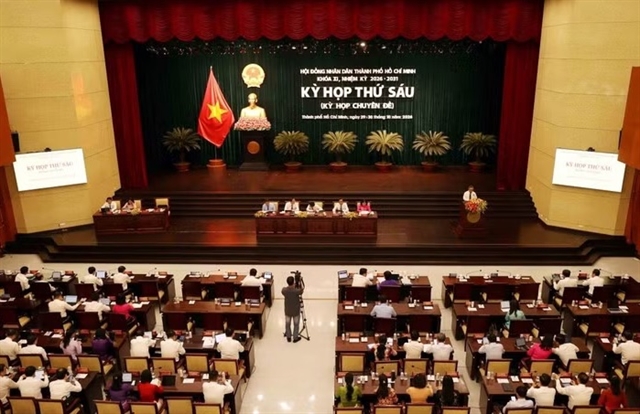
| The 11th HCM City People’s Council passes a resolution approving the city’s master plan for 2025-50 with a 100-year vision during its sixth session on October 30. |
During council sessions, delegates broadly endorsed the multi-centre model while requesting specific functional refinements.
Key proposals included incorporating Bình Dương Ward into the eastern innovation zone to connect Thủ Đức, Thuận An, Dĩ An, and Bắc Tân Uyên with Long Thành International Airport.
Delegates also suggested extending the western education and healthcare pole from the former Bình Chánh area to Hóc Môn and designating high-tech manufacturing functions across Củ Chi based on four existing and four planned industrial parks.
Delegates recommended dividing the western region into distinct north-western and south-western sub-regions due to differing geological and hydrological characteristics.
The north-west will focus on domestic logistics linked to Ring Road 3, Ring Road 4, HCM City-Mộc Bài Expressway, and Sài Gòn River, while the south-west will serve as a gateway logistics hub for the Cửu Long (Mekong) Delta alongside eco-urban development.
To relieve pressure on the historical core, delegates advocated reducing population density, gradually relocating high-density residential functions, and developing Transit-Oriented Development nodes along metro lines.
Further proposals included developing Nhà Bè and Hiệp Phước while safeguarding the Cần Giờ mangrove biosphere reserve, alongside constructing a dedicated freight railway connecting Cái Mép-Thị Vải deep-sea port cluster to industrial complexes and logistics hubs.
Functional allocations for the northern area have been thoroughly structured within the master plan, Trương Trung Kiên, director of the city’s Department of Planning and Architecture, noted.
"While the eastern zone holds a higher concentration of innovation and research, the northern area incorporates research and development (R&D) centres, advanced training facilities, and manufacturing support services within its spatial layout," Kiên said.
Concluding the meeting, the municipal People’s Council chairman Võ Văn Minh said delegates' feedback would be integrated into the final document prior to signing.
Special attention will be paid to ensuring close coordination and guiding local authorities across dynamic development zones during the implementation phase, he said. — VNS
Politics & Law
 Politics & Law
 Politics & Law
 Politics & Law
 Politics & Law
 Politics & Law
 Politics & Law
 Politics & Law
 Politics & Law
 Politics & Law
 Politics & Law
 Politics & Law
 Politics & Law
 Politics & Law
 Politics & Law