 Society

Young people’s mental health: We need to listen – and act
1.
|
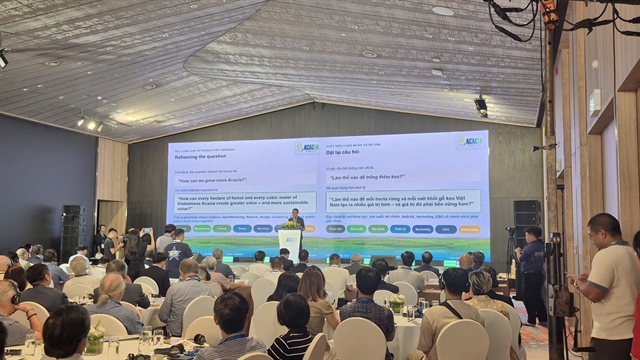
| The forum on sustainable acacia plantations on Thursday. — VNS Photo Trần Như |
By Trần Như
HÀ NỘI — The forestry sector must stop prioritising the expansion of acacia plantations and instead focus on raising their productivity, quality, and resilience, a senior official said on Thursday, as Việt Nam seeks to improve returns for about 1.5 million households that depend on the crop.
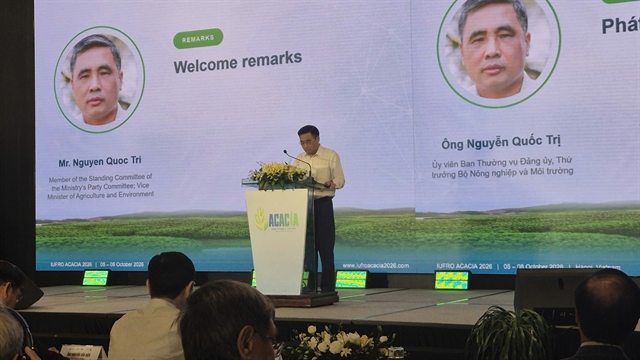
Speaking at a forum in Hà Nội on sustainable acacia plantations and high-value timber, Deputy Minister of Agriculture and Environment Nguyễn Quốc Trị said the industry needed to move from chasing volume to improving value and efficiency across the whole supply chain.
"Developing acacia plantations requires a fundamental shift in thinking, from expanding area and output to raising productivity, quality, added value, resilience and sustainability," Trị said.
Acacia covers about 2.5 million hectares in Việt Nam, roughly 60 per cent of the country's productive plantation forest and about 70 per cent of the world's estimated 3.5 million hectares of the tree.
Over three decades, it has become the backbone of the timber industry, supplying processors and exporters and providing income for rural families, most with small plots.
Yet the value it generates falls short of its potential. About 80 per cent of acacia timber is used to make woodchips and wood pellets, while the share of large logs destined for furniture, deep processing and other premium segments remains limited.
Trị said the ministry would put science and innovation at the centre of efforts to make acacia more valuable. Priorities include breeding and rolling out varieties with higher yields, better wood quality and stronger resistance to disease and extreme weather, and refining methods for growing large-diametre timber.
|
| Deputy Minister of Agriculture and Environment Nguyễn Quốc Trị delivers his opening speech. — VNS Photo Trần Như |
The ministry also plans to expand technical support for small forest owners, strengthen traceability and compliance with legal-timber rules, promote sustainable forest management certification and forge closer links between growers and processors.
Nguyễn Quốc Khanh, chairman of the Vietnam Timber and Forest Product Association (VIFOREST), said the country faces a paradox: abundant plantation resources but too little value drawn from them.
Households manage about 80 per cent of acacia land, he said, so the question is not simply how to grow the trees but how to make each hectare and each cubic metre of wood earn more, sustainably.
Khanh argued that persuading growers to hold trees longer to produce large timber will take more than appeals.
"They need an economic model attractive enough to justify the wait," he said.
He listed credit suited to long growing cycles, forest insurance, long-term contracts between companies and forest owners, certification, carbon schemes and markets that pay a fair price for large timber.
"The highest value of acacia is created at the end of the supply chain, not in the forest," Khanh said.
He called for a strategy linking every stage from seedlings to marketing, and a faster shift from woodchips to veneer, plywood, fiberboard, engineered wood and design-led furniture.
VIFOREST also proposed gradually building a 'Vietnamese Acacia' brand, positioning the wood as a renewable, responsibly managed material with clear origins.
The risks for growers are considerable, said Trần Lâm Đồng, deputy director of the Vietnamese Academy of Forest Sciences, citing pests and disease, climate change, soil degradation and natural disasters.
Leaf pests, stem rot, wilt and leaf-spot diseases are appearing more frequently and causing greater damage. Breeding for disease resistance, combined with better silviculture, could reduce losses, he said, calling for faster commercialisation of resistant varieties and wider use of biological pest control.
Cost and risk have kept many households from switching to large timber even though they increasingly recognise the long-term benefits, he said. Forest insurance and financial support were needed to give growers the confidence to extend harvest cycles.
The academy has set research priorities through 2035 that include breeding resilient varieties, diversifying species by region, intensive cultivation of large timber and forest health.
Research will also cover deep processing, new materials, circular-economy approaches and the economics, policy and carbon issues surrounding plantations. The academy's report said storms and floods can directly disrupt production cycles and returns, and that longer rotations demand better soil management, forest health and pest control. It also noted that acacia's relatively narrow genetic base complicates breeding.
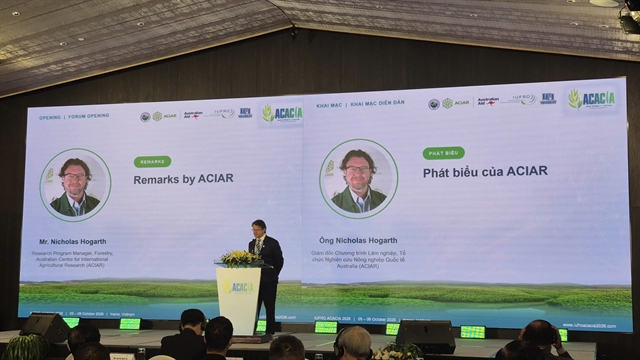
Nicholas Hogarth, who leads the forestry programme at the Australian Centre for International Agricultural Research (ACIAR), said he was impressed by a field visit to the northern province of Tuyên Quang during the forum.
Tracing the chain from plantations to processing plants to export products, he praised the involvement of both companies and smallholders, including some who have won Forest Stewardship Council certification.
|
| Nicholas Hogarth, who leads the forestry programme at the Australian Centre for International Agricultural Research, speaks at the forum. — VNS Photo Trần Như |
The results, he said, showed Việt Nam's plantation sector gradually moving toward a model that generates higher, more sustainable value for rural areas.
ACIAR has invested about AUD$28 million (US$19.5 million) in Vietnamese forestry research over more than three decades, funding 16 projects as well as infrastructure and training.
The work has ranged from genetics and silviculture to processing and, more recently, policy. Hogarth said that groundwork should underpin continued cooperation among scientists, regulators, businesses and growers on research, technology, financing mechanisms and markets.
Speakers broadly agreed that breeding, forest management, forest health, risk management, processing and markets must be tackled together if acacia is to evolve from a source of woodchips into raw material for higher-value products. — VNS
Society
 Society
 Society
 Society
 Society
 Society
 Society
 Society
 Society
 Society
 Society
 Society
 Society
 Society
 Society