 Society

Young people’s mental health: We need to listen – and act
1.
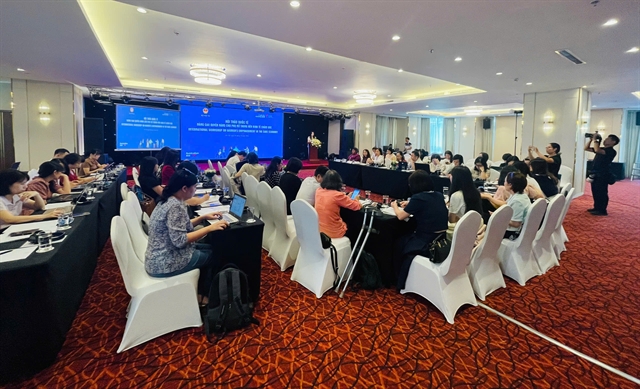 |
| Domestic and international delegates gather at the seminar on empowering women in the care economy. — VNS Photo Thu Trang |
HÀ NỘI — Investing in care means investing in jobs, women's economic empowerment, and a stronger, more resilient economy.
Delegates delivered these key messages at an international seminar held on Thursday in Hà Nội, as Việt Nam begins shaping priorities for the 2027 APEC High-Level Policy Dialogue on Women and the Economy.
Titled the 'Seminar on Empowering Women in the Care Economy', the event was co-organised by the Ministry of Home Affairs (MoHA), the United Nations Entity for Gender Equality and the Empowerment of Women (UN Women), and the Embassy of Australia to Việt Nam.
It aimed to increase regional and international gender equality cooperation frameworks and seek input for policies to advance women’s economic empowerment amid demographic shifts.
The event also served as a technical consultation session to collect views to help shape the themes and priority content for the APEC High-Level Policy Dialogue on Women and the Economy and related events that the Ministry of Home Affairs will host and organise for APEC 2027.
Deputy Minister of Home Affairs Nguyễn Thị Hà said that empowering women in the care economy now demanded a more comprehensive, systemic approach suited to the rapid changes underway in Việt Nam and the Asia-Pacific region.
“The care economy is not solely a matter of social welfare or gender equality. It is also an issue of labour markets, productivity, human resource quality, competitiveness, and the economy’s adaptability to long-term demographic change,” she said.
Gender equality is both a guiding principle and a cross-cutting objective of the care economy.
“It can be affirmed that Việt Nam’s current legal and policy framework is relatively comprehensive and is helping to establish a solid legal foundation for the formation and development of the care economy,” the deputy minister said.
Notable examples include the Labour Code 2019, the Law on Gender Equality 2006, the Law on Social Insurance 2024, and the Population Law 2025.
The National Strategy on Gender Equality sets targets to reduce the time women spend on unpaid domestic and care work relative to men to 1.7 times by last year and 1.4 times by 2030. In practice, the time women devote to housework is trending downwards, according to the MoHA.
According to estimated figures from the labour and employment survey, by last year women’s average hours of unpaid domestic and family care work will stand at 1.68 times that of men.
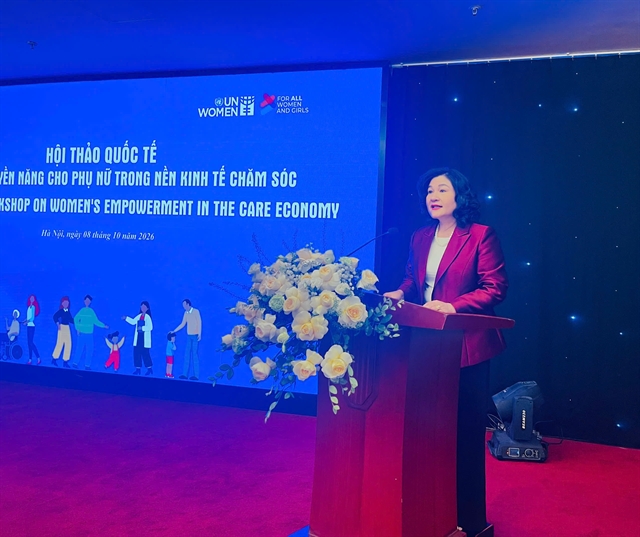 |
| Deputy Minister of Home Affairs Nguyễn Thị Hà speaks at agenda set seminar for gender at APEC 2027. — VNS Photo Thu Trang |
“This issue is becoming ever more urgent as Việt Nam undergoes population ageing and is projected to enter an aged-population phase from 2034,” said the deputy minister.
Alongside shrinking household sizes, declining fertility, and rising labour migration, demand for care is growing, while the traditional care model – which relies primarily on the family and is largely shouldered by women – faces mounting pressures.
“Shifts in the socio-economic context are now clearly identified; at the same time, the importance of the care economy is increasingly affirmed through its close links with labour supply, productivity, and human resource quality, and, at the macro level, as a driver of growth, national competitiveness, and adaptation to long-term demographic challenges,” she said.
At the regional level, women’s economic empowerment is a key priority on the APEC agenda. Evidence shows that unpaid care and domestic work remain among the structural barriers to women’s full participation in the economy.
“The care economy should not be approached as an isolated issue, but as a component of socio-economic development policy. Việt Nam also has a responsibility to contribute to and help shape common regional policy frameworks, including on the care economy,” she said.
Caroline Nyamayemombe, UN Women Representative in Việt Nam, reframed understanding of the care economy – from a primarily social concern to an essential component of economic infrastructure.
“Care is economic infrastructure – and must be treated as such; investing in accessible, affordable, high-quality care services can deliver three benefits: stable employment, better gender equality, and a stronger, more sustainable economy,” she said.
Việt Nam can help elevate women’s economic empowerment as a driver of regional competitiveness and resilience – linking the care, green and digital economies; responding to demographic change; and expanding women’s access to the jobs and enterprises of the future.
The strongest themes will be those that are relevant across diverse APEC economies, grounded in evidence, and capable of generating practical cooperation beyond 2027.
“Our task is therefore to be bold in ambition and disciplined in identifying where regional partnership can add real value,” she added.
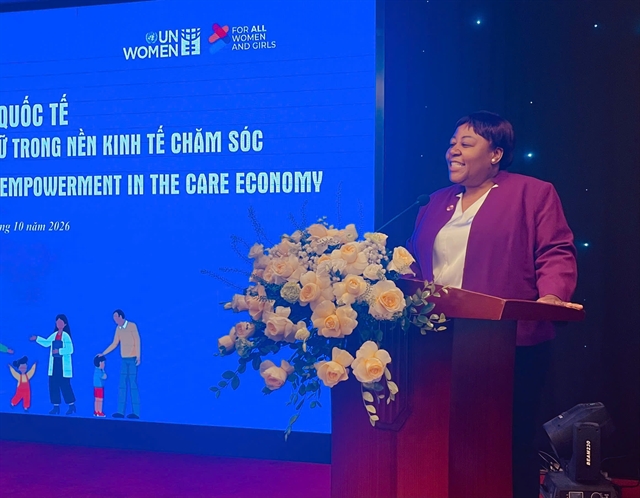 |
| Caroline Nyamayemombe, UN Women Representative in Việt Nam, affirms high-quality care services can bring a stronger and more sustainable economy. — VNS Photo Thu Trang |
Delegates at the seminar argued that building an effective care system requires shared responsibility and investment from government, businesses, communities, and households, encompassing care services, family-friendly working environments, social protection, the development of care enterprises, and innovation.
Next year, Việt Nam will serve as the APEC host, with the MoHA assuming key responsibilities for chairing and organising the APEC High-Level Policy Dialogue on Women and the Economy (Ministerial Conference), the Public-Private Dialogue on Women and the Economy, and related events.— VNS
Society
 Society
 Society
 Society
 Society
 Society
 Society
 Society
 Society
 Society
 Society
 Society
 Society
 Society
 Society