 Society

Vietnamese Prime Minister meets with top Lao leader in Vientiane
1.
|
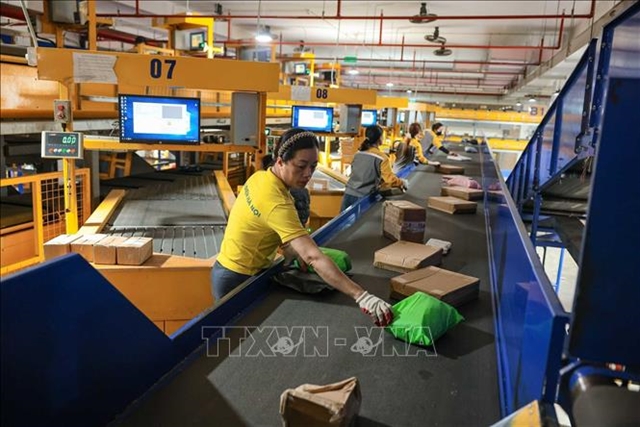
| Workers at Vietnam Post’s Northern Regional Transport and Logistics Centre, featuring a high-tech automated sorting system. — VNA/VNS Photo Hoàng Hiếu |
HÀ NỘI — Vietnam Post is gradually integrating technology into its postal and logistics operations as it moves towards a smarter, more interconnected network.
From using artificial intelligence (AI) to optimise vehicle dispatch and digitise agricultural supply chains to testing unmanned aerial vehicles (UAVs) for hard-to-reach delivery routes, technology is reshaping how Vietnam Post organises and operates its postal-logistics network.
The move is aimed at building a smart postal-logistics ecosystem in which its physical network is connected with data and technology not only to transport goods, but also to support production, e-commerce, public services and the access of local products to wider markets.
At the Việt Nam Digital Technology Forum in the Republic of Korea and Japan earlier this month, Vietnam Post introduced five strategic solution groups: AI-powered smart logistics networks; smart last-mile delivery through PUDO 2.0 pick-up and drop-off points; co-creating the low-altitude economy with UAVs; AI-powered digitisation of documents and handwriting; and AI-based Chatbot-Callbot virtual assistants.
Notably, the solutions do not operate in isolation. They are being integrated into an existing large-scale network comprising more than 13,000 service points, automated sorting systems already in operation and digital address platforms such as iPOSTMAP and the Vietnam Logistics Platform.
In logistics, AI is being deployed in one of the areas with a direct impact on the efficiency of the entire network: vehicle dispatch.
Vietnam Post plans to launch an AI-powered logistics optimisation platform this month to manage vehicle arrival and departure times at transit hubs, with the aim of cutting waiting times and congestion from several hours to around 15–20 minutes.
Alongside operational optimisation, data is also being used to connect different links in the supply chain.
Vietnam Post is working with partners to develop a digital agricultural supply-chain platform designed to standardise processes from collection, processing and packaging through to export.
The platform will also manage growing-area codes and farmers’ digital address codes and connect them with customs and export procedures.
New possibilities for logistics
While AI helps Vietnam Post optimise its existing operations, UAVs offer a way to address challenges that are difficult for conventional road-based logistics networks to overcome.
In Mường Ảng Commune, the northern mountainous province of Điện Biên, the challenge is not the distance itself but the “last mile” from production areas to collection points.
Coffee and macadamia-growing areas are located on hills, with some sites 4-5km from collection and purchasing points.
Steep terrain, narrow and winding roads and heavy dependence on weather conditions have made collection a bottleneck in the logistics chain.
In response, Vietnam Post has deployed UAVs to transport agricultural products, with a payload of 50kg per trip.
The UAVs carry goods from harvesting sites to collection points, after which the products are transported by ground vehicles to cooperatives, purchasing facilities or processing plants.
Chu Quang Hào, General Director of Vietnam Post, said technology was an important driver of innovation in postal and logistics operations.
UAVs, he said, represented a new technological avenue that Vietnam Post was actively researching and testing to assess their practical applications.
Vietnam Post’s participation in developing the low-altitude economy is not simply about adopting a new means of transport.
More broadly, it is about combining our existing physical network with technology to create new and more efficient logistics models that better serve the needs of people, businesses and localities, Hào said.
Multi-service infrastructure
In the Central Highlands province of Đắk Lắk, the postal network is being incorporated into a broader ecosystem linking digital transformation, public services, e-commerce, logistics and agricultural distribution.
From 2017 to 2025, the 288 service points operated by the province’s Post received, processed and returned nearly 3.9 million administrative procedure dossiers.
For 2026–30, Vietnam Post and the province plan to develop commune- and ward-level post offices into “Commune Postal and Public Administration Service Centres”, combining multiple business services while ensuring that all communes and wards have adequate space to serve the public.
It also plans to transform around 8,000 transaction points nationwide into a “Bách hóa Bưu điện” (Post Office General Store) chain, operating on a centrally managed retail platform and prioritising the distribution of products certified under the One Commune, One Product (OCOP) programme.
These figures demonstrate that the scale of the transformation goes beyond introducing a handful of new technologies. It aims to redefine the role and functions of the postal network itself.
Looking ahead, Vietnam Post is seeking opportunities to cooperate with international companies in AI, robotics, autonomous technologies, unmanned traffic management (UTM), the Internet of Things (IoT) and related technological solutions. — VNS
Society
 Society
 Society
 Society
 Society
 Society
 Society
 Society
 Society
 Society
 Society
 Society
 Society
 Society
 Society