 Society
Authorities urge swift delivery of resettlement sites for North–South high-speed rail
1.
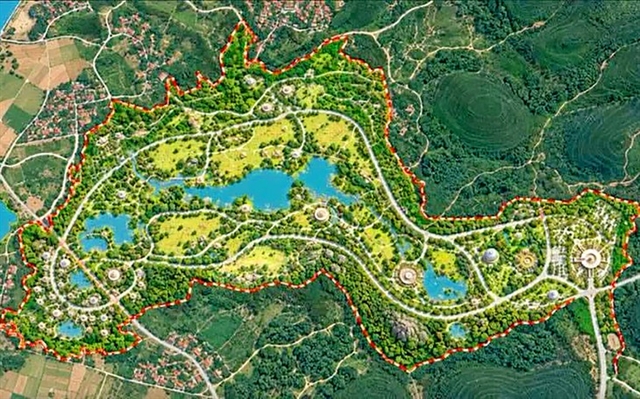 |
| A preliminary rendering of the Ba Vì Ecotourism Complex. — Photo from SunGroup |
HÀ NỘI — The Hà Nội Party Committee has agreed to proceed with investment in the Ba Vì Safari Park in the mountain commune of Ba Vì, although the project footprint will likely be reduced to around 300 hectares from nearly 600 following a review.
Detailed plans still need to be completed and approved by authorities, according to an official at the municipal Department of Finance.
The capital city targets a ground-breaking ceremony around October 10 this year, marking the 72nd anniversary of Hà Nội's Liberation Day.
Made under Resolution 29 recently issued by the municipal Party Committee’s Executive Committee, the decision follows a proposal submitted on October 3.
The Party Committee was tasked with directing relevant agencies to review and complete project dossiers and carry out the necessary procedures in accordance with regulations.
Hà Nội authorities are also required to step up communication and public engagement to build consensus and prevent complaints, particularly among residents in areas potentially affected by administrative boundary adjustments between the capital and Phú Thọ Province.
The municipal Party Committee’s Inspection Commission was asked to strengthen supervision from the outset, while the municipal People’s Committee is to regularly report progress and any difficulties or obstacles to the city’s Party leadership.
The Safari Park forms part of the proposed Ba Vì Ecotourism Complex, which was initially put forward by the private developer and conglomerate Sun Group-affiliated Sun Property Group under a special mechanism provided for by the new Capital Law.
Under the original proposal, the project would cover more than 580 hectares, with a preliminary investment of around VNĐ10 trillion (US$384 million). Around VNĐ1.5 trillion will come from the project's investor, while the remaining VNĐ8.5 trillion will be mobilised from other legal sources.
The project is expected to be carried out in two phases. Construction of Phase 1, which covers about 251 hectares, will take place from the fourth quarter of 2026 to the fourth quarter of 2028. Phase 2, covering approximately 330 hectares, will begin in the fourth quarter of 2027 and continue until the first quarter of 2030.
Initially, the project was expected to accommodate about ten million visitors each year for sightseeing and leisure once fully completed, with its opening for commercial activities slated for early 2030.
According to the preliminary plan, the maximum total built-up area is approximately 72.8 hectares, with an actual construction density of around 13 per cent. Buildings will range from one to five storeys, depending on the function of each area.
Green spaces and water surfaces will account for approximately 446.89 hectares, or 76.95 per cent of the project area, including themed parks, landscaped green areas, water bodies and buffer greenbelts.
The remaining land will be allocated for commercial and service facilities, tourism services, research, training and education, and entertainment and animal experiences, as well as technical infrastructure and transport.
Project footprint under review
After the Hà Nội Department of Finance publicly posted information on the project proposal, the city has established an appraisal council to review the investment policy proposal, as the project is classified as a Group A project.
At a municipal administration press briefing held earlier this week, Deputy Director of the Hà Nội Department of Finance Đỗ Thu Hằng responded to queries expressing concern for the livelihoods of residents in the project area.
Hằng said Hà Nội has set a target of achieving annual GRDP growth of around 11 per cent during the 2026–35 period, as part of the national efforts to reach double-digit growth to serve the two major centennial development goals.
To meet this order, the city will seek to tap all available potential and strengths, including in trade, services and tourism, Hằng noted.
At the same time, Hằng said that the city’s approach is to pursue socio-economic development while ensuring social welfare and protecting residents’ livelihoods and legitimate interests – reflected through the decision to cut down the footprint of the project in this historic area following an appraisal.
Based on a review of existing land management and use, as well as potential impacts on organisations, households and individuals in the project area, the preliminary project area has now been reduced to around 300 hectares.
But the project's exact boundaries and land area will only be determined through detailed planning, the deputy director noted.
According to Hằng, the city will ensure that information is made public and that local communities are consulted during the planning process.
The project still needs to complete a number of procedures, including detailed planning and approval by relevant authorities, before its final scale and investment components can be determined. — VNS
Society
 Society
 Society
 Society
 Society
 Society
 Society
 Society
 Society
 Society
 Society
 Society
 Society
 Society
 Society