 Society
Authorities urge swift delivery of resettlement sites for North–South high-speed rail
1.

|
| A student asks questions about vocational training and career guidance at a jobs fair in Khánh Hòa Province. — VNA/VNS Photo Phan Sáu |
Thu Trang
HÀ NỘI — Vocational training, career guidance and connecting workers – especially those from ethnic groups – to the market are recognised as critically important in the new era, meanwhile achieving this workforce development will require the collaboration of many relevant agencies and units, according to experts.
Vũ Tuyết Nhung, director of the Vocational Education and Continuing Education Centre in Cam Đường Town, Lào Cai Province, said: “From the very moment students enter our centre, we focus on career guidance and grouping. Based on that, we provide counselling and communication to students.”
As a result, students and workers, particularly ethnic youth and women, are better able to choose careers and orient their employment paths.
“They understand their own abilities, capabilities, strengths, conditions and family circumstances, while also learning what the labour market needs, so they can choose suitable careers and jobs,” Nhung said.
In addition, the centre has prioritised building connections with enterprises both within and outside the locality.
At present, the centre has signed agreements and established links with nearly 100 enterprises and production facilities in the area, enabling learners to practise, undertake internships and improve their vocational skills and craftsmanship.
At the same time, this also provides companies with a source of quality labour.
“Enterprises are also very interested, so we invite them to participate in developing vocational training programmes, ensuring that the curriculum meets practical requirements,” Nhung said.
The centre also collaborates with local authorities to provide counselling for ethnic youth.
“We consider this the group we are most concerned about,” Nhung said.
Recently, the centre has run vocational training classes, such as culinary techniques, traditional brocade embroidery and weaving, and community-based tourism.
“Hundred per cent of our graduates have found employment, of whom 98 per cent are working in the exact trades they studied,” Nhung said.
Ly Thị Rua is a worker from Phố Village in Bắc Hà Commune, Lào Cai Province. Previously, Rua's work consisted mainly of farming and housework.
“I faced many difficulties. I did not have stable work or income, and I also lacked opportunities to learn, gain experience and access modern science and technology,” Rua said.
After participating in a vocational training class where she learned traditional Mông brocade embroidery patterns and how to create new products suited to modern life, Rua joined the Phố Village brocade embroidery and sewing network and learned how to promote her goods.
Now, Rua has a stable income and a better standard of living.
Connecting information
|
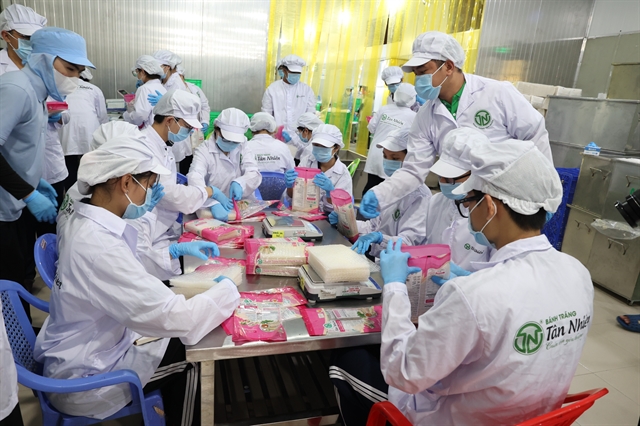
| High school students experience real work at Tân Nhiên Company in Tây Ninh Province. The connection between schools and enterprises is an important factor in furthering careers. — VNA/VNS Photo Thanh Tân |
Nguyễn Kim Thúy, director of the Research Centre for Gender, Family and Environment in Development, suggested that bringing information to workers, especially ethnic female youth, in ways that are easy to understand, trustworthy and closely tied to the specific characteristics of each locality is vital.
“Female youth often face many barriers, such as hesitation and a lack of self-confidence. They therefore find it difficult to access information related to recruitment or vocational training, as well as funding sources,” Thúy said.
Information should be spreaded to them through the Women's Union, the Youth Union, agencies and mass organisations, as well as community-based organisations, especially in remote areas.
“The second factor I would like to mention is support. Support must be comprehensive, focusing on enhancing the intrinsic capacity of workers themselves, particularly ethnic female youth,” Thúy said.
Vocational training alone is not enough, she added.
“We also need to provide soft skills, such as job application skills, business planning skills and financial management,” Thúy said.
It is also necessary to provide information on labour law and insurance, and to teach students skills for self-protection and occupational safety, as well as the prevention of sexual harassment.
“Workers will become more confident and able to make their own decisions in choosing careers without being influenced by the gender stereotypes around them. They will also be more confident in accessing capital sources and support during their working and start-up processes,” she said.
According to Thúy, support should not be delivered through separate, isolated activities, but rather as a continuous chain.
“The chain begins with career orientation for young people. Next, on the basis of that career orientation, training is organised to match the learners' abilities and needs. Then, following that training, they are supported in finding suitable employment and accessing to enterprises with labour demands,” she noted.
For those who create their own jobs or start businesses, they should be supported in accessing mentors, experts in financial management and technical expertise, as well as provided with information on markets, products and product outlets.
“Through such a continuous chain, we can ensure that they have the opportunity to work and fully realise their potential,” Thúy said.
“And perhaps we must mention another factor: gender equality. Female youth very much need support and backing from their families and communities."
|
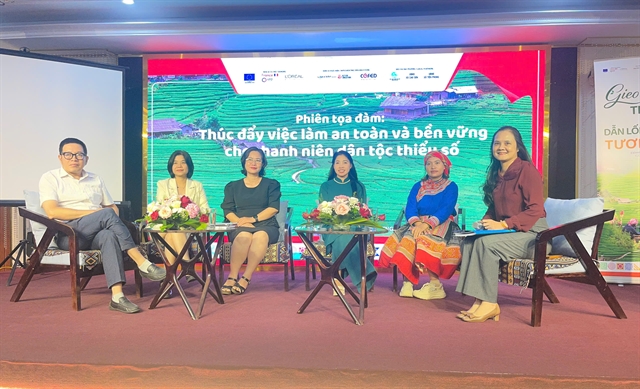
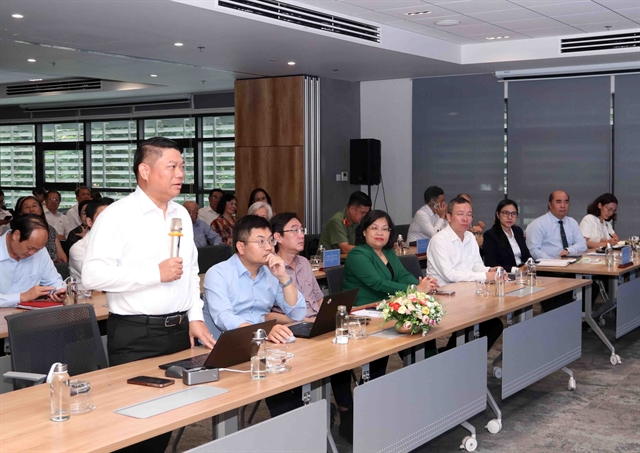
| Delegates at a talk on promoting safe and sustainable work for ethnic youth, which was held in September in Lào Cai Province. — VNS Photo Thu Trang |
In many places, ethnic women still bear a double burden: they are workers, yet they also carry responsibilities related to caring for their families, children and elderly relatives.
“Beyond that, there are also prejudices in career choice: this occupation is for women, that occupation is only for men – women should not do it, are not allowed to do it. And within the family, they have little decision-making power,” Thúy said.
“Therefore, in support activities for women, we should not work only with women, nor focus solely on enhancing women's capacities. We also need to work with families, communities, agencies, departments and relevant units."
Thúy added that, through this approach, everyone will develop a correct awareness of gender equality and take action to support and encourage female youth to participate in the labour market. — VNS
Society
 Society
 Society
 Society
 Society
 Society
 Society
 Society
 Society
 Society
 Society
 Society
 Society
 Society
 Society