 Society

Japan-owned Kao Vietnam launches programme to improve women wokers’ reproductive health
1.
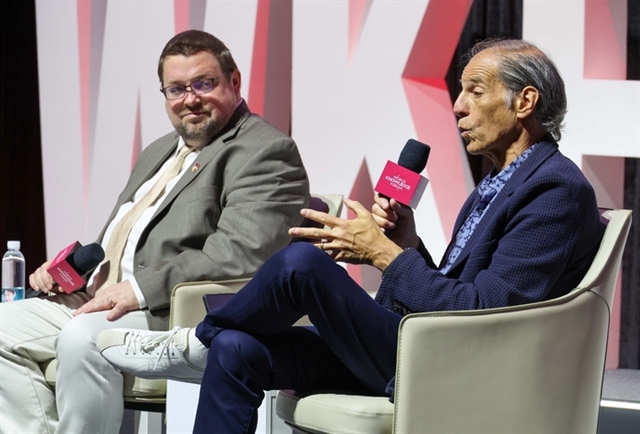 |
| At the 27th World Knowledge Forum's "Future of AI-era Content Industry" session held at Shilla Hotel in Jung-gu, Seoul on the 9th, C.B. Cebulski, editor-in-chief of Marvel Asia Originals, editor-in-chief of Marvel Asia Originals, and Jeffrey Godsik, vice president of global partnership and brand strategy at Sony Pictures Entertainment, are holding talks. Photo WKF |
Thu Vân
SEOUL — Artificial intelligence can make film and television production more efficient, but it should remain a tool rather than replace the human creativity and emotion behind storytelling, entertainment industry leaders said at the World Knowledge Forum 2026 in Seoul.
The session, titled “The Future of the Content Industry in the Age of AI”, brought together C.B. Cebulski, Executive Editor at Marvel Comics Asia Originals, and Jeffrey Godsick, a former Sony Pictures Entertainment executive.
Moderated by Amara Walker, Vice President of Public Relations at Porsche Cars North America and a former CNN news anchor, the discussion looked at the global rise of Korean content, how major entertainment companies adapt stories for local markets, the importance of authenticity, the development of global intellectual property and the role of AI.
Much of the discussion focused on a basic question: why some stories can travel across borders while others cannot.
The phone becomes a window to the world
Cebulski said one major change had been the way audiences could now discover stories from other countries.
Recalling a saying from Marvel legend Stan Lee that the Marvel Universe was “the world outside our window”, he said that window had changed dramatically.
“But now that window is the cell phone,” he said. “That's the window that we all have to the world.”
He said the rise of smartphones and the way content was distributed through them had helped Korean webtoons, streaming content and other forms of entertainment reach audiences far outside Korea.
Another change, he said, was a generational shift in attitudes towards culture.
Cebulski recalled that, as a child of immigrants growing up in the United States, he had wanted to fit into American culture and had sometimes felt embarrassed by his parents' accents and food.
“I didn't want to be a part of those worlds; I wanted to be American,” he said.
Younger generations were different, he said, with many embracing both their family backgrounds and the cultures of their friends.
“There's a community and a sharing that happens,” he said, adding that this had helped the spread of Korean content in the United States and other markets.
Cebulski also pointed to a seemingly small change that had made foreign-language content easier to watch: people had become much more comfortable reading subtitles.
He linked that partly to platforms such as TikTok and Instagram, where subtitled video had become common.
“You want to watch it on silent in your bedroom or on the train, you're used to reading stuff now,” he said.
He said this had helped Korean films and programmes reach wider audiences through streaming services.
“There's an accessibility now to all global content because of all the different platforms that we have,” he said. “And that accessibility brings great stories to everybody.”
Godsick made a similar point, saying the basic need for stories had not changed through history.
“Stories have always been at its core the same. What's changed is the platform,” he said.
Digital platforms, he said, had allowed people around the world to find stories that in the past might have remained largely within their country of origin.
Korea's cultural rise
Both speakers said Korean content still had room to grow internationally.
Godsick said the international interest went beyond films and television to a wider cultural movement involving music, food, cosmetics and other products.
He said Korean dramas now attracted viewers around the world not because those viewers were Korean, but because they enjoyed the stories.
“Korean dramas are not just for Koreans,” he said. “You have people all around the world that are enjoying them, because the story is really good.”
Cebulski said Korea had spent years absorbing entertainment and popular culture from other countries before developing its own way of presenting those influences.
“Korea was almost like a sponge,” he said. “It just absorbed comics and film and television dramas and music from around the world.”
Eventually, he said, Korean creators began sending those influences back out through their own cultural perspective.
“But it exploded by taking everything that they learned and sending it through a Korean lens back to the rest of the world,” he said.
He pointed to the quality of Korean writers, directors and cinematography as part of this development.
Godsick also placed strong emphasis on authenticity.
“I'm not, because I think authenticity now kind of rules everything,” he said when asked whether he was surprised by global demand for stories deeply rooted in another culture. “I think it's the ultimate motivator.”
He argued that global audiences were increasingly willing to enter cultures different from their own if the stories and experiences felt genuine.
Cebulski said Korean dramas in particular had given foreign viewers a much closer look at ordinary Korean life than some earlier films.
“You were brought into these people's lives, and you learned so much about Korean culture through these characters,” he said.
He said the simultaneous growth of K-pop, K-food, K-cosmetics and other parts of Korean culture had also strengthened one another.
“Korea is unique in the sense that so many cultural attributes are growing at the exact same time parallel to each other,” he said.
Local creators, not simply global brands
Cebulski said Marvel had also had to learn that taking an established global brand into another country was not simply a matter of telling local audiences what Marvel thought they should want.
“We always thought that we knew what Marvel was, so let us tell you the stories that you should be embracing, or the stories that maybe you should be telling,” he said.
Over time, he said, the company learnt that it needed to listen more closely to people in each market.
“We have to listen to the consumers in the culture, particularly here in Korea, about what you need, what you want, and craft our stories and our content with authenticity and with the local market in mind,” he said.
He gave several examples from Korea.
When Marvel began working with Webtoon, he said, it chose to work with Korean creators rather than simply use American or Korean-American creators to tell stories involving Korea.
“Let's work with Korean creators here and create new Korean characters,” he said. “Tell stories based in Seoul, based in Busan.”
Cebulski cited Avengers: Electric Rain, an original comic created in Korea in 2014, which brought the Avengers to Seoul and introduced a Korean-based group of superheroes.
“We used the Avengers as the entry point into Korean culture, not just to bring Korean readers in, but also to introduce Korean culture to Avengers fans and to Marvel fans,” he said.
The project used a Korean writer and artist and included new Korean characters, among them White Fox, a character Cebulski said was based on the Korean gumiho tradition.
Marvel also learnt from Korean consumers in its merchandise business, he said.
Rather than simply selling the same character-heavy designs used elsewhere, the company found that Korean consumers preferred more understated designs and smaller expressions of the Marvel brand.
“So we started hiring Korean designers to redesign clothing, to redesign streetwear, backpacks, skateboards, whatever,” he said.
Marvel later launched stores in Korea selling locally designed and produced products, he added.
A global story still needs a human core
While localisation was important, the speakers said successful global characters also needed qualities that people everywhere could recognise.
Godsick used Spider-Man as an example.
He said Peter Parker was relatable because, despite becoming a superhero when he put on the mask, he dealt with problems familiar to ordinary teenagers.
“Peter Parker was going through the exact same thing that teens around the world go through: ‘How do I get the girl I like to recognise me? How do I do well in school?’” he said.
“So that relatability, I think, is universal. I don't think that's for one country.”
Cultural details could be added, he said, but companies should not change the heart of a character simply to fit one market.
“You do want to take cultural nuances into account, but you don't want to deviate to cater to a culture,” he said. “You want to stay true to the character, and then start to create new and unique stories.”
Cebulski said Marvel used what it called the “five H's” when thinking about characters and stories.
“And it's heart, hope, heroism, humour, and humanity,” he said.
Of those, he said, humanity was the most important.
Marvel might market films and comics under the names Spider-Man, Captain America or Iron Man, but inside the company, Cebulski said, they were stories about Peter Parker, Steve Rogers and Tony Stark.
“If the reader, if the viewer can relate, relatability is very important. Relate to the human, then they're going to find the superhuman aspect that much more believable,” he said.
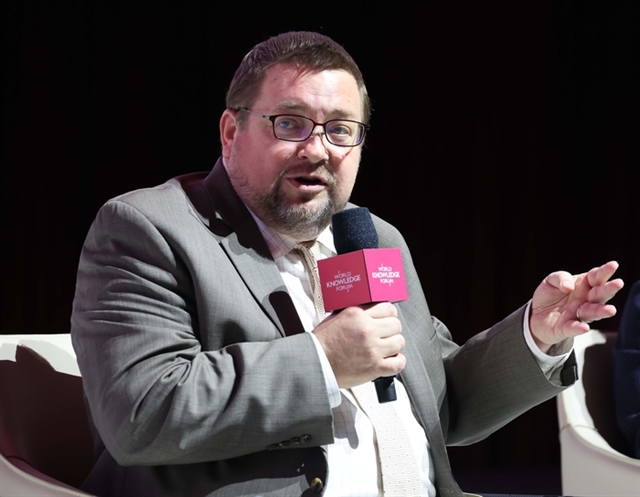 |
| At the 27th World Knowledge Forum 'Future of AI-era Content Industry' held at Shilla Hotel in Jung-gu, Seoul on the 9th, C.B. Cebulski, editor-in-chief of Marvel Asia Originals, speaks. Photo WKF |
That human connection, he said, was what allowed audiences to connect with a character on a page or screen.
Content rather than advertising
The discussion also touched on partnerships between entertainment companies and brands.
Godsick said younger audiences in particular did not want to feel that they were simply being advertised to.
“Don't create advertising,” he said. “Audiences today, especially the younger audience out there, you push away from advertising. You don't want to be marketed to.”
He cited Sony's work with Samsung on a Spider-Man partnership.
Rather than producing a conventional advertisement for a Samsung phone, he said, the companies created a roughly 90-second piece that looked and felt like part of the Spider-Man film.
In the story, Spider-Man repeatedly broke his phone while fighting, and his AI assistant helped create a phone suitable for him, which was a Samsung device.
“So that minute-and-a-half piece of content that we created felt like the movie, looked like the movie, was not in the movie, but it was authentic because of that,” Godsick said.
A conventional advertisement simply telling people to buy the product would not have worked in the same way, he argued.
“That's not going to do because it's not authentic. It's not interesting. It's not content. It's marketing.”
An ‘experiential economy’
Godsick also said audiences were putting greater value on experiences.
He pointed to the return of vinyl records and even cassettes as examples of people wanting something physical despite the growth of digital technology.
Digital collectables, by contrast, had lost momentum, he said, arguing that collectors often wanted something they could physically hold and show.
“At the end of the day, we are in an experiential economy,” he said. “Today everything is about experience.”
He said the pandemic had also changed behaviour, making people more comfortable staying at home while at the same time increasing demand for opportunities to come together.
Digital communication connected people across the world, he said, but being on a phone could also be isolating.
“So that's why people are creating and craving experiences so they can be together,” he said.
Live sport was one example.
“A live sporting event is authentic because you don't know what's going to happen,” he said.
AI can improve efficiency, but not replace people
Despite the title of the session, AI only became a direct topic near the end, when an audience member pointed out that the panel had barely discussed it and asked what the entertainment industry might look like in five years.
Godsick said he could not predict the industry that far ahead, but saw AI as a useful tool.
“AI is a great tool,” he said. “AI does not necessarily replace humanity.”
He pointed to visual effects as an area where new technology could help creators and said AI could improve efficiency in film and television production.
“Of course AI provides efficiencies,” he said. “They're absolutely things that we can use to make the making of a movie or the making of a TV show more efficient, but that doesn't mean it should replace the humanity that people bring to it.”
He expected AI-generated material to become increasingly realistic.
“There is absolutely a place for it as a tool,” he said. “And it will grow tremendously, where it will be hard to tell the difference.”
But he said live experiences remained different.
“I don't think AI is going to replace live sports, live concerts. I don't think AI replaces experiences, which I think are so important.”
He returned to the same idea that had run through much of the discussion.
“But there still has to be humanity and heart in everything,” he said. “And AI is a tool, not a live human being.”
Cebulski also saw AI in the wider history of technological change.
He recalled earlier fears that telephones or email would replace letter writing and that new digital technology would replace older forms of music consumption.
“But the one thing that any technology, be it AI or anything, can never replace is the human experience,” he said.
For Cebulski, creativity also remained human.
“What we have to remember is it will never replace creativity. It will never replace our minds,” he said.
“It will never replace what we have in our heads that we're putting through our hands onto story, or onto, you know, a comic book page, or onto the big screen in a movie.”
He said technology might help individual creators in different ways, but the work itself would still begin with people.
“What we do in entertainment will always be crafted by the human hand,” he said. VNS
Society
 Society
 Society
 Society
 Society
 Society
 Society
 Society
 Society
 Society
 Society
 Society
 Society
 Society
 Society