 Society

Top leader urges deeper, higher-value economic ties with EU, Belgium
1.
Digital transformation is gradually changing the way healthcare facilities operate, from patient reception and medical records management to diagnosis and treatment.
At Hà Nội Medical University Hospital, many healthcare procedures have been digitised, helping reduce waiting times, improve the efficiency of medical staff and provide patients with a more convenient experience.
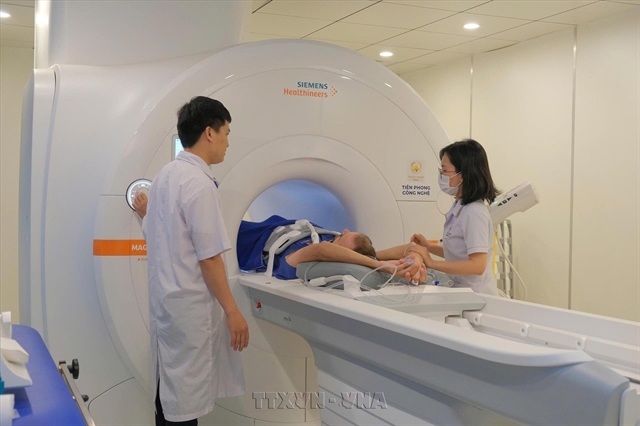
The hospital’s Radiology Centre was among the first departments to embrace digital transformation. The workflows of doctors and medical staff have been digitised, while artificial intelligence (AI) is being used to support the analysis of medical images.
AI has proved particularly useful in interpreting and analysing CT scans, including scans of the pulmonary and coronary arteries. The technology helps significantly reduce the time needed to process medical images and supports doctors in making clinical assessments.
Digital technology is not limited to diagnosis. It is also being introduced into surgery. Two modern robotic systems, Cori and Da Vinci, have been put into use to assist doctors in performing complex operations with greater precision.
From familiar day-to-day procedures to advanced technological systems, digital transformation is giving healthcare at Hanoi Medical University Hospital a new look. VNS
 |
An app allows patients to book appointments with their preferred doctors in advance. VNS Photo Hải Anh |
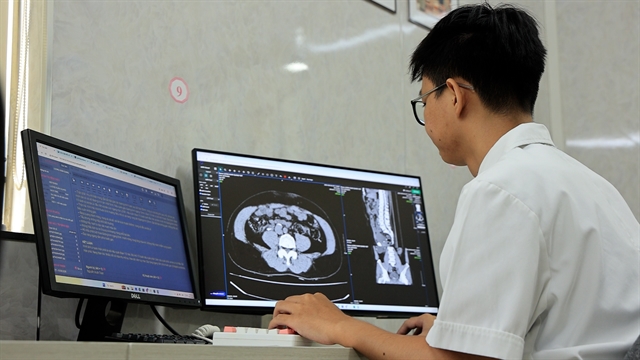 |
| The Radiology Centre was among the hospital’s early adopters of digital transformation, with doctors using AI to assist in reading CT scans. VNS Photo Lê Hương |
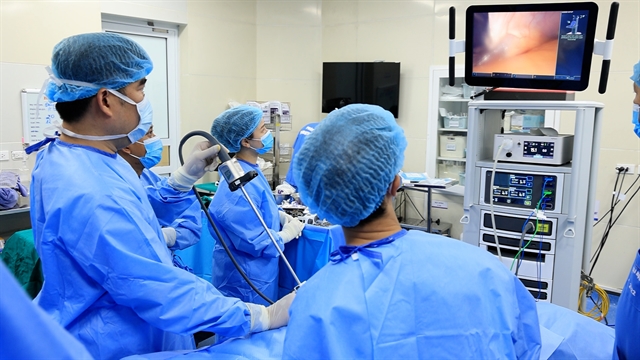 |
| The Da Vinci robotic system is closely monitored and controlled by surgeons during operations. VNS Photo Hải Anh |
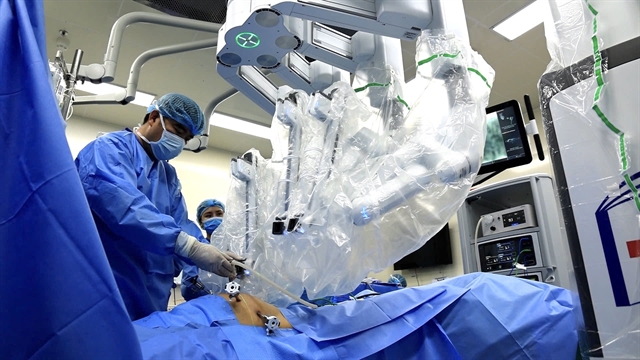 |
| A surgeon performs an operation with help from the Da Vinci robotic system. VNS Photo Hải Anh |
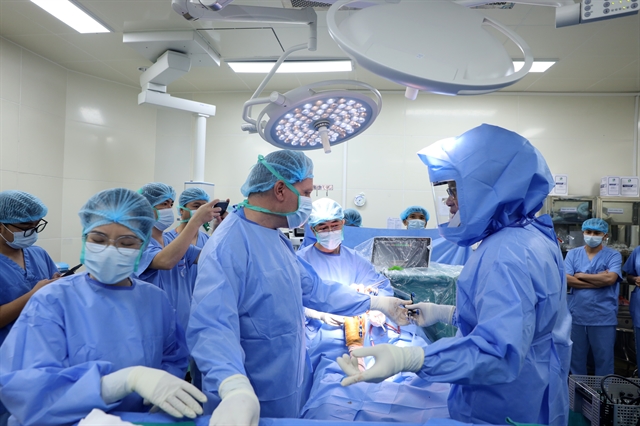 |
| A team of surgeons performs an operation using the Cori robotic system. VNS Photo Lê Hương |
Society
 Society
 Society
 Society
 Society
 Society
 Society
 Society
 Society
 Society
 Society
 Society
 Society
 Society
 Society