 Society

Advancing investigative interviewing
1.
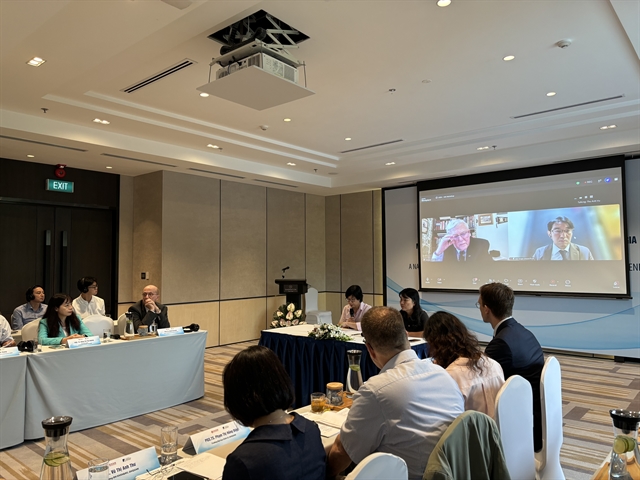
|
| Vietnamese and international experts share their perspectives on Việt Nam’s development model in comparative dialogue with East Asian developmental states. —VNS Photo Khánh Dương |
HÀ NỘI — Việt Nam’s development model during the Đổi mới (Renewal) process has both characteristics shared with regional development patterns and its own distinctive features, heard a workshop held in Hà Nội on Friday.
The workshop presented the findings of a research project conducted by the University of Social Sciences and Humanities (USSH), Việt Nam National University Hà Nội, in collaboration with Germany’s Konrad-Adenauer-Stiftung (KAS) on Việt Nam’s Đổi mới in the context of East Asia.
The research examined Việt Nam’s evolving development model in comparative dialogue with East Asian developmental states, combining insider and outsider perspectives and to derive policy-relevant insights consistent with the resolutions of the 14th National Party Congress.
Dr Vũ Thị Anh Thư, one of the researchers from USSH-VNU, Hanoi, said the research unlocks three core questions: How has the East Asian developmental state model transformed since the early 21st century under the impacts of globalization, climate change and technology? Is Việt Nam a variant of the East Asian developmental state model, a hybrid model or an entirely distinct category? How can Việt Nam leverage the advantages of socialist-oriented developmental state to solve development bottlenecks?
Experts agreed that in the context of East Asia’s growth, the development model of Việt Nam during the 40 years of Đổi mới is a hybrid one.
USSH’s PhD Student Nguyễn Lê Đình Quý, one of the researchers, said Việt Nam has adopted elements of the developmental-state model of East Asian countries, with the State playing a strong role in most decisions, setting development goals and formulating policies, while viewing exports and industrialisation as important drivers of growth.
However, Việt Nam’s development trajectory differs from that of other East Asian countries, he said.
From the outset, FDI enterprises have played an important role in Việt Nam’s economy, and Việt Nam joined global value chains earlier than other developed countries in East Asia comparatively, he added.
Quý said: “Although the Vietnamese Government plays an important role in setting development orientations and goals, its role in Việt Nam has gradually shifted towards that of an enabling state, rather than one focused on administration and control. This is a distinctive change in Việt Nam’s development model.”
He highlighted institutional layering and adaptive governance as two key elements of Việt Nam’s development model, saying that rather than abolishing the existing institutional structure, Việt Nam has gradually introduced selective changes. Institutional reform in Việt Nam has therefore been incremental.
Over the past 40 years, Việt Nam has faced external shocks in the economic and geopolitical spheres. The country has adapted by making timely and selective changes, simultaneously building institutions incrementally and adapting to the global context, he said.
Professor Đặng Thị Thu Hương, vice rector of USSH-VNU, Hà Nội, said Japan, Korea, Taiwan, Singapore, China and many other economies have achieved remarkable development through very different combination of market, state combination, institution and international integrations. Việt Nam shares some important features with this regional experience.
Việt Nam is both part of the East Asian development story and a distinct native national case. Its development has been shaped by its own history and institutional development orientation, Hương said.
Việt Nam shares important feature with East Asian development experiences, while following distinctive path shaped by its socialist legacy, she said, adding: “This allows us to look at Đổi mới not as a model to be copied, but as a process of learning, adaptation and institutional creativity.”
As Việt Nam is entering a new stage of development, she said the changes are no longer the same as though in 1986. Việt Nam now needs to further improve the quality of its institution, develop high quality human resource, raises productivity, strengthens science, technology and innovation.
The next step requires not only continued reform, but also stronger institution and greater national capacity to innovate and adapt, she said. — VNS
Society
 Society
 Society
 Society
.jpg) Society
Society
 Society
 Society
 Society
 Society
 Society
 Society
 Society
 Society
 Society
 Society
.jpg)




