 Society

PM urges Hưng Yên to become dynamic growth hub by 2030
1.
|
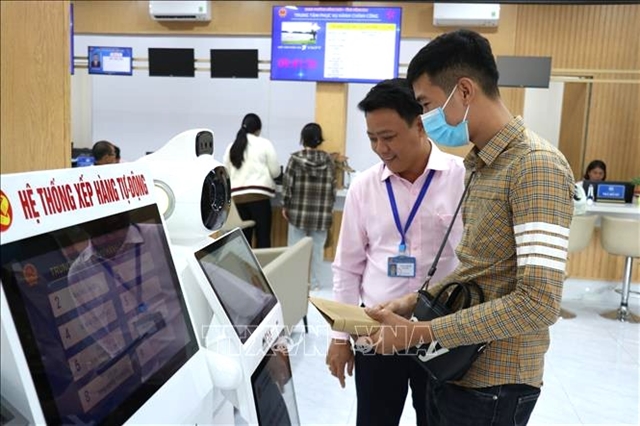
| A public servant at the Public Administrative Service Center in Đồng Xoài Ward in the southern province of Đồng Nai, guides a resident on how to search for information on administrative procedures using a system powered by artificial intelligence (AI). In Việt Nam's public sector, AI offers opportunities to improve the quality of services provided to citizens and businesses. — VNA/VNS Photo K GỬIH |
HCM CITY — Artificial Intelligence (AI) is opening up numerous opportunities to enhance the efficiency of public service operations, ranging from information retrieval, synthesis, and data analysis to decision-making support. However, technology plays only a supporting role; the responsibility for verification, evaluation, and final decision-making remains with humans.
As the Law on Artificial Intelligence is being implemented, the challenge lies in promoting AI adoption while ensuring safety, transparency, risk management and accountability.
AI does not replace human responsibility
Speaking at a training conference on the implementation of the AI law and its subordinate regulations organised by the Ministry of Science and Technology in HCM City last weekend, Deputy Minister of Science and Technology Trần Trung Tính noted that as AI evolves rapidly, it is exerting an increasingly profound impact on socio-economic development, innovation, labor productivity, competitiveness, digital transformation, and the efficiency of national governance.
In the public sector, AI offers opportunities to assist with information retrieval and synthesis, document review and drafting, data analysis, and decision-making support, ultimately improving the quality of services provided to citizens and businesses.
However, the deputy minister placed special emphasis on the requirements for risk management and accountability when utilising AI.
AI can participate in various stages of State agency operations, from information search and synthesis to drafting assistance, data analysis, and decision-making support. Yet, the use of technology does not alter the responsibilities of public officials.
Consequently, any output generated by AI must be verified and evaluated before use.
“Technology can support civil servants and public employees, but it cannot replace human responsibility. AI-generated outputs must be verified and evaluated before being used in official public duties,” said Tính.

|
| Deputy Minister of Science and Technology Trần Trung Tính speaks at a training conference on the implementation of the Law on Artificial Intelligence and its subordinate regulations in HCM City on August 19. — Photo courtesy of the Ministry of Science and Technology |
Translating AI law into practice through specific use cases
In this context, AI adoption raises requirements regarding system quality and reliability, data governance, safety and security, the protection of the legitimate rights and interests of organisations and individuals, as well as transparency and accountability.
Consequently, ministries, sectors, and localities must simultaneously address two requirements: promoting AI development and application, and ensuring safe, transparent, and responsible AI governance that serves the public interest.
Deputy Minister of Science and Technology Tính emphasised that the enactment of the Law on Artificial Intelligence is a crucial step toward establishing a legal framework for the development, provision, deployment, and use of AI in Việt Nam.
The law will only truly deliver value when translated into specific regulations, procedures, and practical implementation methods. Therefore, the primary requirement is for agencies and units to correctly understand and adopt a unified approach to the Law and its implementing guidelines.
They also need to clearly define responsibilities regarding the development, deployment, and use of AI systems, and identify and manage high-risk systems and data governance, he said.
Furthermore, legal implementation must be aligned with actual AI application needs, Tính added.
"Each agency and locality should begin by addressing specific questions: Which tasks are currently time-consuming? What data remains underutilised? Which processes can be supported? Which services for citizens and businesses can be improved?," he said, adding that only by addressing these practical challenges can a suitable AI deployment model be selected.
Tính urged departments of Science and Technology across the country and relevant agencies to proactively provide advice and organise the implementation of the AI law, as well as to assess the demand for AI applications and select suitable use cases.
"The departments and agencies should also increase sharing of knowledge and experiences on effective models and practices throughout the implementation process," he said.
For its part, the Ministry of Science and Technology will continue to refine the institutional framework, develop data infrastructure and the AI ecosystem, and promote the application of this technology to foster socio-economic development and improve the operational efficiency of state agencies, the deputy minister said. — VNS
Society
 Society
 Society
 Society
 Society
 Society
 Society
 Society
 Society
 Society
 Society
 Society
 Society
 Society
 Society