 Society
NA President meets with Chinese Premier in Beijing
1.
|
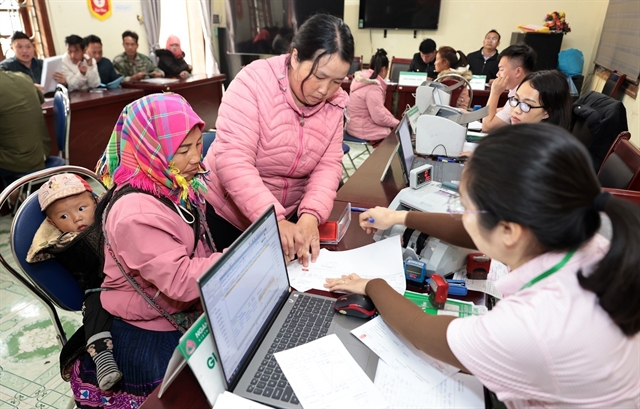
| A woman in the northern province of Lai Châu thumbprints a preferential loan agreement with the Vietnam Bank for Social Policies to help her family escape poverty. — VNA/VNS Photo |
HÀ NỘI — Việt Nam will raise the income threshold in its multidimensional poverty standard for 2027-2030, the Ministry of Agriculture and Environment said.
The monthly per-person benchmark for rural households will rise to VNĐ2.2 million (US$84.5) from VNĐ1.5 million ($57.6), and for urban households to VNĐ2.8 million ($107.6) from VNĐ2 million ($76.9).
Income will not be the only yardstick. Households will still be classed as poor or near-poor by how far they lack basic services in six areas: employment, health, education, housing, information, and water and sanitation.
The indicators have been sharpened to reflect daily life, covering everything from job status and health insurance to nutrition, digital access, clean water and waste disposal. The aim is to capture the hardships each household actually faces, not just what it earns.
The current standard, set for 2021-2025, stays in force this year, the first of a 2026-2030 national programme covering new rural development, sustainable poverty reduction, and development in ethnic minority and mountainous regions.
The programme folds three earlier national programmes into one to pool funds, avoid duplicate spending and improve results on the ground. Central government will set goals and policies and step up oversight, while local governments get more freedom to decide how to carry them out, and will answer for the results.
The criteria for new rural development have been pared back to essentials. Funding will go first to the hardest-pressed places, including the poorest communes, border areas, islands, and ethnic minority and mountain regions.
By 2030, the programme aims to improve the quality of new rural areas, cut multidimensional poverty and lift living standards. The focus is on creating livelihoods, raising incomes, widening access to basic services and keeping families from slipping back into poverty, rather than simply reducing the number of poor households.
Local governments will tailor targets to their own conditions, tying poverty reduction to vocational training, digital transformation, livelihood support, farm and business development, and policy loans. Bringing these efforts together, instead of running them as separate programmes, is expected to produce more coordinated results.
Under the new framework, progress will be judged not just by whether a household crosses an income line, but by whether it has essential services, steady work, better living conditions and a lasting way out of poverty. — VNS
Society
 Society
 Society
 Society
 Society
 Society
 Society
 Society
 Society
 Society
 Society
 Society
 Society
 Society
 Society