 Society
Hà Nội aims to turn traditional crafts into drivers of economic growth
1.
|
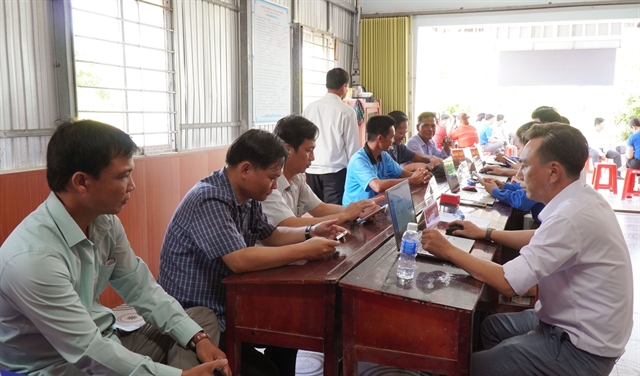
| Communes and wards in Cà Mau Province set up mobile teams to provide administrative services to residents. — VNA/VNS Photo |
CÀ MAU — Cà Mau Province has made progress in applying science and technology and digital transformation to public administration, production and business, while launching a 100-day campaign to tackle bottlenecks and accelerate digital transformation.
The efforts are in line with the implementation of the Politburo’s Resolution No. 57 on breakthroughs in science, technology, innovation, and national digital transformation issued in December 2024.
Nguyễn Minh Luân, deputy chairman of the Cà Mau People's Committee, said: “Since the implementation of Resolution No. 57, science and technology, innovation and digital transformation in the province have undergone clear changes and become increasingly linked with administrative reform and services for people and businesses.
“The resolution has been implemented throughout the political system, while digital transformation is gradually becoming a new way of operating, managing and directing work, particularly as the two-tier local administration model is put into operation.
“Data has been identified as the foundation of digital transformation.”
The southernmost province is currently implementing 113 databases under central Government direction and 42 province-specific databases.
It has digitised 100 per cent of its civil status database and entered 1,069,657 land lots into the national land database, also reaching 100 per cent.
The connected databases are being used for administrative procedures, searches, verification and online public services, helping shift work from reliance on paper records towards the use and reuse of available data.
Digital infrastructure has also been strengthened. All hamlets and residential areas have mobile coverage and fibre-optic connections.
The document management and administration system is connected across three levels – central, provincial and commune – while the Local Government Service Platform has been connected with 35 information systems and databases.
|
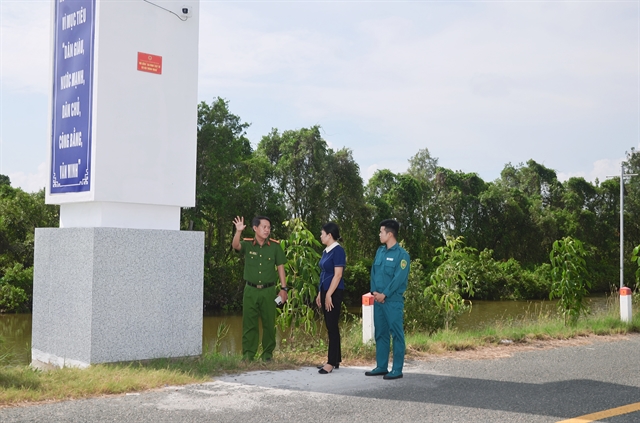
| The “Smart Social Security” model in Tân Hưng Commune features 20 surveillance cameras at 11 key locations, helping improve local security and governance, and engage residents in maintaining public order. — VNA/VNS Photo |
Digital transformation has also reached production and business.
The province now has more than 3,365 businesses using ".vn" domain names, nearly 547,000 registered cashless payment accounts and 114 e-commerce sales websites.
It has supported 56 producers of products recognised under the country’s “One Commune – One Product” programme in placing 110 products on e-commerce platforms.
The "Digital Literacy for All" movement has organised 41 training courses and 74 videos or lectures, attracting tens of thousands of accounts and hundreds of thousands of learning and interaction sessions.
Community digital technology teams are present in all hamlets and residential areas and have directly helped more than 358,000 households access digital platforms and services.
Luân said the province's implementation of Resolution No. 57 had brought an important shift from "applying technology" towards changing governance methods, with data serving as the foundation.
He identified the key breakthrough for the coming period as applying science and technology, innovation and digital transformation to sectors in which the province has strengths, turning existing advantages into new value and competitiveness.
Aquaculture is a priority. The province plans to promote high technology, data, the Internet of Things (IoT), artificial intelligence (AI), automation, traceability and circular technologies in farming, processing, environmental and disease management.
It also plans to apply science and technology and digital transformation to marine economic management, logistics, offshore aquaculture, environmental protection and renewable energy, while using digital technology to develop smart tourism and promote the "southernmost land" brand.

|
| Marine aquaculture cages in Cà Mau Province. The application of digital technology in aquaculture is a key priority as the province works towards a green, digital and sustainable economy. — VNA/VNS Photo |
Digital agriculture
In agriculture, digital transformation has helped the province's distinctive farming models, including shrimp-rice farming, to improve production, strengthen value-chain links and expand markets.
Nguyễn Bình Thuận, deputy director of the province Department of Agriculture and Environment, said the rice-shrimp farming model has high ecological value, suits climate change conditions and offers potential to increase the value of local agricultural products.
He stressed that sustainable development requires higher-quality, safer rice products with stronger brands and better prices. This requires an integrated value chain covering seeds, production, harvesting, processing, packaging, traceability, branding and markets.
“In that value chain, farmers must be the main actors and the people who receive the most appropriate benefits,” he said.
Businesses should work with farmers from the outset, while State agencies should provide technical support and facilitate market development, he added.
Nguyễn Trần Thức, head of the province Plant Production and Protection Sub-department, said digital technology can facilitate product promotion and traceability while creating transparent data on cultivation areas.
At the same time, it provides convenience and reliability for businesses to expand investment and develop concentrated, high-quality raw material areas, he said.
|
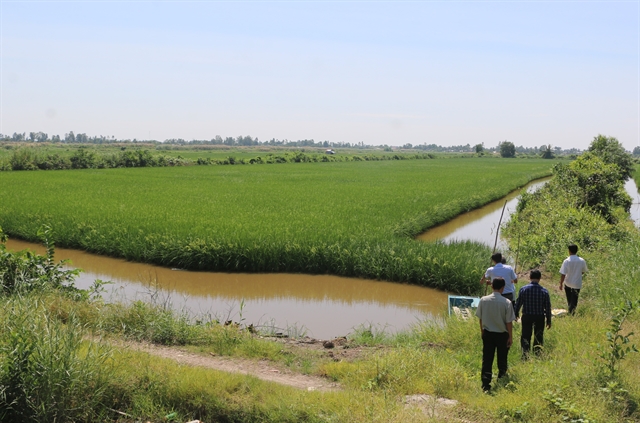
| Shrimp-rice fields in Cà Mau Province. — VNA/VNS Photo |
The Ba Đình General Agricultural Co-operative in Vĩnh Lộc Commune provides a practical example.
Established in November 2018, the co-operative has more than 290 members and manages over 733ha of shrimp-rice and other combined production models.
It is among the province’s first co-operatives to use drones and cluster seeders for rice cultivation.
Combine harvesters are used across all its rice-growing areas, while FaceFarm software records production data from cultivation to harvesting, supporting traceability and market links.
Nông Văn Thạch, chairman of the co-operative, said: “The application of digital technology has gone beyond management, helping the co-operative strengthen market links, reach more business partners, increase product value and expand outlets.”
Cà Mau has more than 185,000ha of rice, more than half of which is cultivated under the shrimp-rice farming model.
100-day campaign
The province launched a 100-day action campaign in mid-July to address obstacles to digital transformation and improve services for residents.
The campaign includes 59 tasks in 10 areas: institutions, digital infrastructure, digital data, digital platforms, online public services, the digital economy, digital society, human resources, finance and disbursement, and implementation discipline.
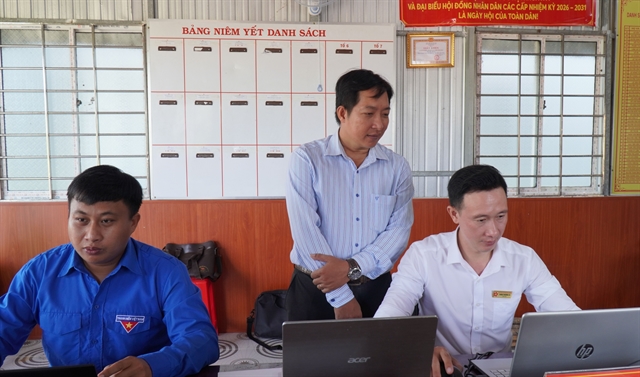
At the Vĩnh Lợi Commune Public Administrative Service Centre, improvements in digital infrastructure and systems have become more evident.
The centre’s stable system has helped staff members process dossiers on time while reducing the need for residents to travel.
Assistance with digital procedures is also gradually helping people develop the habit of using online public services, making technology a practical tool in daily life.
Trần Thị Nhi, a resident of Vĩnh Lợi, said when the centre receives dossiers and returns results, everything is done within the prescribed time.
“I am also very satisfied with the way the staff communicates with people. They are friendly and enthusiastic. It makes the process more convenient, saves us time and, in general, creates favourable conditions for economic development.”
|
| Local authorities in Cà Mau Province are stepping up efforts to expand the use of electronic certification and online processing of administrative applications. — VNA/VNS Photo |
The 100-day campaign is a peak period for identifying and addressing bottlenecks in digital transformation.
It is also helping lay the foundations for longer-term digital transformation, from ensuring stable connectivity and equipment to digitising documents, standardising data and improving the quality of services for residents.
Luân said the campaign is not simply a technology task but is intended to help realise breakthroughs in science, technology and innovation and support the province's goal of double-digit economic growth.
The province is accelerating disbursement of funds for science and technology, innovation and digital transformation, while prioritising information technology infrastructure for Party agencies for 2025-28 and equipment for commune-level administrations.
It aims to review and standardise provincial data according to the required criteria in 2026 and address fragmentation and poor interoperability. — VNS
Society
 Society
 Society
 Society
 Society
 Society
 Society
 Society
 Society
 Society
 Society
 Society
 Society
 Society
 Society