 Society

Việt Nam, EU and Belgium seek deeper, practical cooperation
1.
|
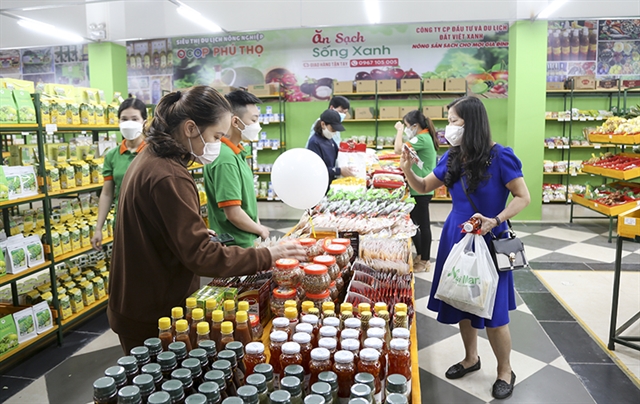
| Tourists visit a booth with local OCOP products. — Photos baophutho.vn |
By Trần Như
PHÚ THỌ — One Commune, One Product (OCOP) programme is helping producers in Phú Thọ Province tap into tourism, creating new income opportunities while encouraging communities to preserve traditional crafts and cultural heritage.
Đinh Văn Dần, head of the Mỗ village comumunity tourism co-operative group, said community-based tourism had helped improve living standards, particularly among ethnic minority residents.
By taking part in tourism activities and introducing visitors to local products and culture, residents earn additional income while gaining an incentive to preserve what makes their communities distinctive.
Average per capita income exceeded VNĐ41 million (US$1,570) in 2025, while the number of poor households fell to four and near-poor households to two.
“The important thing is that people benefit from the value they create themselves,” Dần said.
“When their livelihoods improve, they have more incentive to preserve their culture, landscape and environment.”
Phú Thọ is seeking to extend that model by incorporating OCOP products into tourism itineraries.
Rather than treating agricultural goods simply as commodities, the province is linking production areas, craft villages and processing facilities with tourist destinations.
Visitors can then see production processes, taste local products and buy them directly from producers.
Following a recent administrative merger, the province has a larger agricultural base, offering a range of products that could be incorporated into tourism experiences, including vegetables, flowers, mushrooms, cordyceps, Long Cốc tea, Đoan Hùng pomelos and Hùng Lô rice noodles, as well as specialties from Hòa Bình.
Trần Thị Hoa, a visitor from Hà Nội, said seeing where products were made helped build trust.
“If production facilities were connected into experiential tours, the trips would be more interesting,” she said.
“Visitors could explore the sites and learn about the products, and once they like them, they would be more likely to buy them as gifts.”
Phú Thọ currently has more than 600 OCOP products, according to the provincial Department of Agriculture and Environment. They include 88 products rated four stars and nine rated five stars, the highest category.
Many producers have adopted quality-management systems including ISO, VietGAP, HACCP and FSSC 22000, while expanding sales through distribution networks, digital platforms and exports.
For businesses, OCOP certification can help standardise production, build brands and reach new markets.
Lê Thị Nga, general director of HONECO, said the company has four nationally certified five-star OCOP products and exports to the United States, Germany, Singapore, South Korea and Japan, among other markets.
Exports account for around 20 to 30 per cent of the factory's production capacity, she said.
Tourism can provide another way to promote such products, allowing visitors to see the raw-material areas and production processes and learn about the standards behind them.
|
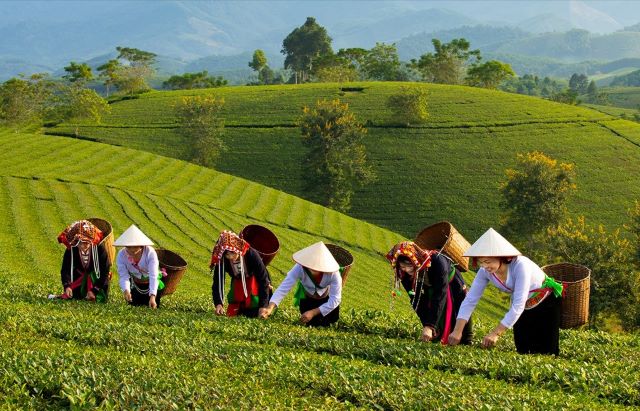
| Visitors take part in tea picking at an eco-tourism site featuring OCOP tea products in Long Cốc Commune. |
For small farmers, cooperatives and producers, a sale at a market or shop may generate a single transaction. But incorporating products into tourism can create additional revenue from tours, food, accommodation and purchases made after visitors return home.
The Tất Thắn Agro-Forestry Cooperative in Cự Đồng Commune has five OCOP products and has combined grape-growing with tourism experiences since 2021.
It now welcomes 400-600 visitors a month, while OCOP sales have risen about 40 per cent, with some visitors placing orders after returning home.
Linking agriculture and tourism
The province is also linking agriculture, OCOP and tourism.
In March, the Department of Agriculture and Environment submitted a draft plan to develop circular agriculture and agricultural and rural tourism through 2030.
Nguyễn Văn Quân, deputy director of the department, said the province would continue strengthening product brands and quality certification while promoting links with community-based and experiential tourism.
“What people need is not another OCOP star, but an ecosystem that helps products sell sustainably at higher value,” Quân said.
Producers will be linked with tourism businesses, hotels and restaurants, with OCOP products featured in gift baskets, menus and visitor experiences.
Nguyễn Thanh Hiệp, deputy head of the provincial Sub-Department of Rural Development, said authorities would continue mobilising resources to support businesses, cooperatives and producers with capital and technical assistance.
The province also plans to develop community tourism routes linking tourist destinations with OCOP production areas, he said.
Phú Thọ Province has also adopted a tourism stimulus plan for the second half of this year.
A programme titled “Phú Thọ tourism – A multicolored experience” is scheduled for September 25-27 in Mai Châu, featuring 55 booths showcasing local products, culture and traditional crafts.
By 2030, the province aims for 70 per cent of OCOP producers to have stable raw-material sources and plans to develop or upgrade 50-55 products rated three stars or higher each year, with a budget of more than VNĐ76.22 billion. — VNS
Society
 Society
 Society
 Society
 Society
 Society
 Society
 Society
 Society
 Society
 Society
 Society
 Society
 Society
 Society