.jpg) Society
Society
Việt Nam seeks to modernise state audit amid emerging challenges
1.
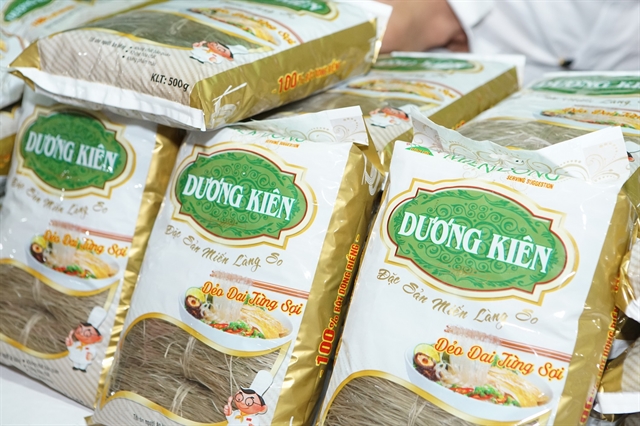 |
| Recognised as a five-star OCOP product in the second round of 2025, Dương Kiên dong riềng vermicelli is steadily establishing its reputation for quality in both domestic and international markets. |
HÀ NỘI — Recognised as a five-star OCOP product in the second round of 2025, Dương Kiên cassava vermicelli, rooted in a long-established vermicelli-making craft village in Hà Nội, is steadily building its reputation in both domestic and international markets. Its story also highlights how the “One Commune, One Product” (OCOP) programme is helping Vietnamese craft products increase their value, build stronger brands and reach wider markets.
Preserving a craft through quality
In So Village, Hưng Đạo Commune, Hà Nội, the craft of making cassava vermicelli has been passed down through generations. From the humble cassava-like rhizomes of the dong riềng plant, local makers produce translucent, pleasantly chewy strands with a naturally subtle sweetness – a familiar ingredient in Vietnamese cuisine.
The family of Dương Đình Khôi is among those with a long-standing connection to the craft. Born into the village community, Khôi was introduced to vermicelli making from an early age, learning techniques handed down by previous generations. After spending some time at university, he decided to return home and continue the family trade.
Starting with a small-scale traditional workshop, he gradually invested in machinery, standardised production and developed a brand with the ambition of taking So Village vermicelli to wider markets.
According to Khôi, the quality of vermicelli begins with its raw materials. Dương Kiên cassava vermicelli is made from pure dong riềng starch sourced from suitable growing areas. The roots are washed, ground, filtered and processed to extract the starch before entering production.
Good raw materials, however, are only the starting point. The experience of skilled makers remains crucial at many stages of the process. From cooking the starch mixture and forming the sheets to drying the strands, each step requires precision and a thorough understanding of the ingredients.
“If you get the calculations wrong, the vermicelli will either become too dry or lose its elasticity,” Khôi explains.
Traditional drying techniques also contribute to the product's distinctive qualities. In the past, strands of vermicelli were spread out on bamboo racks to dry naturally in the sun and wind. Workers had to observe the direction of the wind, the intensity of the sunlight and the timing of the drying process to ensure that the strands dried evenly while retaining their shape and quality.
Khôi says that even when production methods are broadly similar, differences in raw materials and drying techniques can distinguish one producer from another. For experienced makers, such knowledge cannot easily be replaced by machinery.
Preserving a traditional craft in the modern era, however, does not mean simply maintaining old production methods. To meet increasingly demanding requirements for quality and food safety, Dương Kiên has invested in modern technology.
In 2016, Khôi's family invested more than VNĐ2 billion (US$76,940) in machinery, moving to machine-based vermicelli production and establishing a closed production line from starch filtration to cooking. A closed drying system powered by clean energy was also introduced to improve hygiene, stabilise product quality and reduce dependence on weather conditions.
Technology has increased productivity, but it has not replaced the experience of skilled workers. The ratio of starch to water, the duration of steaming and forming, the degree of cooking and the right moment for drying all continue to require knowledge accumulated over many years.
This combination of traditional expertise and modern technology has become the foundation for Dương Kiên to standardise its products and meet increasingly demanding market requirements.
OCOP raises value and opens the way to global markets
For products rooted in traditional crafts, one of the greatest challenges is ensuring that their value is recognised beyond their local communities – by consumers across the country and, ultimately, in international markets.
The “One Commune, One Product” programme has provided an important framework for this process. Through product assessment, classification and improvement, the programme encourages producers to pay greater attention to quality, production processes, packaging, traceability and brand development.
For traditional craft products, OCOP is about more than simply receiving a product rating. More importantly, the programme encourages producers whose work has traditionally relied heavily on inherited skills and experience to adopt more professional production methods, while connecting the cultural value of traditional crafts with the standards expected by modern markets.
Dương Kiên cassava vermicelli is one such example.
At the end of 2019, the product was recognised as a four-star OCOP product by the Hà Nội municipal authorities. This marked an important step in giving the product greater access to distribution networks and new business partners.
Following the four-star recognition, the product attracted the attention of a Japanese partner, who took samples for quality testing before the two sides proceeded to sign a contract. The stringent requirements of the Japanese market also prompted the company to further improve its production processes, quality control and product presentation.
In June 2020, Dương Kiên Production, Trading and Import-Export Co., Ltd. was established, providing a formal basis for expanding production, business operations and exports.
Dương Kiên vermicelli has since been exported to Japan and Taiwan (China), while negotiations are under way with a partner in Canada. The product is also available in major Vietnamese cities, including Hà Nội, Đà Nẵng and HCM City.
Most notably, Dương Kiên cassava vermicelli was recognised as a five-star OCOP product in the second round of 2025. The recognition represents the highest level of the OCOP programme and provides a further opportunity for the brand to strengthen its position in the market.
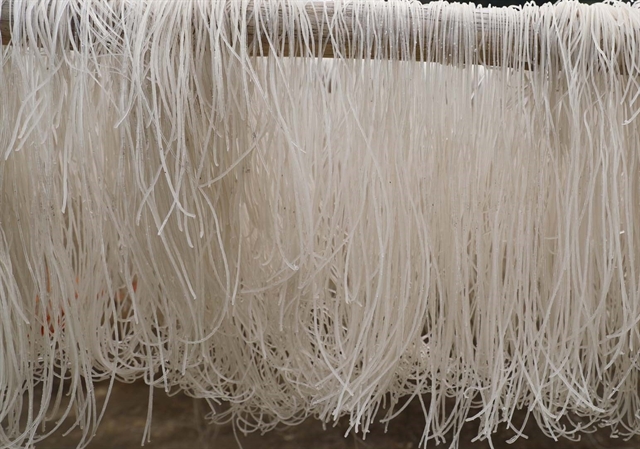 |
| With Dương Kiên dong riềng vermicelli, each strand carries not only the familiar flavour of a Vietnamese dish, but also the story of a traditional vermicelli-making village steadily making its presence felt in international markets. |
The move from four-star to five-star OCOP status reflects a continuous process of improvement. Requirements relating to quality, food safety, production processes, packaging and traceability have become drivers for innovation and higher standards.
The value of OCOP for traditional craft products also lies in its ability to connect products with the stories of their places of origin, the people who make them and the crafts they preserve. Once quality has been standardised and a brand developed professionally, a product once familiar mainly within its local market can reach a much wider customer base.
This is one of the important contributions of the “One Commune, One Product” programme to the development of Vietnamese agriculture and traditional crafts. It encourages producers to view their products not simply as consumer goods, but as economic assets rooted in the cultural identity and distinctive strengths of their local communities.
For craft villages, the development of such products is also closely linked to preserving traditional occupations, creating jobs and safeguarding knowledge passed down through generations. When these values are combined with improved quality and professional standards, traditional craft products gain greater opportunities to compete in an increasingly open market.
For a traditional product to enter international markets, quality must go hand in hand with a clear story of origin. According to Khôi, exporting vermicelli requires strict compliance with requirements concerning quality and presentation. The company therefore continues to refine its production processes, control raw materials and finished products, and pay greater attention to packaging and product information.
The company currently operates four workshops, each covering nearly 300 square metres, providing employment for a number of permanent workers and around 40 seasonal workers. Production capacity stands at about one tonne of vermicelli a day and can reach three tonnes during peak periods.
These figures demonstrate that a traditional craft can adapt to modern-scale production without necessarily losing its distinctive values.
Dương Kiên cassava vermicelli is made without artificial colouring, bleaching agents or additives intended to create its characteristic qualities. When cooked, the strands retain a pleasant elasticity and structure, together with the subtle sweetness associated with pure dong riềng starch.
For Khôi, this is at the heart of the craft. He often tells his workers: “Making vermicelli is like being a good person – you have to be genuine.” It means being honest about the ingredients, rigorous in the production process and responsible towards consumers.
From a craft maintained by families in So Village, Dương Kiên cassava vermicelli has gradually developed into a standardised product, earned five-star OCOP recognition and reached a number of overseas markets.
Its story demonstrates that the path for a Vietnamese traditional craft product to reach the wider world can begin with very simple foundations: a traditional occupation, a source of raw materials, skills passed down through generations and a determination to improve quality.
When the OCOP programme helps these values to be standardised, positioned and connected with markets, local products gain an opportunity to transform cultural value into economic value.
For Dương Kiên cassava vermicelli, each strand carries more than the familiar flavour of a Vietnamese food. It also tells the story of a craft village adapting to change, a product raising its standards, and a way for values rooted in agriculture, craftsmanship and local culture to gradually find a place in international markets. — VNS
* This article was produced in cooperation with the Hanoi Office for Coordination of the New-style Rural Development Programme.
Society
 Society
 Society
 Society
 Society
 Society
 Society
 Society
 Society
 Society
 Society
 Society
 Society
 Society
 Society