 Sci-Tech

Fitch upgrades Techcombank’s rating, boosting global market position
1.
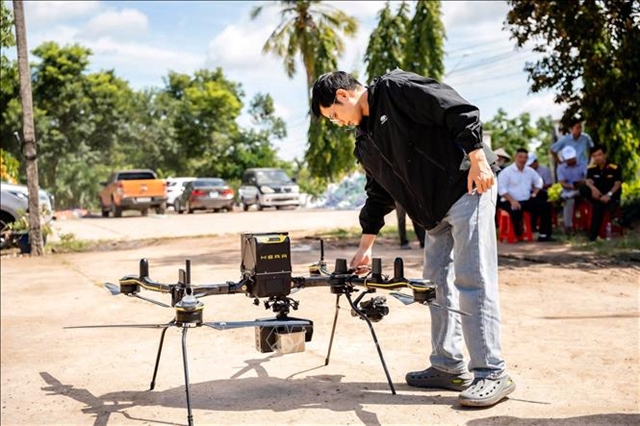 |
| A technician checks the technical specifications of an unmmaned aerial vehicle (UAV) before a test fly in the southern province of Tây Ninh on August 20. The province has chosen UAVs as the strategic product to be prioritised for development to actualise the Politburo's Resolution 57. — VNA/VNS Photo Giang Phương |
HÀ NỘI — In recent years, rapid advancements in robotics, sensors, artificial intelligence and positioning technology have laid the foundation for significant development of unmanned aerial vehicles.
In Việt Nam, the implementation of the Politburo's Resolution No. 57-NQ/TW, which focuses on breakthroughs in science, technology, innovation and national digital transformation, is being accelerated. UAV has been listed among the strategic technologies and products prioritised for development in the Prime Minister’s Decision No. 21/2026/QĐ-TTg.
These guiding documents serve as a crucial basis for fostering research and development, mastering technology, establishing supply chains and expanding UAV applications across various socio-economic sectors.
Having evolved from serving primarily specialised tasks, UAVs are increasingly integrated into diverse production and service activities. With their complex technological architecture – encompassing hardware, control software, semiconductor chips, sensors, data connectivity and operational management platforms – UAVs create opportunities for enterprises to participate in multiple stages of the value chain, from research, design and component manufacturing to the development of specialised solutions and services.
Alongside the advancement of UAV technology, the 'low-altitude economy' is emerging as a new economic frontier, encompassing an ecosystem of technologies, infrastructure, data and services operating within the low-altitude airspace.Applications range from logistics, precision agriculture, surveying and mapping, and infrastructure inspection to environmental monitoring, search and rescue, and smart city services.
At the Vietnam International Forum on Low-Altitude Economy and UAV Industry held in Hà Nội on September 9, Võ Xuân Hoài, deputy director of the National Innovation Center (NIC), emphasised that the opportunity for Việt Nam lies not merely in expanding UAV applications but also in building industrial capacity, mastering technology and deepening participation in the value chain.
"The UAV sector strongly intersects with various strategic technologies such as artificial intelligence, semiconductors, sensors, data and automation," he said.
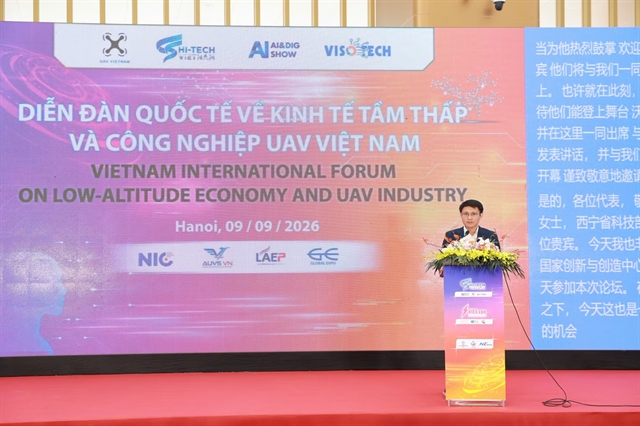 |
| Võ Xuân Hoài, deputy director of the National Innovation Center, speaks at the Vietnam International Forum on Low-Altitude Economy and UAV Industry held in Hà Nội on September 9. — Photo courtesy of the centre |
Recognising UAV development as a sector with the potential to evolve into a new high-tech industry in Việt Nam, the NIC has launched the Vietnam UAV Innovation and Expert Network (UAVS Vietnam) to connect experts, enterprises, research institutes, universities and organisations operating in the UAV sector, both within Việt Nam and globally.
Additionally, NIC is collaborating with the Japanese Government and the United Nations Development Programme (UNDP) to establish the Việt Nam-Japan Innovation Space. Scheduled to become operational in 2026, this facility aims to link technological resources, experts and businesses from both countries.
Discussing the practical development of the low-altitude economy in the southern province of Tây Ninh, Huỳnh Thị Hồng Nhung, director of the provincial Department of Science and Technology, noted that the province would serve as a real-world testing ground where new technologies can be validated before scaling up.
"Our approach focuses on clarifying strategies to harness local potential, refining policy frameworks, building testing infrastructure and developing an ecosystem for UAV applications," she said.
Currently, Tây Ninh aims to integrate UAV technology into key sectors such as smart agriculture, industry, urban management, logistics and tourism.
"Proactively planning low-altitude flight infrastructure and establishing testing regulations will help the province attract investment resources, gradually build a comprehensive UAV industrial ecosystem, and make a positive contribution to the province's digital economic growth in the near future," Nhung said.
Mastering the UAV suppl
In the era of digital transformation, strategic technologies serve as pillars driving profound, comprehensive global change across three main axes: transforming production and operations, creating new business models and reshaping value chains.
According to Tạ Ngọc Thanh, a representative of the Vietnam Aerospace and UAV Systems Network, developing, building and mastering the supply chain for Vietnamese UAV systems requires multi-party collaboration.
"Instead of a single enterprise developing the entire product on its own, the model should aim to pool the capabilities of enterprises, research institutes, universities, and technology partners to gradually master key components within the value chain," he said.
"Mastery does not mean manufacturing every single component in-house, but holding the power to decide on and control the entire system," Thanh added.
"The true capability of the UAV industry is measured by the ability to consistently supply high-quality products, rather than the number of successful prototypes."
He proposed a three-stage localisation roadmap to realise this goal.
The first and early stage should focus on strengthening system integration, software development, AI applications and operational services to quickly secure orders.
The next, medium-term stage involves autonomous production of accessible components such as airframes, cameras, control stations, and data transmission modules, while the third stage is long-term and involves in-depth investment into the technology, according to Thanh.
Regarding operational mechanisms, Thanh emphasised the need for a designated lead entity. This means that even when multiple units collaborate on research and development, a single systems enterprise must assume comprehensive responsibility for the entire lifecycle, from design and integration to verification and maintenance.
"Furthermore, the key prerequisites for the Vietnamese UAV industry to achieve a breakthrough include finalising shared testing infrastructure, standardising testing and validation procedures, and training professionally certified personnel," he said. — VNS
Sci-Tech
 Sci-Tech
 Sci-Tech
 Sci-Tech
 Sci-Tech
 Sci-Tech
 Sci-Tech
 Sci-Tech
 Sci-Tech
 Sci-Tech
 Sci-Tech
 Sci-Tech
 Sci-Tech
 Sci-Tech
 Sci-Tech