 Society

Ministry prioritises restructuring education system, developing elite universities
1.
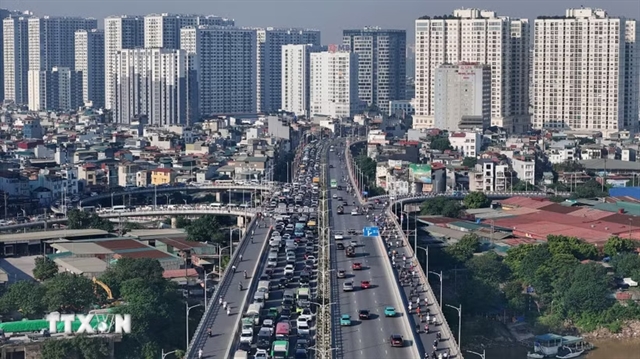 |
| Heavy traffic is putting pressure on Hà Nội’s transport infrastructure and environment. — VNA/VNS Photos |
HÀ NỘI — More than eight million vehicles registered in Hà Nội, plus about 1.2 million from other provinces and cities that regularly enter the capital, are putting mounting pressure on the city’s roads and environment.
Transport accounts for about 23 per cent of the capital’s PM2.5 pollution, according to government research, but secondary particles account for an even larger share at 27 per cent. Construction and road dust contribute another 20 per cent.
The data make clear that reducing vehicle emissions, while essential, cannot by itself solve Hà Nội’s air pollution problem.
Congestion and pollution
Hà Nội has about 1.1 million cars and more than 6.9 million motorbikes under its management, with the vehicle fleet growing by four to five per cent a year.
Transport infrastructure, meanwhile, has failed to keep pace.
Roads account for about 12.2 per cent of the city’s land area, while land for parking and other static transport facilities makes up only 0.65 per cent. Public transport meets just about 20 per cent of travel demand.
The resulting congestion has been identified as one of five major 'bottlenecks' Hà Nội plans to tackle in 2026, alongside flooding, environmental pollution, construction violations and food safety.
But congestion is only part of the problem.
Nguyễn Hoàng Ánh, deputy head of the Environmental Quality Management Division at the Ministry of Agriculture and Environment’s Environment Department, said monitoring data showed no clear improvement in air pollution in the Capital Region between 2022 and 2025.
PM2.5 remained the main concern, with average concentrations ranging from about 47 to 48 µg/Nm³ during 2023-2025.
Air quality exceeded national standards on about one-third of days each year, mainly during the pollution season from September to April.
Levels of other pollutants, including nitrogen dioxide, ozone, carbon monoxide and sulphur dioxide, were generally within permitted limits.
Research by the Ministry of Agriculture and Environment for 2023-2025 found that Hà Nội’s PM2.5 pollution came from a range of sources, both within the city and from neighbouring areas.
Transport contributed about 23 per cent, construction and road dust 20 per cent, industry 10 per cent and open burning, including waste and agricultural residues, 12 per cent.
Secondary particles formed from gaseous pollutants accounted for about 27 per cent, while other sources made up the remaining eight per cent.
The findings suggest that tackling traffic emissions alone would leave much of the pollution problem untouched.
Even with cleaner vehicles and reduced congestion, the capital will still have to deal with dust from construction and roads, industrial emissions, open burning and pollution drifting across provincial boundaries.
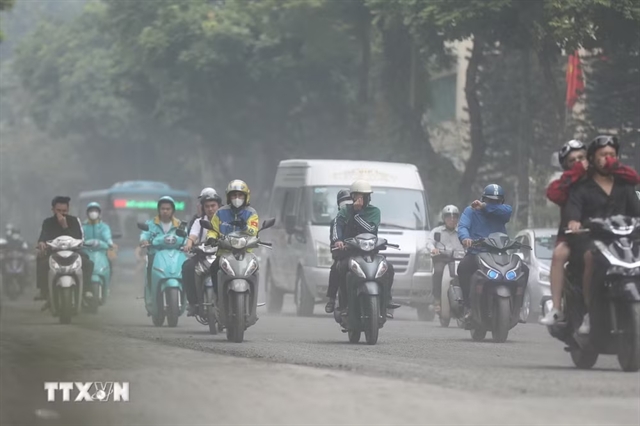 |
| High traffic volumes are making cuts in transport emissions an urgent priority for Hà Nội. |
A wider approach
The challenge was highlighted at a seminar in Hà Nội on September 9, where policymakers, scientists, health experts, businesses and social organisations discussed measures to improve air quality.
The event was part of the 'Act together for a blue sky 2026' campaign launched by the For Green Future Foundation, established by Vingroup.
Air pollution is not only a respiratory health concern but is also closely associated with cardiovascular disease, experts said.
Dr Lê Thái Hà, executive director of the foundation, said clean air should be viewed not simply as an environmental issue but as a factor affecting health, quality of life, productivity and sustainable economic development.
The national action plan on air pollution for 2026-2030, with a vision to 2045, aims to bring Hà Nội’s annual average PM2.5 concentration below 40 µg/m³ by 2030, a 20 per cent reduction from 2024.
Neighbouring provinces are expected to cut their annual average PM2.5 concentrations by at least 10 per cent over the same period.
The plan also calls for all public transport vehicles in Hà Nội and HCM City to switch to clean and environmentally friendly energy by 2030, while major industrial emission sources are to be placed under tighter control.
Hà Nội has already begun rolling out measures aimed at reducing transport emissions, including low-emission zones, cleaner vehicles, expanded public transport and tighter controls on high-emission vehicles.
But officials and experts acknowledge that these measures will have limited impact unless other sources of pollution are tackled at the same time.
That means controlling construction and road dust, reducing open burning, tightening industrial emission controls and improving co-operation with neighbouring provinces.
From traffic to urban order
Hà Nội’s approach is also increasingly linking congestion with wider questions of urban management and environmental quality.
At a meeting on September 10, the Hà Nội Police said the number of locations regularly affected by traffic jams had fallen from 12 to nine. Police were maintaining traffic control at 287 locations.
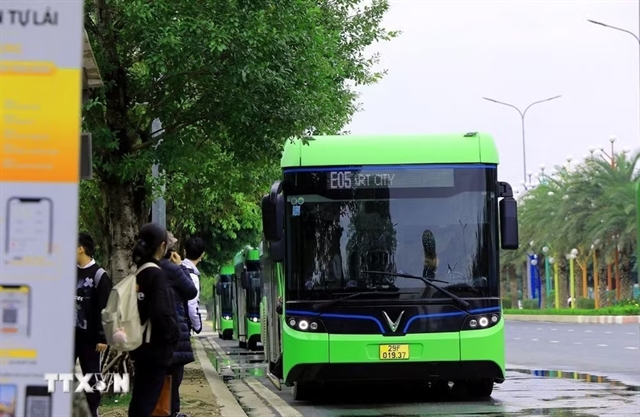 |
| Hà Nội is expanding its use of green transportation, introducing electric, CNG-powered buses and public bicycles to promote more environmentally friendly travel. |
During the reporting period, more than 41,000 traffic-order and safety violations were handled, with fines totalling more than VNĐ93 billion (US$3.58 million).
In a parallel effort to restore urban order, 19 wards had begun tackling problems at 34 locations, including pavement and roadway encroachment, illegal parking and other violations affecting the cityscape.
Lieutenant General Nguyễn Thanh Tùng, director of the Hà Nội Police, called for sustained enforcement combined with public awareness campaigns to improve compliance.
He also ordered stronger action against public-order violations, rubbish and waste dumping, while calling for power and telecommunications cables to be moved underground as part of efforts to upgrade infrastructure and improve the urban landscape.
The measures point to the growing overlap between traffic management and environmental concerns in the capital.
Keeping roads moving, clearing construction barriers, restoring pavements and dealing with rubbish can all affect the quality of the urban environment.
But the two problems are not interchangeable, Tùng said.
Reducing congestion and vehicle emissions can help improve air quality, but PM2.5 pollution will not fall substantially unless emissions from construction, industry, open burning and neighbouring areas are also brought under control.
For Hà Nội, the task is therefore broader than greening transport.
Meeting the 2030 PM2.5 target will require simultaneous action across transport, construction, industry, waste management and regional co-operation, with cleaner air, rather than smoother traffic alone, as the ultimate measure of success. — VNS
Society
 Society
 Society
 Society
 Society
 Society
 Society
 Society
 Society
 phát biểu tại buổi hội thảo.jpg) Society
Society
 Society
 Society
 Society
 Society
 Society