 Society
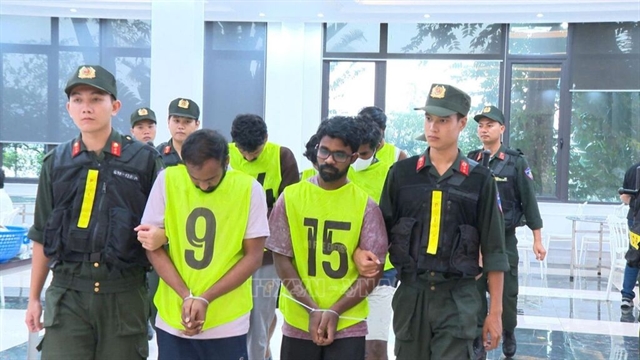
84 individuals investigated for transnational online frauds
1.

|
| Tourists stay at a five-star hotel in HCM City. —VNS Photo Thu Hằng |
HCM CITY — HCM City urgently needs supervisors, department heads, mid-level managers, general managers, and a pipeline of future leaders capable of managing hotels in an increasingly digital, international, and highly competitive environment, tourism officials said.
Advances in technology, data, and artificial intelligence (AI) are reshaping hotel operations and service delivery, said Võ Ngọc Điệp, head of the hotel management division under the HCM City Department of Tourism.
Beyond professional competencies, workers must improve digital skills, foreign language fluency, tech and AI integration, service-oriented mindsets, communication, and continuous learning habits, Điệp said at a conference on development of human resources in the hotel sector held on September 11.
The hotel industry faces a severe shortage of Vietnamese middle managers, supervisors, department heads, and general managers, as well as personnel proficient in foreign languages, digital tools, AI applications, revenue management, and online travel agency (OTA) operations, she said.
In the tourism value chain, the hotel sector represents the largest employment share and directly drives the average length of stay and visitor spending, she said.
She reported that the city currently boasts more than 4,809 accommodation establishments with around 106,000 rooms, employing 120,000 to 125,000 workers.
However, the quality of human resources remains inconsistent. Typically, around 36 per cent of workers are untrained or possess only elementary-level skills.
To reach the target of welcoming 20 million international visitors and 67 million domestic tourists by 2030, the city needs to expand its accommodation capacity to between 197,000 and 210,000 rooms, Điệp said.
The estimated demand for new recruits ranges from 23,000 to 38,000 workers annually, four to six times the current capacity of formal vocational training institutions, she said.
This gap presents both a major challenge and a valuable opportunity to revamp training models and elevate professional standards, she added.
Lê Trương Hiền Hòa, Deputy Director of the HCM City Department of Tourism, said that the city seeks to build a professional, high-quality hotel workforce equipped with technological mastery, strong management skills, and international integration capabilities to support HCM City’s growth strategy through 2030.
He emphasised that the high-quality workforce directly improves service quality, visitor experience, and the long-term competitiveness of HCM City.
The challenge lies not merely in worker quantity, but in occupational standards, practical skills, foreign language proficiency, technology adoption, management capacity, and adaptability, he added.
At the event, delegates discussed the future workforce requirements through 2030, ASEAN occupational standards, international training benchmark integration, labour market dynamics, the impact of AI and digital transformation, and policy mechanisms to nurture high-quality talent.
Last year, the city welcomed 8.5 million international visitors and 45 million domestic tourists, generating total tourism revenues of nearly VNĐ279 trillion (US$10.76 billion). — VNS
Society
 Society
 Society
 Society
 Society
 Society
 Society
 Society
 Society
 Society
 Society
 Society
 Society
 Society
 Society