 Society

ASEAN Digital Economy Framework Agreement to enable trusted, interoperable data flows
1.
|
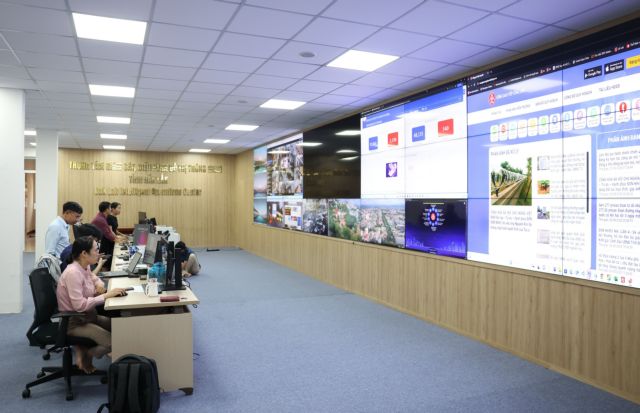
| Staff at the Smart City Operations and Monitoring Centre in the Central Highlands province of Đắk Lắk. — VNA/VNS Photo Tuấn Anh |
ĐẮK LẮK — The Central Highlands province of Đắk Lắk has identified digital transformation as one of the key drivers for reforming governance, improving the quality of public services, supporting businesses and creating new space for economic growth.
The province is gradually developing an integrated digital ecosystem tailored to its local characteristics and strengths, with the issuance of Plan No. 95 on digital transformation for 2026-30, alongside programmes to develop the digital economy and support small and medium-sized enterprises (SMEs).
In the economic sector, the province's digital transformation plan sets a target for the digital economy to account for 30 per cent of GRDP by 2030, with the digital economy making up at least 20 per cent of each industry and sector.
It also aims for 100 per cent of businesses to use e-invoices and more than 80 per cent of SMEs to use digital platforms.
To achieve these targets, the province is drafting a scheme on developing the provincial digital economy for 2026-30, with a vision to 2045.
Under the draft scheme, the digital economy is expected to account for 14 per cent of GRDP in 2026 and at least 30 per cent by 2030.
Notably, the localitiy does not view the digital economy as a standalone sector, but aims to integrate digital technologies across areas in which it has advantages, including agriculture, processing, e-commerce, logistics and tourism.
One proposed breakthrough initiative is the development of a “digital agricultural produce flow”, linking data from growing areas and production through processing, traceability, logistics and distribution to consumers.
By 2030, the province aims to ensure that 100 per cent of exported coffee and durian consignments have digital traceability records.
It also plans to establish an “agricultural produce data exchange” to standardise and systematically exploit data, supporting transactions, credit, insurance and market forecasting.
SMEs are also being placed at the heart of the digital transformation process.
Under the plan to implement the digital transformation scheme for SMEs in the province during 2026-30, the province aims in 2026 to ensure that 100 per cent of SMEs have access to information and communication materials on digital transformation; at least 30 per cent undergo surveys and assessments of their digital transformation readiness; and at least 20 per cent receive support to use at least one digital platform for production, business operations or corporate management.
Đắk Lắk also aims to organise at least three training courses and capacity-building programmes on digital skills for businesses.
It targets 100 per cent of SMEs using e-invoices in accordance with regulations, while at least 50 per cent use digital signatures, electronic contracts or digital payments in their production and business activities.
By 2030, at least 70 per cent of SMEs are expected to have access to and greater awareness of digital transformation, while at least 50 per cent are expected to apply digital platforms in management, production and business operations.
Notably, the province plans to provide digital transformation consultancy to at least 500 businesses, support at least 100 businesses in adopting emerging digital technologies such as artificial intelligence (AI), the Internet of Things (IoT) and big data, and develop at least 20 exemplary digitally transformed businesses in priority industries and sectors.
Simplifying administrative procedures
The province aims to build a “digital government operating on the basis of data and digital technologies, simplifying administrative procedures and providing high-quality public services, with people and businesses at the centre, as the subjects and driving forces of digital transformation.”
The province also aims to develop an effective and efficient digital government, make the digital economy an important driver of growth, and build a civilised, safe and inclusive digital society.
In developing digital government, the province has set specific targets for each stage.
By 2027, 100 per cent of eligible administrative procedures are expected to be available fully online.
All information, documents and paperwork required for administrative procedures related to production and business activities should be provided to State administrative agencies only once.
Notably, all essential fully online public services are expected to apply AI in at least one stage, including receiving and processing applications, assisting users or making automated decisions.
By 2030, the province aims for 99 per cent of people and businesses to report satisfaction with online public services, 50 per cent of essential online public services are to be delivered proactively, with AI providing personalised support, notifications or recommended actions based on key life events.
Additionally, the province is also seeking to narrow the digital divide and reduce the information gap, particularly in remote and isolated areas and communities with large ethnic minority populations.
By 2030, the province aims for at least 95 per cent of its population to possess information and communications technology skills; at least 70 per cent of the adult population to have a digital or personal electronic signature; and at least 95 per cent of people aged 15 and above to hold an account with a bank or another authorised institution.
In terms of infrastructure and access to information, the province aims for 5G mobile broadband networks to cover 99 per cent of the population.
At the same time, 100 per cent of residents are expected to have access to official information channels on digital platforms, while all households with an Internet connection are to have access to the national digital television platform.
These are considered important conditions for expanding people's access to information, digital services and the benefits of the digital environment, helping narrow the digital divide between different areas. — VNS
Society
.jpg) Society
Society
 Society
 Society
 Society
 Society
 Society
 Society
 Society
 Society
 Society
 Society
 Society
 Society
 Society