 Society
Students to compete in first national dance talent contest
1.
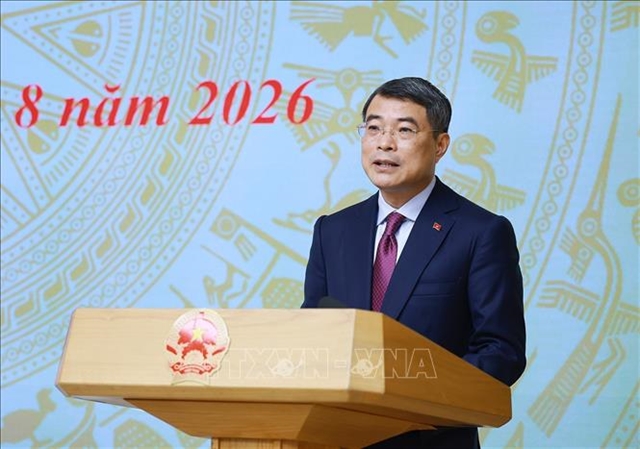 |
| Prime Minister Lê Minh Hưng speaks at the hybrid conference held Thursday between the Government headquarters and 34 provinces and cities to review the previous school year and assign tasks for the 2026-27 academic year. — VNA/VNS Photo |
HÀ NỘI — Prime Minister Lê Minh Hưng has said that the 2026-27 school year must bring breakthroughs, foster innovative thinking and drive substantive changes in education and training to help build a healthy and disciplined academic environment.
Speaking at a hybrid conference held Thursday between the Government headquarters and 34 provinces and cities to review the previous school year and assign tasks for the 2026-27 academic year, Hưng said education and training must move one step ahead to serve the transformation of the country's development model.
In his remarks, the PM noted that the 2025-26 school year marked the first year of carrying out Resolution 71-NQ/TW on breakthrough development in education and training.
He pointed to several shortcomings, including delays in carrying out action programmes and inadequate quality in policy and legal recommendations. In some areas, policies have not been carried out effectively, while enforcement capacity remains limited, he said.
Shortages of teachers, classrooms and equipment persist and require immediate attention, according to the PM.
Innovation, creativity and bold breakthroughs across the sector have yet to be strong enough, while internal reforms at some schools remain superficial. Teaching, learning and assessment continue to place too much emphasis on grades and examinations, and some aspects of textbook quality remain problematic.
PM Hưng also highlighted persistent issues, such as the pursuit of academic achievement, cheating, distorted forms of extra classes and tutoring, examination-related misconduct and financial burdens on families, all of which affect the sector's reputation.
Shortcomings also remain in moral education, life skills, physical and mental healthcare, school culture and safety. School violence, food safety violations and other inappropriate behaviour continue to occur. Workforce training, links between schools and businesses and alignment with the labour market remain inadequate, while scientific research has yet to translate strongly enough into technologies, products and added value.
Digital transformation, the development of databases and the application of science and technology have also progressed slowly, while coordination among schools, businesses, ministries, sectors and localities remains insufficient. Some local authorities have not yet given adequate attention to education, particularly in terms of staffing, facilities, equipment and education management personnel.
The PM urged ministries, sectors and localities to identify causes as well as responsibilities, and put forward solutions to address them immediately during the new school year and beyond.
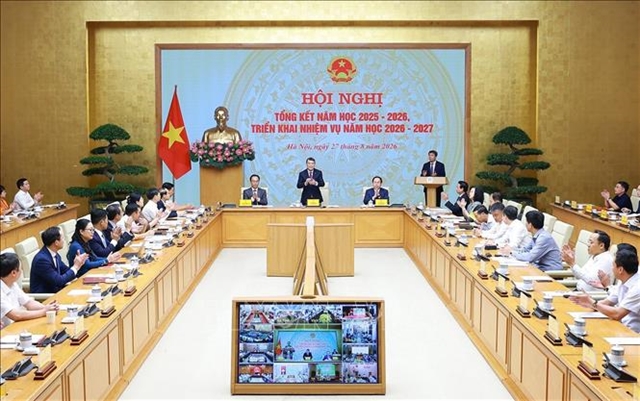 |
| PM Lê Minh Hưng said education and training must move one step ahead to serve the transformation of the country's development model. — VNA/VNS Photo |
He said the 2026-27 school year must mark a transition from focusing on institution-building to effective implementation; from administrative management to development-oriented governance; from counting tasks to measuring results; and from external reforms to substantive changes from within each school, classroom, teacher, learner and the education sector as a whole.
The Government leader called on ministries, agencies and localities to shift the focus from completing policies and institutions to carrying them out with clear, measurable outcomes, so that new education policies truly take effect in people's lives.
PM Hưng said bottlenecks must be removed and all available resources mobilised, with results measured by learners' progress, teachers' working conditions, school performance and the quality of personnel, while ensuring that no child is prevented from attending school because of difficult circumstances.
Authorities were also asked to address classroom and equipment shortages, as well as overcrowding in schools in urban areas and industrial zones. Education management personnel who have been reassigned to teaching should be used effectively. Preparations should also be completed to put multi-level boarding schools in border communes into operation, with mechanisms and guidance reviewed regularly to ensure efficient operation, particularly in mobilising resources and arranging staff and teachers.
The PM called for substantive reform from within the education sector and urged continued consultation with experts and localities and stronger reforms based on their recommendations. Curricula and school textbooks should be reviewed and shortcomings promptly addressed, he added.
He also called for reforms to assessment, firm action against the pursuit of academic achievement and cheating, and a review of requirements for records, paperwork and reports to eliminate documents not required by regulations. This would help reduce unnecessary administrative burdens on teachers and allow them to devote more time to their professional work.
The sector should strengthen education on national history, patriotism, ethics, lifestyles and life skills, as well as foreign languages, digital competency, STEM and the selective application of AI.
At the same time, schools must ensure security, safety and food safety and build a healthy educational environment. Regulations on preventing and combating school violence, child abuse and social ills, as well as protecting children online, must be strictly enforced. Food safety procedures should be reviewed comprehensively, with heads of agencies and units held accountable.
PM Hưng said vocational education must be closely linked with businesses and the labour market, adding that higher education institutions must become centres for talent development, scientific research, innovation and technology transfer.
Specific tasks and solutions were assigned to ministries, sectors and localities at the meeting.
The Ministry of Education and Training was asked to address recommendations raised by local authorities at the conference.
In coordination with the Ministry of Home Affairs and other ministries and localities, the education ministry was also tasked with clearly defining job positions across the education sector from central to local levels, and completing norms, standards and regulations for schools to accurately determine staffing needs.
Relevant agencies are to review and reorganise preschool, general, vocational and higher education institutions in line with Party and Government directions; improve the quality of higher and vocational education and workforce training in close connection with science and technology, innovation and labour-market needs; and accelerate digital transformation and AI applications.
The PM also requested thorough preparations for the 2026-27 opening ceremony and the inauguration of multi-level boarding schools in mainland border communes on September 5.
Agencies in the sector must develop specific plans and roadmaps to review and complete the general education curriculum and textbooks, reform high school graduation and university and college entrance examinations, improve higher and vocational education, and complete policies for teachers.
They must also review and finalise network planning for preschool, general, vocational, university and college education institutions, with proposals to be submitted to the PM this October.
The Ministry of Finance was tasked with reviewing and ensuring the appropriate proportion of State budget spending on education and training, prioritising urgent and key tasks such as school construction, semi-boarding and boarding education, digital infrastructure and support for disadvantaged learners.
Meanwhile, the Ministry of Home Affairs will continue working with the education ministry to finalise regulations on job positions and recommend staffing levels for the education sector.
The Ministry of Construction will coordinate with localities to review planning and ensure sufficient land for schools, particularly in urban areas, industrial zones, areas experiencing rapid population growth and border communes.
Specific measures will be taken by the Ministry of Health to strengthen school healthcare, physical and mental health services, and food safety inspections and supervision at educational institutions.
The Ministry of Public Security will coordinate with the education sector and relevant agencies on appropriate measures to manage the use of mobile phones and social media in schools, reduce risks and prevent harmful online content and school violence.
It will also work to prevent, detect and promptly address school violence, the sale and use of e-cigarettes and drugs, child abuse and other social ills in and around schools, while supporting the development and completion of education databases.
At the same time, the Ministry of Science and Technology will continue close coordination with the Ministry of Education and Training in carrying out Resolution 57, particularly the Central Steering Committee's 100-day plan.
For provinces and cities, the PM asked Party Committee secretaries and standing committee members to identify education and training as a key priority requiring regular attention, leadership and support.
Party Committee secretaries and People's Committee chairpersons should periodically meet with the education sector to listen to and address its recommendations and difficulties within their authority, he said. — VNS
Society
.jpg) Society
Society
 Society
 Society
 Society
 Society
 Society
 Society
 Society
 Society
 Society
 Society
 Society
 Society
 Society