.jpg) Society
Society
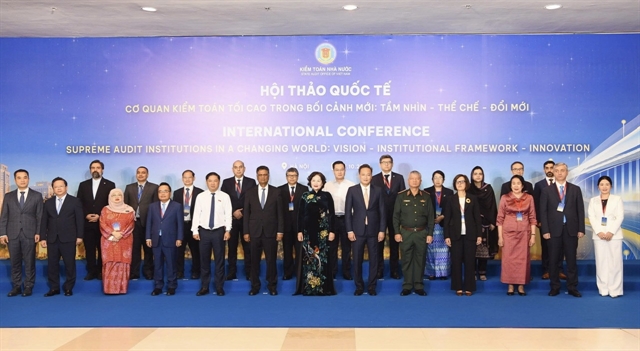
Việt Nam seeks to modernise state audit amid emerging challenges
1.
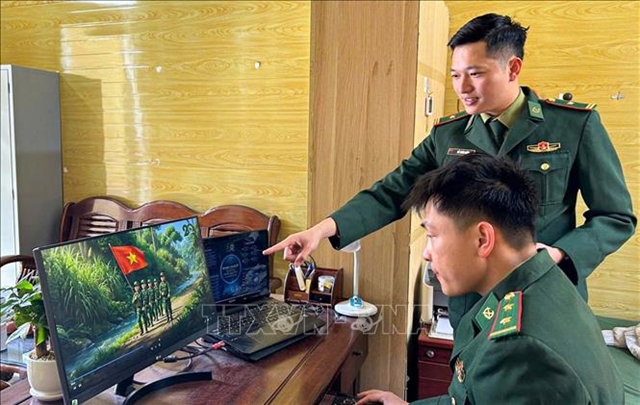 |
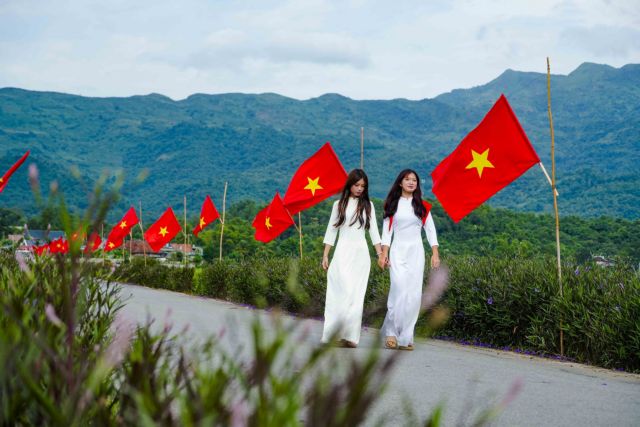
| The Nậm Nhừ Border Guard in Điện Biên Province is working on AI-powered video to promote digital transformation among local residents. Digital society, technology and digital infrastructure will promote the nation’s development. — VNA/VNS Photo Phan Quân |
HÀ NỘI — At a digital transformation workshop held in Hà Nội on Wednesday, experts and scholars proposed solutions to transform the nation’s traditional values into tangible resources for national development amid the digitalisation of sectors across the country.
The workshop titled 'Promoting the fine traditions of the nation in the context of digital transformation: Theoretical and practical perspectives' was organised by the Institute of Anthropology and Religious Studies (IARS) under the Việt Nam Academy of Social Sciences (VASS).
In his opening address, VASS President Professor Lê Văn Lợi said that digital transformation has brought new opportunities for traditional values to be connected with social governance, economic development, tourism and services, cultural industries, healthcare, education, media, international integration, national defence and security, and many other fields.
This, in turn, contributes to transforming cultural, social and human values into resources serving national development. But alongside these major opportunities, the digital transformation is also raising numerous new issues, he said.
These include the risk of erosion or alteration of traditional values during increasingly intense cultural exchange, integration and acculturation and the impact of multi-directional information in the digital environment. Development gaps between social groups and regions in terms of access to and use of technology are another challenge.
In response to these problems, VASS assigned IARS to lead a ministerial-level programme on science, technology and innovation entitled 'Promoting the fine traditions of the nation in the context of digital transformation in Việt Nam today'.
The programme aims to further clarify the theoretical and practical issues arising in promoting the nation’s traditions to serve national development amid the digital transformation.
Lợi expressed his hope that experts and scholars would focus on in-depth exchanges and discussions and raise issues of high academic value with practical applications, particularly those issues still subject to differing interpretations, research gaps and new questions that the programme needs to address.
IARS Deputy Director Bùi Thị Bích Lan said that amid the digital transformation, national traditions are seen as forms of input capital, comprising personnel and traditional culture, society and knowledge.
With a variety of tools and the participation of the State, enterprises, communities, scholars and individuals, these capital resources are identified, selected, preserved and digitised, helping transform them into resources serving national development.
Lan said achievements in this area have exerted a feedback effect, contributing to the regeneration, supplementation and enrichment of the nation’s traditions.
The entire process is unfolding under the influence of the digital transformation, encompassing institutions and policies, technology and digital capacity, culture, economy, society and infrastructure.
This context has created both opportunities and challenges in promoting and transforming Việt Nam's traditions into endogenous resources for national growth, she said.
Nguyễn Thế Trung, member of the National Advisory Council on the Development of Science, Technology, Innovation and Digital Transformation, observed that the promotion of traditions must be assessed on a five-level scale from expression and visibility to transmission, practice and social outcomes.
Historical resources such as the capacity for integration, the aspiration for peace, benevolence and righteousness, the love of learning, and solidarity will only contribute to shaping the future when they are converted into contemporary capabilities, organisational principles and concrete results.
This calls for three further research directions: testing and carrying out a dual set of criteria for heritage items already covered by broad digitisation programmes, empirically surveying the diversity of Vietnamese cultural content that users encounter on popular platforms and analysing the degree of representation of local variants in the training data for Vietnamese language models.
At the workshop, experts focused on several key topics, including clarifying conceptual substance, proposing analytical frameworks and identifying priority approaches and research methods.
They also discussed recognising and determining approaches to promoting the nation’s traditions under modern conditions and identifying the opportunities and challenges that digital transformation poses for this task.
Through these efforts, the workshop helped clarify theoretical and practical issues in promoting national traditions as a resource for sustainable development. — VNS
Society
 Society
 Society
 Society
 Society
 Society
 Society
 Society
 Society
 Society
 Society
 Society
 Society
 Society
 Society