 Politics & Law
VN-Index down slightly due to lingering selling pressure
1.
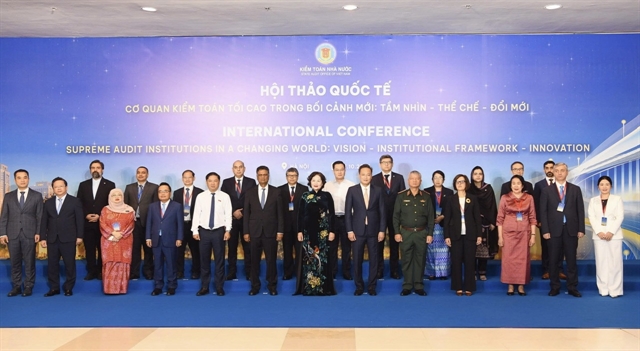 |
| Delegates at the international conference themed “Supreme Audit Institutions in a Changing World: Vision – Institutional Framework – Innovation” in Hà Nội on October 27. — Photo from the Việt Nam State Audit |
HÀ NỘI — The State Audit Office of Vietnam (SAV) must reform its mindset, perfect the institutional framework, adopt advanced technologies and strengthen its workforce to meet emerging challenges in public auditing, National Assembly (NA) Vice President Nguyễn Thị Hồng said on Tuesday.
She was speaking at an international conference themed “Supreme Audit Institutions in a Changing World: Vision – Institutional Framework – Innovation”. The Hà Nội event was attended by representatives of supreme audit institutions (SAIs), policymakers, experts and scholars.
Hồng said that over more than three decades, the SAV has strengthened its role in auditing and overseeing the management and use of public finances and assets, contributing to financial discipline, anti-corruption efforts and more transparent and effective governance.
Embracing technology
Public auditing worldwide has moved beyond traditional financial compliance checks to support macroeconomic policymaking, provide early warnings of systemic risks and improve public value, she said.
Artificial intelligence (AI), big data analytics, geographic information systems, satellite imagery and real-time auditing are reshaping audit methods. Meanwhile, digital assets, national databases, green finance, green bonds and climate change response programmes are creating new demands for SAIs.
The NA Vice President said 2026 is a significant year for the SAV as it develops its strategy through 2035, with a vision to 2045, and reviews the State Audit Law for possible amendments.
This presents an important opportunity to draw on international experience and good practices to improve the institutional framework, strengthen the effectiveness of audit recommendations, accelerate digital transformation and expand auditing into new areas such as green finance, the environment, cybersecurity, public data and sustainable development, Hồng said.
In a video message, Mohamed el-Faisal Youssef, President of Egypt’s Accountability State Authority and Chair of the International Organisation of Supreme Audit Institutions (INTOSAI), stressed that effective public auditing depends on institutional independence, clear legal mandates, access to information and mechanisms to monitor the implementation of audit recommendations.
As public decisions grow more complex and risks become increasingly interconnected, SAIs must move beyond detecting irregularities to identify root causes, analyse emerging trends and issue early warnings to protect public resources and improve policy implementation, he said.
Anticipating emerging risks
K. Sanjay Murthy, Comptroller and Auditor General of India and Chair of the Asian Organisation of Supreme Audit Institutions (ASOSAI), said next-generation auditing should help governments identify risks as they emerge, rather than merely explain past failures.
No SAIs could fully prepare for future challenges alone as public debt, climate change and digital transformation transcend national borders. Cooperation, mutual learning and experience-sharing are therefore essential to strengthening their institutional capacity and public accountability worldwide, he added.
SAV Auditor General Nguyễn Hữu Nghĩa described the conference as a forum for SAI leaders, authorities and experts to discuss challenges arising from digital transformation, AI and big data and work out solutions.
He said SAIs need to adapt their missions, working methods and operational structures to changing circumstances and rising public expectations, while reinforcing their legal status, independence, transparency and accountability and improving the management of public resources.
After 32 years of development, the SAV, a constitutional body established by the National Assembly, has contributed substantially to Việt Nam's development. It is pursuing comprehensive reforms to its legal framework, organisational structure and operations, he noted.
Nghĩa reaffirmed Việt Nam's commitment to contributing actively to INTOSAI, ASOSAI and the ASEAN Supreme Audit Institutions (ASEANSAI), and working with partners to build a professional, transparent and effective audit community in support of sustainable development. — VNA/VNS
Politics & Law
 Politics & Law
 Politics & Law
 Politics & Law
 Politics & Law
 Politics & Law
 Politics & Law
 Politics & Law
 Politics & Law
 Politics & Law
 Politics & Law
 Politics & Law
 Politics & Law
 Politics & Law
 Politics & Law