 Society
NA President meets leaders of international audit organisations
1.
|
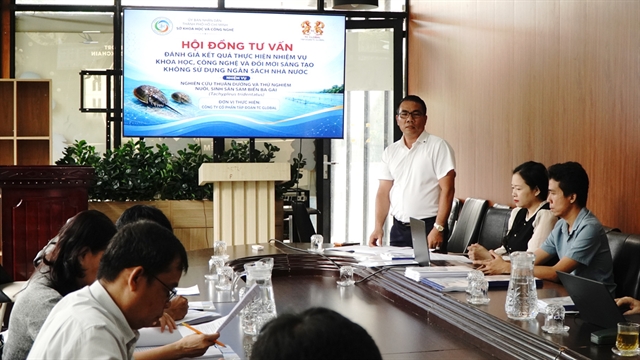
| An overview of the meeting announcing the three-spined horseshoe crabs breeding programme. |
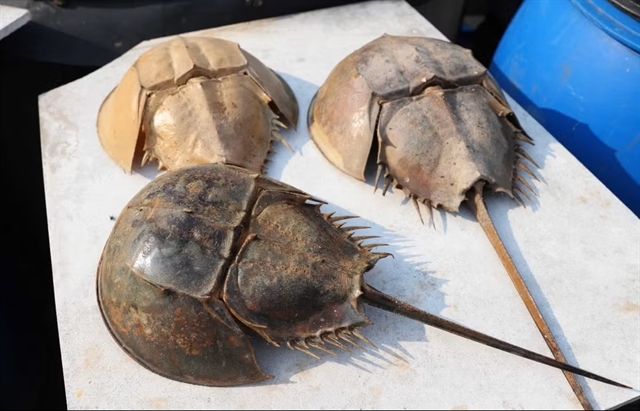
HCM CITY — A HCM City-based company has successfully domesticated and bred three-spined horseshoe crabs (Tachypleus tridentatus) in captivity, producing 2,388 healthy juveniles.
The achievement is expected to contribute to genetic resource conservation, large-scale breeding programmes and research into marine biotechnology applications.
The announcement was made at a council to evaluate the results of a science, technology and innovation project funded without State budget support, convened by the Hồ Chí Minh City Department of Science and Technology.
The evaluation, titled Research into the domestication and Experimental Breeding and Reproduction of the Three-Spined Horseshoe Crab (Tachypleus tridentatus), was conducted at the request of the project’s lead organisation, TC Global Group Joint Stock Company.
At the event, Mai Như Trinh, a representative of TC Global Group Joint Stock Company, said the project aims to study the domestication and experimental breeding and reproduction of three-spined horseshoe crabs under conditions suitable for Việt Nam.
The findings are expected to provide a scientific basis for genetic resource conservation and the development of breeding stock, while laying the groundwork for further research and applications of marine biotechnology, he added.
The project involved scientific experiments combined with biological descriptive research, technical fluctuation analysis and testing of technological processes under controlled artificial (indoor RAS) and semi-natural conditions.
According to the report, the company implemented an intensive experimental farming model at three facilities in Bình Tân, Long Sơn and Cần Giờ.
It successfully produced 2,388 healthy, uniform juvenile horseshoe crabs meeting commercial quality standards for release. The technology enables 100 per cent control of artificial rearing conditions, eliminating dependence on natural breeding seasons and mitigating the risks associated with degradation of tidal-flat environments.
|
| Việt Nam has successfully bred three-spined horseshoe crabs in captivity. — VNA/VNS Photo |
The company also effectively controls fungal infections in embryos and moulting-related shell entrapment syndrome through an optimised trace-mineral buffer system. Survival and growth rates were significantly higher than those recorded in traditional extensive farming models.
The project results demonstrate the potential to supply breeding stock on a large scale for national marine resource restoration programmes, while laying the groundwork for the extraction of horseshoe crab blue blood to produce Tachypleus Amebocyte Lysate (TAL), a reagent used in biomedical and pharmaceutical testing and with particularly high economic value.
The initiative could help reduce pressure on wild horseshoe crab populations, which are classified as Endangered (EN) by the IUCN, contribute to the conservation of coastal biodiversity in Việt Nam and create high-skilled jobs for local workers at coastal facilities. — VNS
Society
 Society
.jpg) Society
Society
 Society
 Society
 Society
 Society
 Society
 Society
 Society
 Society
 Society
 Society
 Society
 Society