 Society
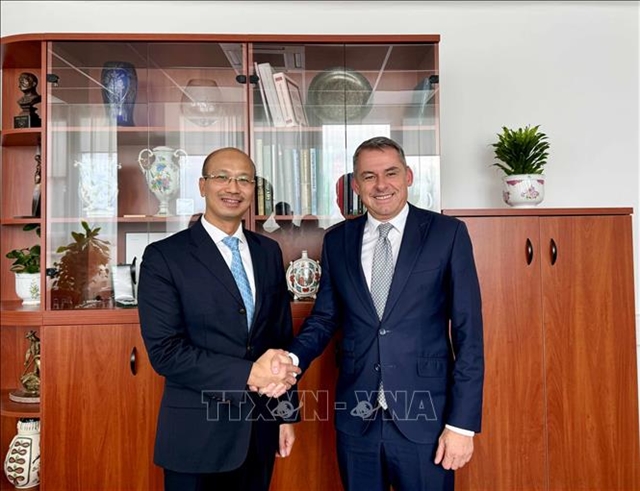
Việt Nam, Switzerland to turn education, sci-tech, innovation into cooperation focus
1.
|
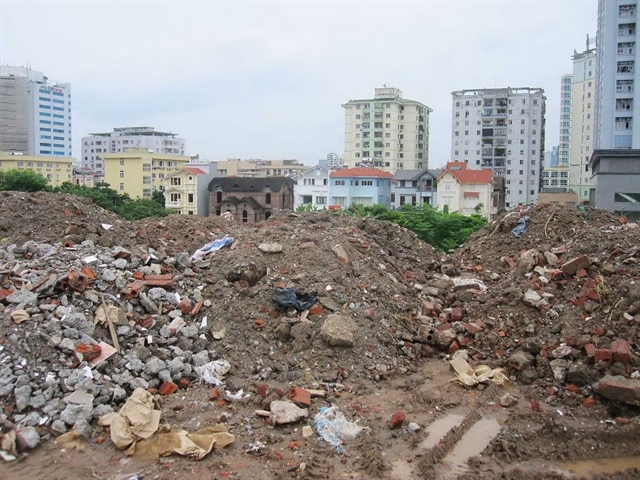
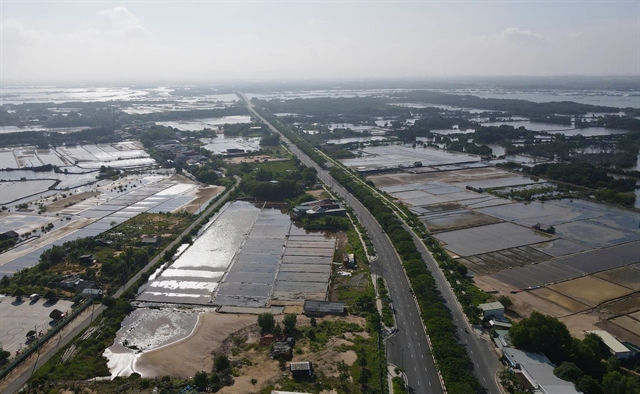
| HCM City is tightening regulations on construction debris and dredging sludge to achieve sustainable green growth. — Photo racthaicongnghiep.vn |
HCM CITY — HCM City is accelerating its transition to become a smart, multi-centre megacity by 2030, balancing a multi-billion-dollar digital infrastructure drive with stringent new environmental regulations to ensure sustainable growth.
Under a newly approved master plan, the southern economic engine is shifting from traditional growth drivers to a model heavily anchored in science, technology, and regional integration.
To secure its position as a leading financial and technological hub in Southeast Asia, it is channelling major investments into data centres, viewed by the government as the indispensable backbone of digital infrastructure.
Chief among these is a memorandum of understanding between the city Department of Science and Technology and the leading international infrastructure investment firm Accelerated Infrastructure Capital to construct a US$2.1 billion AI data centre.
The city has also approved two other massive facilities: the $508.78-million Singapore-backed Evolution DC VN HCMC and the STARMASON hyperscale data centre complex costing $480.26 million.
Domestic tech capabilities are also scaling up.
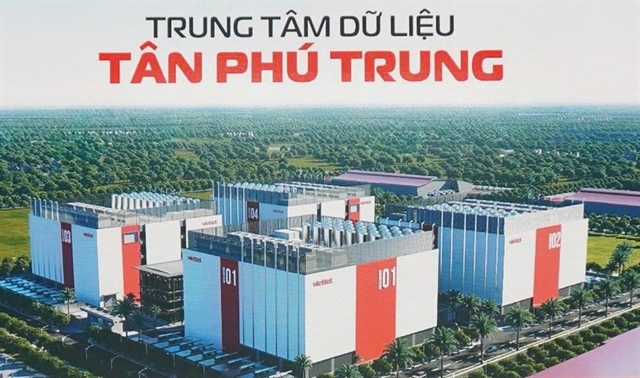
Viettel Group is preparing to launch its high-tech data centre and R&D centre in the Tân Phú Trung Industrial Park. With a capacity of 140 megawatts and 10,000 server racks, the facility is designed to support high-performance computing required for advanced AI applications.
According to Trần Quý, director of the Việt Nam Institute for Digital Economy, 2026 marks a crucial milestone as the city enters a new planning cycle, targeting double-digit economic growth.
"As traditional growth drivers reach their limits, transitioning to an innovation-driven model based on science and technology has become a strategic necessity for the city to maintain its position as Việt Nam's leading economic centre," Quý said.
In 2026, the city expects the digital economy to contribute 18.5 per cent to its economy, with digital adoption across key industries expected to reach at least 13.4 per cent.
The 2030 vision relies heavily on spatial restructuring rather than isolated development.
The city is establishing a multi-centre urban structure, highlighted by the upcoming Northern Hồ Chí Minh City Science and Technology Urban Area in Bình Dương Ward.
|
| Viettel's high-tech facility at the Tân Phú Trung Data Centre project in the Tân Phú Trung Industrial Park in HCM City. The megacity is scaling up its digital infrastructure to power its AI and smart urban integration ambitions by 2030. — Photo courtesy of Viettel |
Bùi Minh Thạnh, vice chairman of the city People’s Committee, said the project would create a vital new growth pole.
The development of this urban area would also provide additional capacity to redistribute urban, industrial, and logistics functions away from the city core, he said.
“This is an important condition for the city to develop into a multi-centre megacity, reduce pressure on the urban core, and improve the efficiency of land use and infrastructure."
Nguyễn Văn Phước, chairman of the HCM City Union of Science and Technology Associations, said the 2026-30 period was going to be pivotal.
"If implemented well, the city can establish a three-pillar structure consisting of an innovation centre, a smart industrial hub, and a modern marine economy.”
"Over the longer term, the city aims to become a smart, green megacity that is resilient to climate change and highly competitive internationally," he added.
Improving construction waste management
As massive urban expansion projects get underway, city leaders are simultaneously addressing environmental challenges caused by construction debris and canal dredging.
Following a meeting convened by vice chairmen Hoàng Nguyên Dinh and Bùi Minh Thạnh, the People’s Committee said the management of solid construction waste and dredging sludge is fragmented, impacting the progress of key infrastructure projects like the Rạch Xuyên Tâm canal restoration.
To resolve this, the city has directed its Department of Construction to study Hà Nội’s successful models for recycling solid construction waste into materials suitable for land levelling.
A unified system to inspect, monitor, and approve the disposal of construction waste is being co-developed by the departments of construction, natural resources and environment, and planning and architecture and the police.
In the interim, temporary guidelines will be issued to assist contractors and local authorities with safe waste classification.
All relevant city agencies and local authorities have been given a strict deadline of July 30, 2026, to finalise these regulatory frameworks, ensuring the city's high-tech future is built on a sustainable, circular economy foundation. — VNS
Society
 Society
 Society
 Society
 Society
 Society
 Society
 Society
.jpg) Society
Society
 Society
 Society
 Society
 Society
 Society
.jpg) Society
Society