 Society

Việt Nam, Switzerland to turn education, sci-tech, innovation into cooperation focus
1.
|
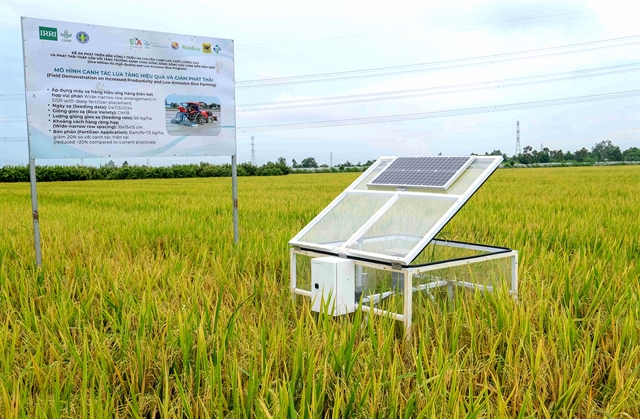
| A solar-powered environmental monitoring system operates in a rice field at New Green Farm Co-operative in Thuận Hưng Ward, Cần Thơ City. — VNA/VNS Photo |
CẦN THƠ — Cần Thơ has approved new support measures for co-operatives, providing funding for training, digital transformation and trade promotion to strengthen the collective economy.
The city People's Council has issued Resolution No. 22, which took effect on July 10, setting specific funding levels to support the development of co-operative groups, co-operatives and co-operative unions.
The resolution also supports workforce development by fully funding training programmes and providing wage support for up to two employees at eligible collective economic organisations for up to 36 months.
The Cửu Long (Mekong) Delta city will also fully fund a wide range of trade promotion activities.
These include participation in domestic and international trade fairs and exhibitions, leasing venues to showcase products, registering quality certifications, protecting brands and developing e-commerce trading platforms.
Consultancy services, science and technology applications, digital transformation, financial advisory services and risk assessments will also receive full funding.
The city People's Committee estimates that implementing the policy will require about VNĐ36.5 billion (US$1.39 million) during 2026–30.
Trần Chí Hùng, Deputy Chairman of the city People's Committee, said support policies in 2021–25 had helped improve the performance of the collective economy.
However, many co-operative groups and co-operatives still faced challenges because of their small scale, limited capital, outdated facilities, inadequate management capacity and difficulty accessing credit, he said.
Against this backdrop, issuing new regulations on support funding was essential to implement the 2023 Law on Co-operatives and Government Decree No. 113, which provides detailed guidance on implementing the law, he said.
"The regulations will also create a legal framework and provide adequate resources to promote the sustainable development of the collective economy," he said.
Co-operative expansion
During the first half of this year, Cần Thơ established 24 new co-operatives, bringing the city’s total to 897 co-operatives and nine co-operative unions with more than 51,200 members.
The city's collective economy has not only expanded in scale but also steadily improved in operational quality.
It is increasingly serving as an important link between production and the market, helping raise the value of agricultural products and increase local people's incomes.
Many have adopted new operating models, applied science and technology and worked with businesses to build value chains from production to marketing.
One successful example is the New Model Development Agricultural Co-operative in Long Phú Commune, which has 57 members farming more than 123ha of rice.
The co-operative has established a value chain covering agricultural input supplies, technical support and guaranteed product purchases.
During the first half of the year, it partnered with two companies to produce rice. The partnership enabled its members to sell paddy at prices VNĐ200–700 per kilogramme higher than market rates.
|
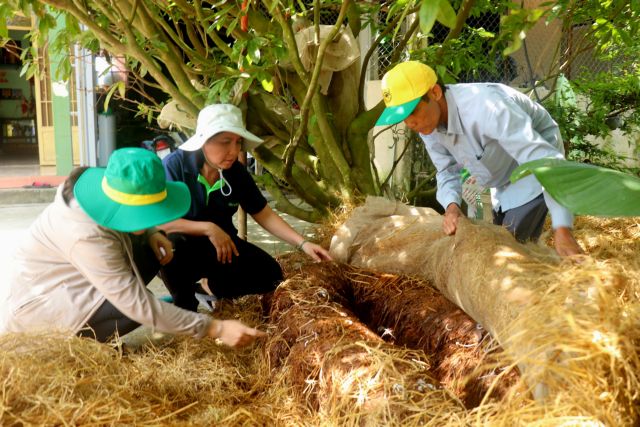
| Members of Thuận Tiến Co-operative in Thuận Quới Ward use rice straw from low-emission rice fields to grow straw mushrooms, helping increase incomes while reducing emissions. — VNA/VNS Photo |
To strengthen the collective economy at the grassroots level, the city Farmers' Association has expanded the development of occupational farmers' groups and associations.
These groups and associations are gathering places for farmers engaged in the same occupation. Through them, members share experiences, gain access to preferential loans, receive scientific and technical support, and build agricultural value chains.
Phạm Thanh Hoài, deputy chairman of the city Farmers' Association, said: “Occupational farmers' groups and associations have renewed the association's activities by better meeting members' practical needs.
“They also help develop the collective economy and support the city's goal of building a modern, sustainable agricultural sector,” he said.
Digital transformation
Under its digital economy development plan in 2026–30, Cần Thơ aims for the digital economy to account for at least 20 per cent of the agriculture and environment sectors by 2030.
At least 50 per cent of farms and agricultural co-operatives are expected to use digital platforms for management and operations.
It will also promote technologies such as the Internet of Things (IoT), artificial intelligence (AI), big data, product traceability and e-commerce to improve production efficiency and expand agricultural markets.
Products under the country’s “One Commune – One Product” (OCOP) programme will be prioritised for development to increase the value of agricultural products.
The city currently has 903 OCOP products from 454 producers. These include four five-star products, 242 four-star products and 657 three-star products.
The city is encouraging co-operatives, co-operative groups and businesses to join the OCOP programme, with priority given to processed and deeply processed products as well as products from traditional craft villages.
It strives to have at least 103 additional OCOP products recognised with three stars or above this year.
It also aims to gain recognition for two additional tourism-related OCOP products. — VNS
Society
 Society
 Society
 Society
 Society
 Society
 Society
 Society
 Society
 Society
.jpg) Society
Society
 Society
 Society
 Society
 Society