 Society

Sovico signs cooperation agreement with Hamburg, eyes transport and infrastructure projects
1.
|
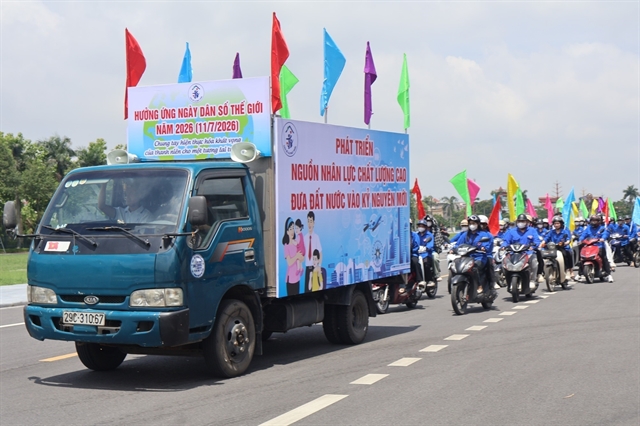
| Youth union members, young people and students took part in a parade along the streets to spread messages about population work in the new era. — VNA/VNS Photo Hạnh Quyên |
HƯNG YÊN — Việt Nam is confronting challenges that threaten the country’s sustainable development, as a prolonged trend of low fertility would directly and profoundly affect population size and structure, risking future labour shortages, population decline, accelerated population ageing and increased migration flows.
The Ministry of Health (MoH) highlighted the message at a rally and parade to mark World Population Day on July 11, held on Friday morning in Hưng Yên Province.
Held by the MoH in collaboration with the United Nations Population Fund (UNFPA) in Việt Nam and the Hưng Yên People’s Committee, the event is taking place against a backdrop of deep global upheavals in the economic, social and environmental spheres, as well as in science, technology and demography.
UNFPA has put the focus on young people, the largest population cohort and a key driving force for societal development.
The theme of World Population Day 2026 is 'Working together to realise young people’s aspirations for a brighter future'.
Deputy Minister of Health Đỗ Xuân Tuyên said that the young generation of today enjoys better health and education and is increasingly equipped with the knowledge and skills needed to contribute to national development.
Nevertheless, many young people still face significant barriers in accessing education, employment, healthcare and digital technologies. In many countries, these challenges are compounded by conflict, political instability, food insecurity and environmental impacts.
Enabling young people to fulfil their potential, make their own choices and participate fully in social life – and ensuring equal, non‑discriminatory access to sexual and reproductive health services – are therefore crucial for countries to harness demographic potential and secure rapid, sustainable development in the future.
In Việt Nam, nearly 70 million people are aged 15–64, representing a major opportunity to usher the country into a new era of national advancement. However, alongside this opportunity come substantial challenges for population and development work, particularly concerning young people.
These include the rising trends of marrying later and bearing fewer children — or remaining childless — among young people in many localities.
The average age at first marriage in Việt Nam has risen rapidly in recent years. Later marriage leads to later childbearing and fewer children, and even to childlessness, thus reducing the fertility rate. If prolonged, a low fertility rate would have a massive effect on the country's population and, ultimately, its economy.
“Việt Nam’s sex ratio at birth has remained high for many years, exceeding the natural balance (104–106 boys per 100 girls). This could disrupt family structures: some young men may marry late or remain unmarried, and there may be increases in trafficking of women and girls, prostitution, gender‑based violence and transnational crime,” Tuyên said.
The nation is also ageing rapidly. While in 2024 there were two children for every older person, projections indicate that in 50 years’ time there will be two children for every four older people. Lower fertility among young people accelerates population ageing.
Without appropriate solutions, the future working‑age population will shrink, the burden of social welfare and elderly care will grow, and economic and social development pressures on today’s younger generation will increase.
Investing in youth
United Nations Resident Coordinator in Việt Nam Pauline Tamesis explained that demographic changes are profoundly affecting each country’s development.
As population size, age structure and distribution change, sectors such as employment, health, education, social protection and intergenerational relations also shift. Focusing solely on numbers can miss the most important element: the lives, choices and aspirations of individual people.
Tamesis said: “Population does not determine a country’s future on its own. When young people receive education, secure suitable employment, have stable living conditions, access healthcare and share family responsibilities fairly, they have the foundation to build the lives and families they want.
"Conversely, if these conditions are lacking, young people’s aspirations are unlikely to be realised, and society will struggle to achieve sustainable development."
Việt Nam is at a crucial point in its demographic transition. The country has a large youth population enjoying better education, wider connectivity and deeper global integration, while also experiencing rapid population ageing; the current demographic dividend will not last indefinitely. Decisions made today will therefore have great significance for the future.
The UN resident coordinator commended the Government of Việt Nam, particularly the MoH and the Việt Nam Population Authority, for their efforts to promote population and development policies grounded in rights and choice.
This is evident in the development of the National Target Programme on Population and Development as well as the Population Law. Recent policy changes indicate that individuals and couples should be supported in making free, informed decisions about their reproductive health and lives.
Tamesis noted that investing in young people cannot be the responsibility of a single ministry, sector or field.
"It is a collective responsibility of the whole system and society," she said.
"Young people’s aspirations are not confined to one area; they are linked to opportunities for education, employment, health, housing, social protection, gender equality and community participation. Youth policies should therefore be coordinated and carried out coherently, rather than being fragmented by sector."
Tuyên called on ministries, agencies and members of the National Steering Committee and local People’s Committees to continue their leadership and attention, ensure resources for population work and instil the core contents of the Population Law to transform the awareness of cadres, Party members and the public in carrying out population and development policies.
Immediately after the rally, youth and students took part in a parade along the streets to mark World Population Day 2026, carrying themes and messages about population work in the new era, especially the role and responsibilities of young people towards themselves, their families and the country’s sustainable development. — VNS
Society
 Society
 Society
 Society
 Society
 Society
 Society
 Society
 Society
 Society
 Society
 Society
 Society
 Society
 Society