 Society
Việt Nam seeks solutions to AI challenges in education through international cooperation
1.
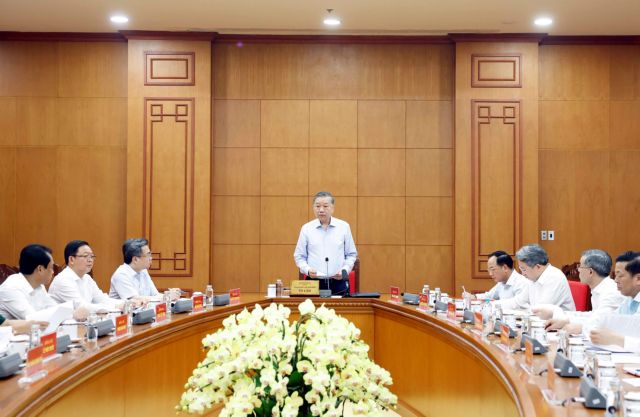 |
| Party General Secretary and State President Tô Lâm speaks at the meeting. VNA/VNS Photo |
HÀ NỘI — Party General Secretary and State President Tô Lâm ordered a systemic shift from reactive disaster response to proactive risk management at a Monday meeting in Hà Nội, directing the Government Party Committee and agencies to brace for storms, floods, extreme weather and climate change through late 2026.
Disaster prevention must be woven into national development planning, public investment, production, business, investment attraction, social welfare and livelihood protection, he stressed.
He said the approach must shift from mopping up after disasters to preempting risks early and from afar, from seasonal reaction to year-round readiness, and from experience-based management to data-driven governance anchored in sci-tech, law, planning discipline and leadership accountability.
Protecting human life is the highest priority and the foremost command, he said, adding that every contingency plan, operational decision and resource must first and foremost be directed toward safeguarding the public, particularly the elderly, children, pregnant women, the disabled, the sick, poor households, those living alone and in high-risk zones.
Through the year-end, he instructed agencies to carry out a full review and update of all 2026 disaster response scenarios, customising them to specific regions, river basins, infrastructure categories and vulnerable groups.
He also ordered proactive preparations for drought, water shortages and saltwater intrusion in the 2026–27 dry season. The south central coast, Central Highlands and Mekong Delta regions were told to pre-plan crops, boost water storage, regulate reservoirs, secure water supplies, prevent forest fires; protect crops, livestock, aquaculture and fruit output; support livelihoods, and ensure clean water access in all conditions. Steps should also shield production, critical infrastructure and local economic growth targets.
The Government Party Committee was tasked with turning the meeting’s conclusions into a detailed action plan through late 2026, with clearly defined responsibilities for ministries and agencies, deadlines, resource allocations and monitoring mechanisms.
Municipal and provincial authorities, he said, must assume direct responsibility for disaster management in their mandates. Provincial Party secretaries and People’s Committee chairpersons were required to personally supervise high-risk zones, while commune-level officials must keep accurate, real-time data on local populations, terrain and hazards, not just filing general reports.
The Việt Nam Fatherland Front and mass organisations must uphold their role in mass mobilisation, oversight and community support, pooling local volunteers for prevention, emergency response and recovery, and ensuring aid is delivered transparently and reaches the right recipients, he added.
Looking to 2026–2030, the top leader stressed the imperative to overhaul the legal framework, calling for a review and amendment of laws and regulations on disaster prevention, civil defence, water resources, irrigation, dyke management, hydrometeorology, planning, public investment, state budget, insurance, search and rescue, and the mobilisation of personnel and assets.
He also called for the rapid drafting, approval and rollout of the national disaster prevention and control plan for 2026–2030, to be aligned with the national disaster prevention strategy to 2030 with a vision to 2050, the master plan on disaster prevention and irrigation for 2021–2030 with a vision to 2050, and related river basin, urban, rural, transport, energy, land-use and construction blueprints. — VNA/VNS
Society
 Society
 Society
 Society
 Society
 Society
 Society
 Society
 Society
 Society
 Society
 Society
 Society
 Society
 Society