 Society
Int’l cooperation helps address nuclear power workforce shortages
1.
|
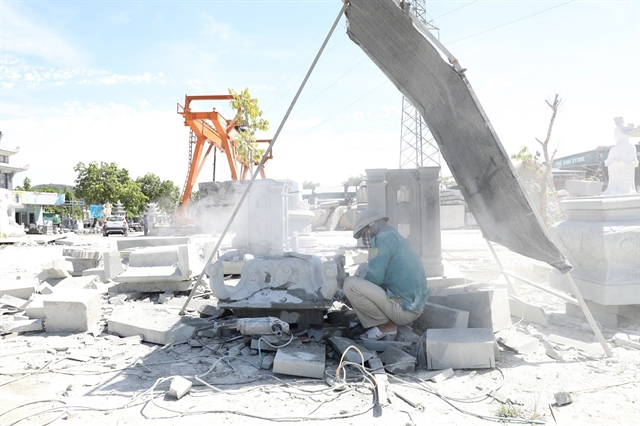
| A worker at the Ninh Vân stone carving village in Ninh Bình Province labour under scorching heat. — VNA/VNS Photo Đức Phương |
HÀ NỘI — Extreme heat is increasingly emerging as a new social protection risk, triggering income loss, medical expenses and chronic health issues for outdoor workers.
However, significant gaps remain in the implementation of policies designed to protect vulnerable groups, particularly outdoor workers, experts have warned.
Strengthening social protection is essential to ensure that no one is left behind, they said.
Heatwaves are becoming more frequent, prolonged and severe.
In northern mountainous and midland regions, as well as in Hà Nội, temperatures have recently ranged from 35 to 38 degrees Celcius.
More alarmingly, the perceived temperature in urban areas has at times reached a record 50 degrees Celcius. Under such sweltering conditions, the health and livelihoods of millions of outdoor workers are under serious threat.
A recent study titled 'Adaptive Social Protection for Workers Exposed to Extreme Heat', conducted by the Institute for Sustainable Development under the National Economics University in collaboration with the United Nations Development Programme (UNDP) in Việt Nam, identified major policy gaps in protecting vulnerable groups and warned of what it described as an entirely new social protection risk.
Double burden
An analysis of data collected from 156 meteorological stations across Việt Nam between 1961 and 2025 confirmed an unmistakable trend: heatwaves are increasing in frequency, intensity and geographic scope.
In major cities such as Hà Nội and HCM City, rapid urbanisation, the urban heat island effect and air pollution are creating increasingly harsh working conditions.
|
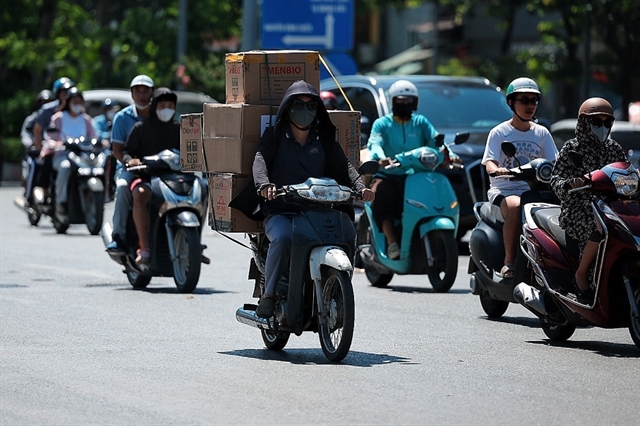
| A delivery rider is forced to cover up completely with sun-protective clothing, a face mask and a helmet to cope with the extreme heat in Hà Nội. — VNA/VNS Photo Phạm Tuấn Anh |
In Hà Nội, maximum temperatures have risen steadily by between 0.03 and 0.07 degrees Celcius annually. In HCM City, the increase has averaged 0.023 desgrees Celcius per year. However, the combination of extreme heat and persistently high humidity throughout the dry season places enormous physiological stress on workers.
Night-time urban heat island effects mean temperatures in city centres rarely fall below 28 degrees Celcius, depriving workers of the opportunity to fully recover after a long day of labour.
Working under these conditions, outdoor workers are facing severe and systemic impacts on both their health and livelihoods.
The study paints an alarming picture, with 94 per cent of respondents reporting at least one heat-related health issue. The most common symptoms included dizziness (46 per cent), mental fatigue (41.2 per cent), exhaustion (39.5 per cent) and dehydration (38.6 per cent). One in five respondents reported experiencing four or more health problems simultaneously.
Describing the increasingly harsh weather, ride-hailing driver Nguyễn Quốc Cường said: “The heat today is twice as intense as it used to be. It drains your energy very quickly. If you're out on the road and don't stop in the shade to rest, it's simply unbearable.”
|
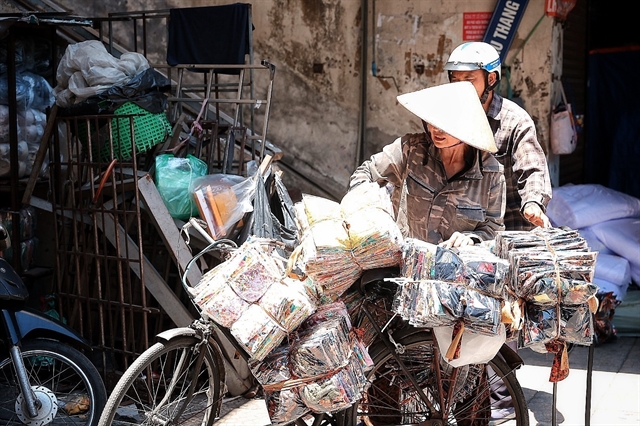
| A female worker loads and transports goods under extreme heat conditions. — VNA/VNS Photo Phạm Tuấn Anh |
Beyond its physical toll, extreme heat is trapping workers in a vicious economic cycle, forcing them to cope simultaneously with rising costs and declining earnings.
The study found that 66.2 per cent of workers incurred additional adaptation expenses, such as purchasing drinking water, portable fans and sun-protection equipment, while 46.4 per cent experienced direct income losses.
As many as 30.3 per cent reported reducing their working hours to protect their health and safety. In major heat hotspots such as Hà Nội, the figure climbed to 45.3 per cent.
Workers are left struggling to balance the need to safeguard their health against the pressures of earning a living, creating significant economic and psychological strain.
Comprehensive safety shield
The research also revealed substantial gaps in policy implementation for informal outdoor workers.
Many remain outside the formal social protection system and rely largely on self-adaptation measures such as adjusting working hours, taking informal rest breaks, seeking shade or receiving support from local communities and small businesses.
Bùi Đức Thọ, chairman of the National Economics University Council, stressed that extreme heat is no longer merely an environmental or weather-related issue.
“It is increasingly becoming a new social protection risk, directly affecting health, employment, income and quality of life,” he said.
Sharing this view, Lê Quang Cảnh, head of the research team, said strengthening social protection was a prerequisite for ensuring that no one is left behind.
Workers themselves have identified practical priorities. Around 66.7 per cent want more trees planted to provide shade, 42.3 per cent seek income support, 37 per cent advocate clearer occupational safety regulations, and 35.2 per cent want assistance with the treatment of heat-related illnesses.
To build a comprehensive protective framework, the study proposes an adaptive social protection model based on four pillars: protection, prevention, promotion and transformation.
In the short term, local authorities should urgently establish public cooling centres, free drinking water stations and 'Water-Rest-Shade' infrastructure. The study also recommends exploring forecast-based financial support mechanisms, with priority given to migrant workers and female workers.
Preventive measures should include upgrading heat-risk forecasting systems, developing response protocols linked to temperature thresholds and introducing stricter occupational safety standards.
To strengthen livelihoods, authorities should provide reskilling programmes, preferential credit for purchasing heat-protection equipment and support for workers transitioning to occupations with lower exposure to extreme heat.
In the longer term, the study recommends developing a national heat action plan and integrating data on outdoor workers into national population and health insurance databases to facilitate coordinated management and policy responses.
The report emphasises that building such a protection network will require broad societal participation.
Architect Trần Minh Tuấn noted that while architects can design ideal public spaces, substantial efforts from the political system are needed to ensure those solutions reach workers on the ground.
Highlighting the need to shift from reactive responses to proactive protection, Francesca Nardini, deputy resident representative of UNDP in Việt Nam, said social protection remains one of the most powerful tools for building resilience and protecting workers not only from traditional economic shocks, but increasingly from climate-related risks as well. — VNS
Society
 Society
 Society
 Society
 Society
 Society
 Society
 Society
 Society
 Society
 Society
 Society
 Society
 Society
 Society