 Society

Drive to Great: BAIC FOTON Africa Partners Conference Set to Open
1.
|
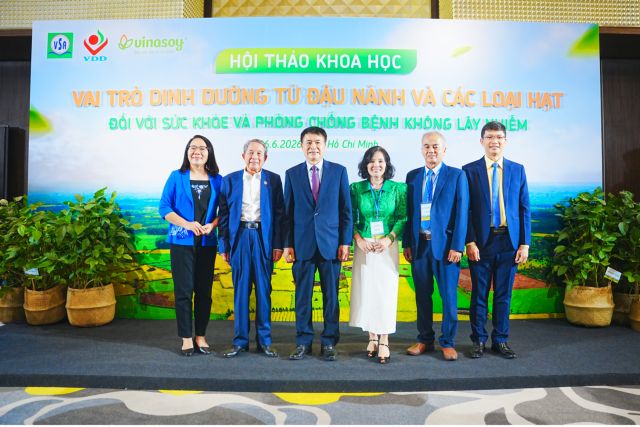
| Speakers at the scientific conference titled “The Role of Nutrition from Soybeans and Nuts in Health and the Prevention of Non-Communicable Diseases” in HCM City on June 26. — Photo courtesy of the organisers |
HCM CITY — Nutrition is one of the most effective ways to prevent non-communicable diseases (NCDs) and improve public health, particularly as the Law on Disease Prevention takes effect on July 1, 2026, marking a shift in the country’s healthcare system from treatment to prevention, experts said at a conference in HCM City on June 26.
Co-organised by the National Institute of Nutrition and the Vinasoy Soybean Research and Application Centre (VSAC), the scientific conference titled “The Role of Nutrition from Soybeans and Nuts in Health and the Prevention of Non-Communicable Diseases” brought together leading experts in nutrition, preventive medicine, agriculture and food technology to present the latest evidence-based recommendations for disease prevention and healthier living in Việt Nam.
According to the World Health Organisation, NCDs, including heart disease, stroke, cancer and diabetes, account for 74 per cent of all deaths globally. In Việt Nam, this group is responsible for approximately 80 per cent of fatalities.
Experts pointed out that alongside an ageing population, numerous lifestyle and dietary risk factors are driving this trend. Salt consumption remains higher than recommended, over 60 per cent of the population fails to eat enough fruit and vegetables, and more than 30 per cent of adults are physically inactive.
Associate Professor Dr Trần Thanh Dương, director of the National Institute of Nutrition (NIN), noted that Việt Nam faces a “double burden” of nutrition. While stunting among children under five remains close to 15 per cent, overweight and obesity rates are rising rapidly, particularly among young people.
“The Law on Disease Prevention marks an important transition from a disease-curing mindset to proactive prevention. In this process, nutrition plays a foundational role because it exerts the earliest, broadest, and most sustainable impact on public health,” he said.
According to presentations at the conference, modern nutrition science is moving beyond simply providing sufficient energy and nutrients, focusing instead on food quality, long-term health outcomes and the sustainability of food systems.
|
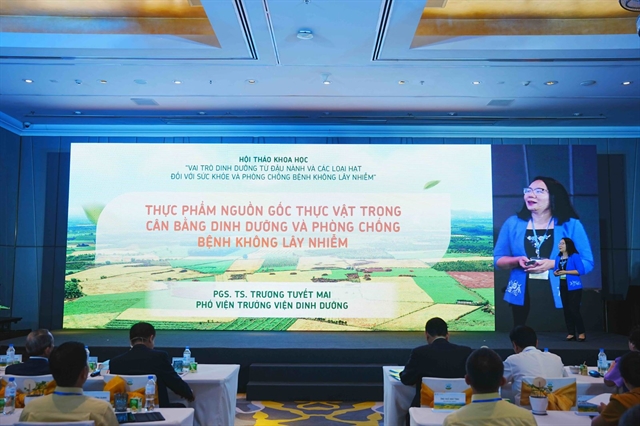
| Associate Professor Dr Trương Tuyết Mai, deputy director of the National Institute of Nutrition, speaks at the conference. — Photo courtesy of the organisers |
Associate Professor Dr Trương Tuyết Mai, deputy director of the NIN, noted that large-scale studies show a balanced plant-based diet helps manage blood lipid disorders and blood sugar levels, while improving gut microbiota health.
Evidence shows that consuming up to 800 grams of fruit and vegetables per day can reduce the risk of cardiovascular disease by 20–32 per cent. Meanwhile, people with the highest intake of whole grains have about a 30 per cent lower risk of developing type 2 diabetes compared to low-consumption groups.
Furthermore, she said a balanced plant-based diet helps manage metabolic risk factors and prevent chronic diseases, while also supporting sustainability by reducing greenhouse gas emissions and improving land and water use efficiency.
Dr Nguyễn Song Tú from the NIN highlighted soybeans as a rare complete plant protein source, comparable in quality to animal protein, containing all nine essential amino acids. They also provide isoflavones, lecithin, dietary fibre and unsaturated fats that support cardiovascular and metabolic health.
International guidelines increasingly recommend greater plant protein intake as a key strategy to reduce chronic disease risk.
Similarly, nuts such as walnuts, almonds, flaxseeds and oats provide beneficial bioactive compounds.

|
| Different soybean varieties on display at the conference. — Photo courtesy of the organisers |
Associate Professor Dr Đặng Minh Nhật from the University of Đà Nẵng – University of Science and Technology explained that experimental tests on unsweetened soymilk and fibrous oat liquid showed high positive Prebiotic Activity Scores (PAS), supporting the growth of beneficial bacteria such as Lactobacillus and Bifidobacterium while inhibiting harmful E. coli. This fermentation process produces short-chain fatty acids (SCFAs), which are vital for gut health and immune function.
He noted that the gut microbiome is increasingly recognised as a highly complex functional system, meaning the value of food lies not only in its nutrient content but also in its ability to shape this microbial ecosystem.
The conference also highlighted the nutritional value chain of soybeans, spanning the conservation of more than 2,200 soybean genetic resources, plant breeding and advanced processing technologies.
Dr Lê Hoàng Duy, director of the Vinasoy Soybean Research and Application Centre, said processing technology plays a pivotal role in preserving the nutritional value of plant proteins, unsaturated fats and essential micronutrients, while maintaining fibre and bioactive compounds such as prebiotics and isoflavones and removing anti-nutritional factors.
He added that soybeans also have biological nitrogen-fixing properties, helping improve soil health, reduce fertiliser use and lower carbon emissions.
At the conference, experts called for closer collaboration between policymakers, research institutes, businesses and farmers to advance microbiome research, develop sustainable raw material regions, expand advanced processing technologies and strengthen evidence-based nutrition communication to support healthier lifestyles in Việt Nam. — VNS
Society
 Society
.jpg) Society
Society
 Society
 Society
 Society
 Society
 Society
 Society
 Society
 Society
 Society
 Society
 Society
 Society