 Society
Int’l cooperation helps address nuclear power workforce shortages
1.
|
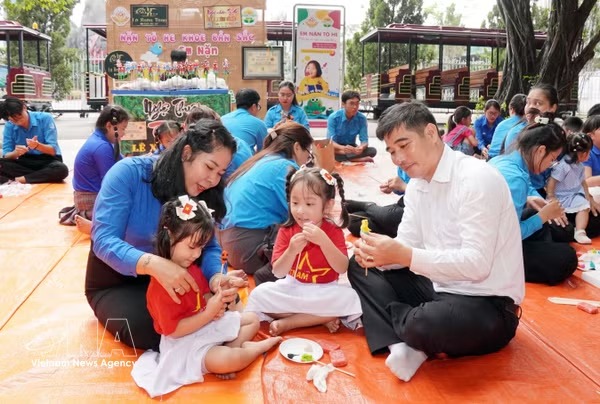
| A family makes traditional "tò he" figurines at the 2026 Happy Family Festival. — VNA/VNS Photo |
HÀ NỘI — Rapid social change, digital transformation and deeper global integration are reshaping Vietnamese families, prompting policymakers and researchers to place renewed emphasis on family values as a pillar of the country's future development.
Family at the heart of Vietnamese cultural value system
Nationwide, localities across Việt Nam have staged a month-long series of events throughout June to mark Việt Nam Family Day (June 28). Family forums, parenting and relationship contests, award ceremonies honouring model families, photo exhibitions and community dialogues all underscored a common message: The family remains society's emotional anchor and the primary custodian of the nation's enduring values.
In recent years, the Party and State have introduced a range of family development policies. Việt Nam Family Day has been observed every June 28 since 2001, celebrating family traditions and tightening bonds between generations. National campaigns promoting cultural families, exemplary parenting, new-style rural development, civilised urban communities and lifelong learning have reinforced the drive to build prosperous, equal, progressive and civilised families while safeguarding Việt Nam's cultural heritage.
Ninh Thị Thu Hương, director general of the Department of Grassroots Culture, Family and Libraries at the Ministry of Culture, Sports and Tourism, said industrialisation, modernisation, global integration and digital transformation are reshaping the structure, functions and values of Vietnamese families. Those changes have opened new doors and brought challenges such as domestic violence, a mounting eldercare burden, widening generation gaps and the erosion of some traditional norms.
As Việt Nam enters a new development era targeting a prosperous, civilised and happy nation, the family's role has grown more critical than ever.
Family values as source of national strength
The Politburo's Resolution 80 on Vietnamese culture development calls for comprehensive human development built on the country's national, cultural and family value systems and citizen standards. It defines four core family values: prosperity, happiness, progress and civility.
Assoc. Prof. Dr. Đặng Thị Hoa from the Institute of Sociology and Psychology under the Việt Nam Academy of Social Sciences, said modern families must do more than nurture compassion. They should also raise citizens equipped with digital skills, an innovative mindset, legal awareness and a strong sense of social responsibility. Building prosperous, progressive, happy and civilised families, she said, is not only a policy goal but also a means of developing a quality workforce with the ethical standards and capabilities needed for Việt Nam's next growth stage.
Hoa proposed building a national family index and aligning family development policies more closely with on-the-ground activities at the local level.
Dr. Trương Thị Hạnh from the Institute of Social Sciences of the Central Region and Central Highlands said family policy should shift from fragmented administration to integrated governance, from passive support to investment in family development, from dealing with consequences to preventing risks, and from experience-based to evidence-based policymaking.
Drawing on their studies, experts proposed a suite of strategic measures, including developing a national family index, embedding family values into Việt Nam's family development strategy, integrating family values education into the national school curriculum, scaling up models of exemplary and happy families, and bolstering coordination among the State, schools, communities and households in family policy enforcement. — VNA/VNS
Society
 Society
 Society
 Society
 Society
 Society
 Society
 Society
 Society
 Society
 Society
 Society
 Society
 Society
 Society