 Society
Việt Nam seeks solutions to AI challenges in education through international cooperation
1.
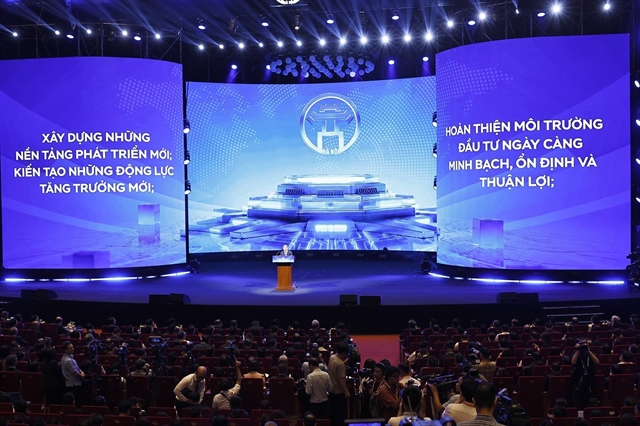 |
| The conference on the Hà Nội Capital Master Plan with a 100-year vision takes place in Hà Nội on Monday. VNA/VNS Photo Doãn Tấn |
HÀ NỘI — Hà Nội's authorities on Monday unveiled the Capital Master Plan with a 100-year vision, setting out a roadmap to transform the city into a globally connected hub for innovation, finance and culture, underpinned by people-centred development, smart infrastructure and sustainable urban growth.
The master plan places people at the heart of development while drawing on Thăng Long–Hà Nội's rich cultural heritage as an endogenous driver of growth. It envisions the capital becoming a global city ranked among the world's leading capitals for quality of life and happiness.
To achieve this vision, the plan identifies four strategic breakthroughs: institutional reform and greater decentralisation; advances in science, technology and digital transformation; development of a multi-layered transport infrastructure network; and restoration of the city's river systems through integrated, multi-functional infrastructure.
The plan introduces a multi-tiered, multi-centre urban structure. Regional transport infrastructure, including ring roads, radial routes and strategic transport corridors, will form the backbone of the new development model, supporting the emergence of a polycentric urban network.
Underground space will be organised by function, with large-scale development concentrated in central urban areas. Ground-level space will prioritise cultural facilities, public spaces, parks and greenery, while high-rise development will be concentrated around transit-oriented development (TOD) zones linked to mass public transport.
For the first time, the master plan incorporates low-altitude airspace below 1,000m into the city's economic structure, paving the way for urban air mobility, including air taxis, eVTOL aircraft, and intelligent drones. The initiative is intended to support a smart city operated through real-time data and digital twin technology.
The historic city centre has been identified as the focal point for urban renewal. Around the iconic Hoàn Kiếm Lake, traffic will be reorganised to prioritise pedestrians, expand public squares, and improve connections between public spaces.
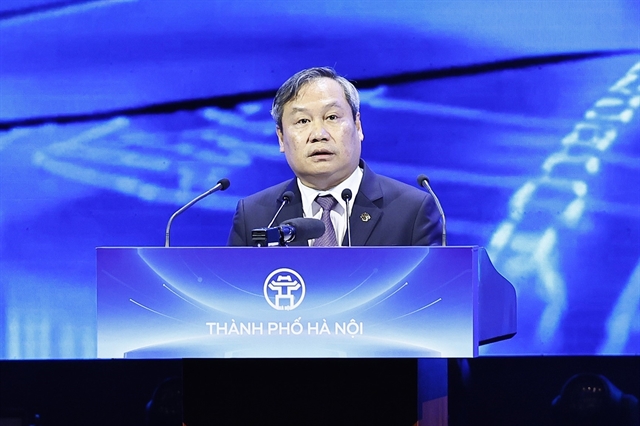 |
| Chairman of the Hà Nội People's Committee Vũ Đại Thắng delivers the opening address and officially announces the Hà Nội Capital Master Plan with a 100-year vision. — VNA/VNS Photo Doãn Tấn |
Hà Nội's Old Quarter will preserve its historic character while integrating new open spaces, underground facilities, and pedestrian craft streets linked to its traditional urban fabric.
The French Quarter is envisioned as a global financial centre developed under a ‘garden city’ model with high-quality office districts.
West Lake will serve as a heritage and landscape zone while becoming a new cultural, creative and tourism hub, anchored by a large-scale opera house complex.
Meanwhile, the Red River boulevard will become a strategic green corridor and a key economic, commercial and service axis. The riverfront will accommodate linear parks alongside finance, tourism and entertainment complexes, while flood control and river management will remain top priorities to ensure long-term safety and sustainable development on both banks.
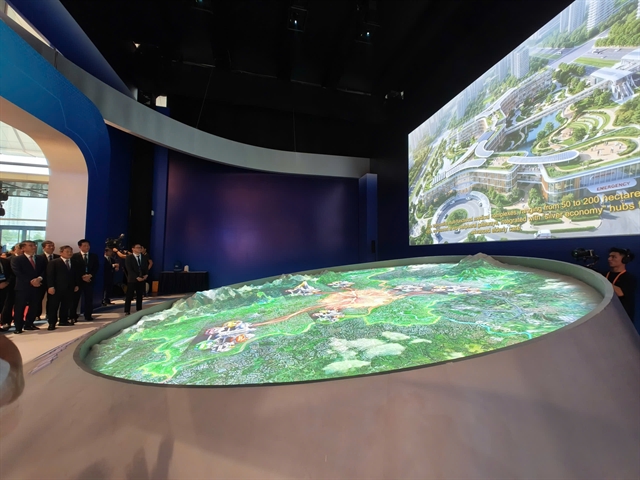 |
| Delegates view a model of Hà Nội’s 100-year master plan. — VNS Photo Khánh Linh |
Transport infrastructure is identified as the plan's principal breakthrough. Hà Nội aims to develop a multi-tier railway network spanning about 1,200km, including approximately 979km of urban rail.
The city plans to fast-track more than 300km of metro lines in the initial phase, with several routes designed to run entirely underground. The network will form the backbone of a multi-centre urban model linking major development hubs and new urban areas.
The road network will also be restructured around eight strategic ring roads and major radial corridors. Multi-modal transport corridors will strengthen regional connectivity, ease congestion in the city centre and improve the movement of goods and passengers.
Transit-oriented development will be implemented around railway stations, with hubs such as Ngọc Hồi, Hà Nội Station and Gia Lâm designated as key investment gateways and high-density development centres.
Urban technical infrastructure will be strengthened through large-scale water management systems, expanded green spaces and integrated river and lake networks, enhancing flood resilience, environmental quality and inland waterway logistics.
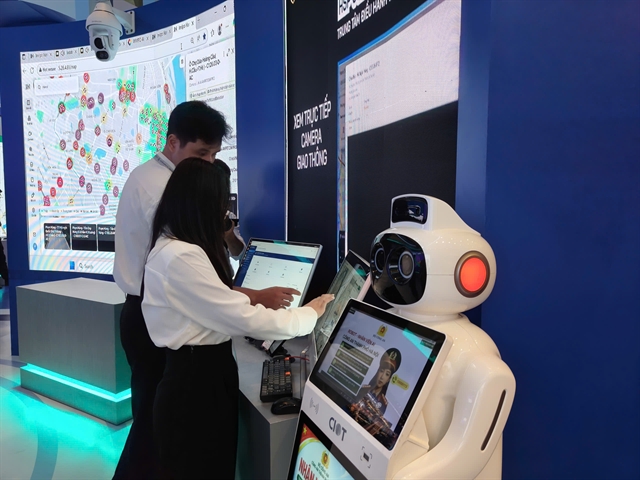 |
| Delegates experience the Hà Nội Police Department’s smart traffic and security management system. — VNS Photo Khánh Linh |
The city's aviation network will also be upgraded, with an expanded Nội Bài International Airport and a new international airport planned in southern Hà Nội. Together, they will support the development of an airport urban ecosystem linked to industry, logistics and free trade.
In rural areas, planning will shift from individual residential clusters to integrated commune-level spatial planning. The ‘villages within the city, city within the villages’ model will be adopted, while traditional craft villages will be connected to OCOP tourism value chains to create a comprehensive green spatial network.
Speaking at the conference, Chairman of the Hà Nội People's Committee Vũ Đại Thắng said that as the nation's capital and political-administrative centre, Hà Nội has a responsibility to pioneer the implementation of the Party and State's strategic policies, reshape its growth model, create new development drivers and strengthen its role as a key growth pole for both the Red River Delta and the country.
He described the conference as the starting point for implementing the master plan at a time when Hà Nội possesses all the necessary conditions for a new phase of development.
"The convergence of long-term vision, a renewed institutional framework and the city's strong determination for reform has created favourable conditions for Hà Nội to realise its aspiration of becoming a cultured, civilised and modern capital, as well as a regional centre for innovation, finance, trade, services and international connectivity," he said.
Thắng said the conference also marked the beginning of efforts to put the plan into action, maximise the effectiveness of new institutional mechanisms and mobilise resources to achieve the city's development goals.
He noted that the city had laid the institutional, infrastructure, financial and governance foundations needed to ensure the plan could be implemented immediately after its announcement.
"Hà Nội understands that, for businesses and investors, even the most visionary master plan only has value if it inspires confidence in the city's ability to implement it," he said.
"That confidence is built not through broad commitments, but through effective governance, a transparent, stable and predictable investment environment, the prompt resolution of business concerns and tangible success on the ground."
Strategic infrastructure top priority
The Hà Nội's mayor said strategic infrastructure development is one of Hà Nội's highest priorities and the foundation for expanding development space, strengthening competitiveness and creating new growth opportunities for decades to come. The city is currently undertaking the largest infrastructure investment programme in its history.
Construction has begun simultaneously on five urban railway lines, marking a major step in expanding mass public transport and advancing transit-oriented urban development. At the same time, major projects including ring roads, Red River bridges, radial highways, flood-control works, technical infrastructure and digital infrastructure are progressing rapidly, with many ahead of schedule, Thắng noted.
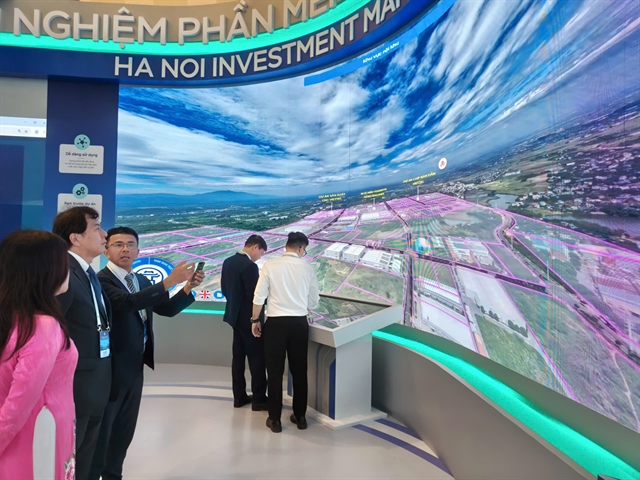 |
| An electronic map showcasing Hà Nội’s urban planning and investment projects. — VNS Photo Khánh Linh |
The city is also implementing housing programmes, promoting multi-functional urban areas, social and rental housing, and investing in education, healthcare, culture, digital infrastructure, innovation centres, environmental projects and other key infrastructure.
"Once these strategic infrastructure projects are completed, Hà Nội will not only overcome transport and urban bottlenecks but also establish a new development structure that better connects growth centres, enhances the city's investment appeal and creates a distinct competitive advantage in the region," Thắng said.
A development-oriented government
Chairman Thắng said the city is building a development-oriented, professional and service-focused administration that places people and businesses at the centre of governance, measuring success by implementation quality and administrative performance.
Recognising that time is a valuable resource for businesses, he said administrative reform is not only a governance requirement but also a direct means of enhancing economic competitiveness.
Hà Nội's overarching objective is to reduce time, costs and risks for businesses while improving transparency, policy stability and administrative efficiency to create an open, secure and predictable investment environment.
Institutional reform, strategic infrastructure and governance innovation are providing the foundation for the master plan's implementation while opening new development spaces, markets and investment opportunities.
According to Thắng, the plan marks a fundamental shift in Hà Nội's development philosophy from expansion driven by scale to growth based on quality, efficiency, innovation and competitiveness and from relying on existing advantages to creating new ones.
The city will prioritise investment in high-value-added sectors with strong spillover effects, including strategic transport infrastructure, TOD urban development, high technology, semiconductors, artificial intelligence, data centres, next-generation industrial parks, smart logistics, clean energy, the circular economy, cultural industries, tourism and high-quality healthcare and education.
These sectors are expected to generate new growth drivers, raise labour productivity, improve human resources and living standards, and strengthen the capital's long-term competitiveness.
Thắng reaffirmed that Hà Nội remains committed to a development model based on quality, efficiency, innovation and sustainability.
"The city will not attract investment at any cost. We will not sacrifice the environment, cultural values or people's quality of life for short-term growth," he said, adding that Hà Nội would instead prioritise projects with high added value, strong science and technology content, efficient resource use, green and low-carbon development, and the ability to create value chains and enhance economic competitiveness.
He called on investors with long-term vision, modern management capabilities and strong social responsibility to partner with the city in developing new economic sectors, growth engines and development spaces.
Thắng pledged that Hà Nội would remain a proactive, action-oriented government committed to practical support for investors. The city will continue improving governance, strengthening implementation capacity, upholding administrative discipline and fostering a transparent, safe and business-friendly investment climate to ensure investors can develop sustainably over the long term.
At the conference, Hà Nội announced 276 investment projects across priority sectors. The city also awarded investment policy approvals and investment registration certificates, while signing memoranda of understanding with a number of major domestic and international corporations. — VNS
Society
 Society
 Society
 Society
 Society
 Society
 Society
 Society
 Society
 Society
 Society
 Society
 Society
 Society
 Society