 Society
Int’l cooperation helps address nuclear power workforce shortages
1.
|
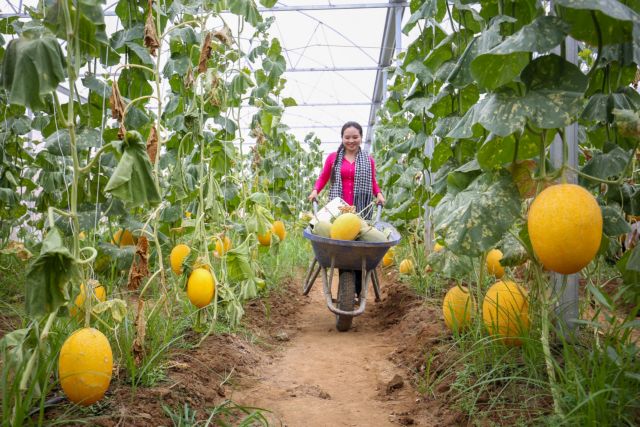
| Honeydew melons grow inside a modern greenhouse system at Baden Farm in Tây Ninh Province’s Bình Minh Ward. The farm’s agri-tourism model helps promote OCOP products and support rural economic development. — VNA/VNS Photo |
TÂY NINH — The implementation of the country’s “One Commune–One Product” (OCOP) programme in the Mekong Delta province of Tây Ninh is helping drive rural growth by adding value to local specialties, boosting tourism and creating sustainable livelihoods.
The southern province now has 417 certified OCOP items, including one five-star product, 87 four-star products and 329 three-star products, according to its Department of Agriculture and Environment.
The sole five-star item is Tân Nhiên ultra-thin rice paper, which has been recognised as a national-level product and demonstrates strong export potential.
These OCOP-certified goods are increasingly serving as a catalyst for rural economic growth, creating opportunities for co-operatives, small businesses, farms and household producers to build brands, access new markets and enhance the value of local farm produce.
During the 2026–30 period, the province plans to develop a greener, more circular and environmentally friendly rural economy while continuing to restructure its agricultural sector to improve incomes and living standards.
It will prioritise the development of high-quality, distinctive and eco-friendly OCOP products.
Tây Ninh also aims to promote the application of science and technology in processing, brand building and market expansion under the programme.
|
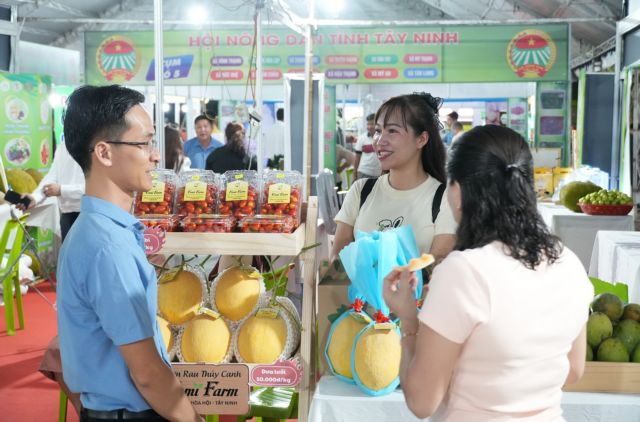
| OCOP products and other outstanding agricultural goods from Tây Ninh Province attract visitors at the first Tây Ninh OCOP Products, Outstanding Agricultural Products and Trade Week 2026, held at Long An Ward Park in April. — VNA/VNS Photo |
Nguyễn Hồng Thanh, deputy chairman of Tây Ninh Province People’s Committee, said developing OCOP products was not only about enhancing the value of farm produce but also about creating jobs, raising incomes and building sustainable livelihoods for rural residents.
Linking these products with tourism, e-commerce and modern distribution channels would help broaden market access and strengthen the competitiveness of local produce in the new development period, he said.
One of the province’s key priorities is integrating OCOP-certified goods with rural tourism, an approach that is already delivering positive results.
To support this effort, the province has established 13 sites for displaying, promoting and trading OCOP products.
The 7 Săng organic mulberry farm, owned by Võ Nguyên Vũ in Dương Minh Châu Commune, currently has four items certified as three-star OCOP products.
The farm cultivates more than 300 mulberry trees using organic methods, providing both high-quality fruit and a foundation for tourism activities.
It yields five to six harvests each year, producing between 500 and 600 kilogrammes per crop. Instead of selling fresh mulberries, the owner focuses on processing them into juice, syrup, jam, yoghurt, wine and mulberry honey to increase their market value.
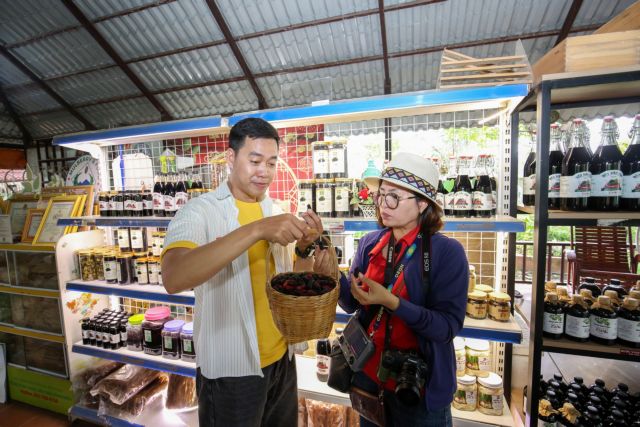
The farm has become a popular weekend destination. Visitors can pick fruit, learn about organic cultivation techniques and enjoy freshly made products on site.
“When visitors can see production processes for themselves, enjoy hands-on experiences and taste the products, their confidence in local goods increases significantly. This is also an effective way to expand markets as competition becomes more intense,” Vũ said.
|
| Visitors enjoy food and drinks made from mulberries at the 7 Săng organic mulberry farm in Tây Ninh Province’s Dương Minh Châu Commune. — VNA/VNS Photo |
Baden Farm in Bình Minh Ward has successfully developed a high-tech agricultural model combined with experiential tourism.
Located near the foot of Bà Đen Mountain, it has invested in modern greenhouse systems to grow honeydew melons and grapes.
The area's unique natural conditions have helped create distinctive agricultural offerings.
Its three-star OCOP honeydew melons are grown through a closed cultivation process using drip irrigation and automated nutrient systems.
Beyond cultivation, the farm has developed an agricultural tourism model that allows guests to tour grape vineyards and melon greenhouses, harvest crops and enjoy freshly picked produce on site.
It also features a culinary area showcasing well-known Tây Ninh specialities, including dew-dried rice paper, wild vegetables, grilled chicken, shrimp salt and a variety of fresh fruit juices.
Nguyễn Trung Đông, director of Baden Farm Trade Services - Agriculture - Tourism Co., Ltd, said visitors gain a deeper appreciation of local produce when they can observe cultivation methods and experience the products first-hand.
“The value of agricultural goods lies not only in their quality but also in the story of the land, the people and the cultivation methods behind them,” he said.
This approach helps these products strengthen their competitiveness, access broader markets and generate additional income for rural communities.
Beyond mulberries and honeydew melons, many other local specialties, including Bà Đen custard apples, Trảng Bàng dew-dried rice paper, shrimp salt, Bàu Đồn durians and Dương Minh Châu grapefruit, are gradually gaining greater market value through the OCOP programme.
These specialties reflect the province’s cultural identity while helping connect agriculture with tourism and promote the image of Tây Ninh to visitors. — VNS
Society
 Society
 Society
 Society
 Society
 Society
 Society
 Society
 Society
 Society
 Society
 Society
 Society
 Society
 Society