 Society
Cultural industry product 'The Moment' debuts to bring new staging experience to theatregoers
1.
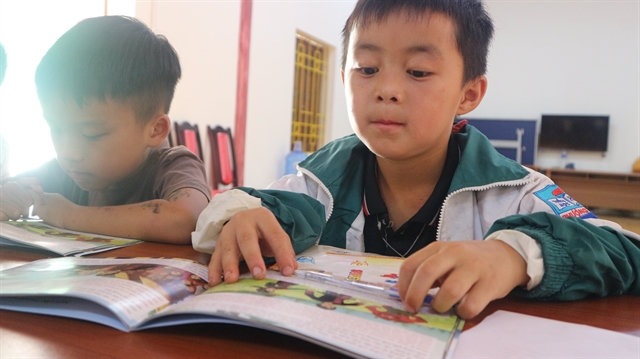 |
| Students of Sà Phìn primary and secondary semi boarding ethnic school at their book reading session. — Photos courtesy of TRIbaLINGUAL |
Khánh Dương
HÀ NỘI — Among many young Mông children, who belong to Việt nam's fourth most populous ethnic group after the Kinh, there is a concerning trend.
Many can speak and understand their mother tongue quite well because they use it every day with their families, but their ability to read and write in Mông is gradually declining.
Realising this fact, a group of volunteer students from the Vietnam National University in Hà Nội and HCM City initiated a project called TRIbaLINGUAL, helping mountainous children improve literacy in their indigenous language while developing their Vietnamese and English skills.
It teaches ethnic children three languages — Mông, Vietnamese and English — through experiential activities which help to promote Mông culture such as acting out a folktale, designing costumes with traditional patterns, playing traditional games.
In early June in the northern mountainous province of Tuyên Quang, laughter and excited voices filled a classroom as children took turns acting out scenes from a story they had just read.
Some spoke in their mother tongue Mông. Others responded in Vietnamese, while a few proudly practised newly-learned English words.
What was once an ordinary classroom has become one of the busiest and most vibrant corners of the village.
Nguyễn Lê Hà Vy, the project's leader, said the initiative seeks to create a springboard for children in remote mountainous areas through education.
"The project promotes trilingual learning, English, Vietnamese and Mông, while equipping students with the skills and mindset needed to confidently integrate into the global community," she said.
"These include teamwork, presentation and critical-thinking skills, while at the same time helping them preserve their cultural roots and identity."
The first season of TRIbaLINGUAL was held in Tả Van Commune in the northern province of Lào Cai last November with more than 100 students at two schools. The second season concluded in early June as a summer camp in Sà Phìn Commune, Tuyên Quang Province, attracting 50 Mông children eager to learn.
When volunteers visited local schools, they discovered that only a small number offered formal Mông language instruction.
"Out of ten schools, perhaps only one or two primary schools teach the Mông language systematically. As a result, children have very limited opportunities to practise writing and reading in their mother tongue," Vy said.
"This is why we want them to understand the importance of the Mông language and why preserving it matters."
Another objective, she added, is to raise awareness among teachers and local authorities about the value of mother-tongue education and encourage more Mông-language classes in schools.
Learning through stories
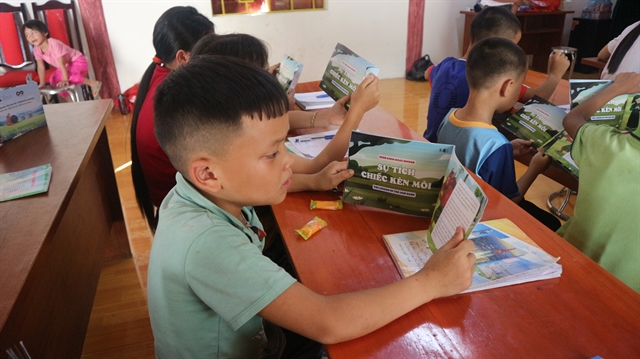 |
| After reading books, students act out scenes from a story they have read. |
At the heart of the programme are trilingual books about culture and folktales.
Children read folk tales and stories in three languages before transforming them into short theatrical performances. Rather than simply memorising the plots, students are encouraged to create alternative endings, develop new characters and adapt the stories to reflect their own experiences.
The approach allows them to practise language skills while fostering imagination and creativity.
For many participants, the experience has strengthened their connection to their cultural heritage.
Sùng Thị Mai, a fifth grader of Sà Phìn primary and secondary semi boarding ethnic school, said the programme made her feel more proud of being Mông people and inspired her to learn more about her people's traditions and language.
After reading stories and performing plays, Mai and her classmates gathered around tables covered with handmade materials collected from their communities.
Using traditional fabrics, embroidery patterns and locally available craft supplies, they decorated shirts inspired by Mông cultural motifs. Each design reflected a story, a symbol or a tradition passed down through generations.
The activity did not end with the artwork.
The students stood before their classmates to present their creations, explaining the meanings behind the patterns and sharing what they had learned about their heritage.
Through these presentations, the children were encouraged not only to understand their culture but also to take pride in it.
Designing clothes and taking part in a fashion show quickly became one of the camp's most popular activities.
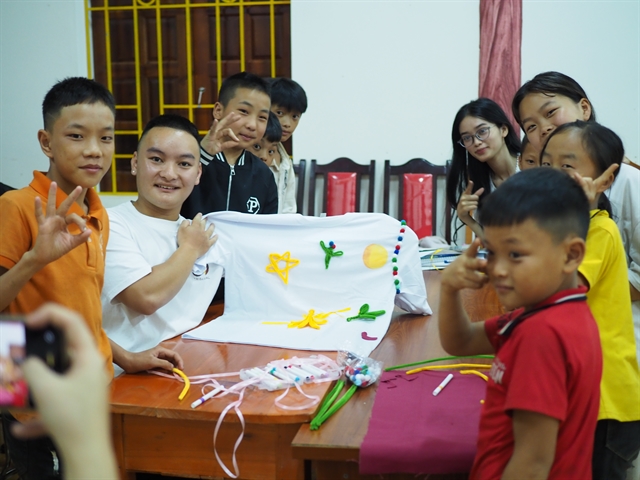 |
| Students decorate shirts with craft supplies to learn more about their ethnic group's culture. |
Vàng Thị Mỹ Duyên, a sixth grader, said, she especially enjoyed the beauty contest and fashion performance.
"It has always been my dream to walk in a fashion show," she said.
"The volunteers came from very far away to teach us. I want to thank them for everything they have done."
Another student, Sùng Mí Nô, a seventh grader, said he enjoyed learning about Mông traditions through games and activities.
"There were many volunteers and many fun activities. I learned a lot about the traditions of the Mông people," he said.
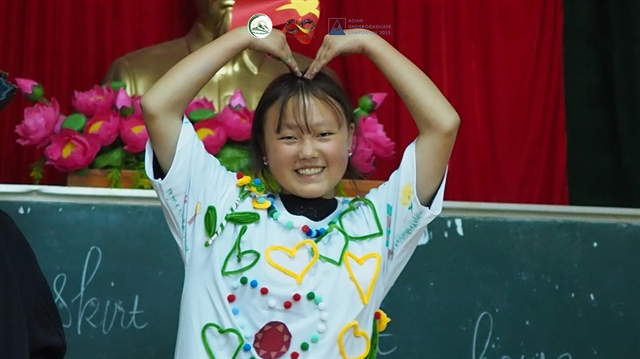 |
| Designing clothes and taking part in a fashion show became one of the camp's most popular activities. |
Teachers also noticed positive changes among the students.
Teacher Vàng Thị Dương from Hầu Thào primary and secondary semi boarding ethnic minority school in Lào Cai Province, said although the programme lasted only two weeks, the students learned many valuable things.
Most importantly, they learned more about preserving Mông culture and especially the Mông writing system, she said.
Lasting legacy
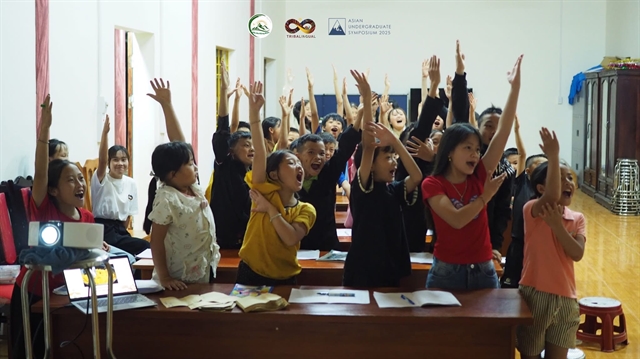 |
| Students are excited raising their hands while joining the camp's activities. |
For Vy, the most memorable moments came after the lessons were over.
"The students gave me gifts passed down from their parents or older siblings, things they treasured deeply," she recalled.
"Some gave me necklaces, bracelets or small keepsakes. To many people, these might seem like ordinary items, but to them they were very precious."
What touched her most, she said, was not the gifts themselves but the affection behind them.
"They were giving me not only gifts but their whole hearts," she added.
"They hugged me, wrote me letters and said ‘Please come back and teach us again next season’.”
Their warmth and enthusiasm convinced her that every hour spent preparing lessons, travelling to remote villages and working with the children had been worthwhile.
When the camp ended, the volunteers left behind more than memories.
They developed a collection of textbooks and fairy tales written in three languages that can be reused by future students. The materials, particularly those in the Mông language, were carefully compiled with the support of Mông-language teachers and educators.
The team hopes the books will continue inspiring children to learn languages while preserving their cultural heritage. — VNS
Society
 Society
 Society
 Society
 Society
 Society
 Society
 Society
 Society
 Society
 Society
 Society
 Society
 Society
 Society




