 Society

Việt Nam, Denmark issue joint statement on establishment of Comprehensive Strategic Partnership
1.
|
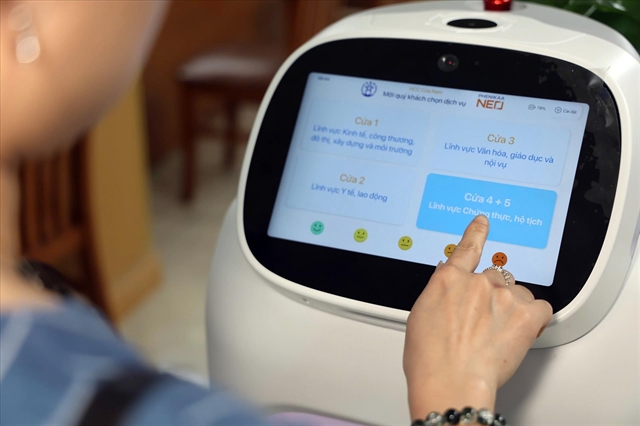
| A resident uses an AI-powered robot to access Government services at an administrative centre in Hà Nội. — VNA/VNS Photo |
HÀ NỘI — Việt Nam aims to rank among the top three countries in Southeast Asia and the top 30 globally on the Government AI Readiness Index, with AI accounting for roughly 6 per cent of GDP by 2030, according to a draft national AI strategy the Ministry of Science and Technology has released for public comment.
The draft organises its 2030 ambitions into five broad goal areas: Government transformation, computing infrastructure, research and development, workforce training and business adoption.
Rewiring Government
Under the draft, every ministry, agency and provincial administration would be required to adopt and implement an AI transformation plan by 2030. All end-to-end online public services would need to integrate AI capabilities to assist citizens, businesses and State agencies.
Provincial-level smart operations centres – digital command hubs that many provinces and cities have built over the past several years to coordinate governance – would be upgraded with AI-powered analytics, forecasting and decision-support tools.
Computing power and data
As for infrastructure, the draft targets a combined public-private GPU capacity equivalent to 250,000 H100, H200 or B200 chips by 2030.
A national AI computer-sharing platform would be established to give public agencies, universities, research institutes, start-ups and small enterprises affordable access to that processing power.
At least 80 per cent of priority Government databases would be standardised, interconnected and made AI-ready, with all ministries and provincial administrations required to publish open-data catalogues to support AI development.
The strategy also calls for the domestic development of at least five Vietnamese-language AI models.
Research and technology
The draft targets a 10 per cent annual increase in internationally published AI research. The number of AI-related patent filings by Vietnamese nationals would grow 16 to 18 per cent per year, with 8 to 10 per cent of granted patents reaching commercial use.
At least three Vietnamese AI research or training institutions would rank among the top 20 in Southeast Asia by 2030 under the plan.
It also calls for a dedicated benchmarking framework for Vietnamese-language AI models, one that would test for accuracy, safety, explainability, cultural fit, bias resistance, resistance to hallucination and compliance with Vietnamese law.

|
| Staff at the Smart Operations Centre in the central city of Huế use AI to detect waste violations. — VNA/VNS Photo |
On the product side, Việt Nam aims to develop, master and commercialise at least 10 strategic AI products built domestically under its 'Make in Việt Nam' initiative. Priority sectors include public administration, education, healthcare, national defence and public safety.
A goal has also been set for at least five shared or sector-specific AI platforms deployable at scale, with at least 80 per cent of nationally funded AI research projects yielding products that are transferred, piloted, commercialised or put to use in the public sector or a priority industry.
Training the workforce
These AI ambitions rest heavily on people. Academic institutions would need to confer at least 10,000 degrees annually in AI, data science and closely related fields.
By 2030, the cumulative goal is to train at least 500,000 workers in AI deployment across Government and industry, with at least 50,000 reaching advanced specialist level in AI development, operations, testing and safety.
Every civil servant and public employee would receive an account and training in a Government AI assistant platform.
All STEM bachelor's and master's programmes would integrate coursework in data analysis and AI. The draft also sets a target of bringing 70 per cent of the general workforce to basic AI literacy.
Business adoption
For the private sector, the draft calls for AI transformation to reach at least 70 per cent of large enterprises, 50 per cent of medium-sized firms and 40 per cent of small and micro businesses.
More than 40 per cent of small and medium-sized enterprises would have access to model-as-a-service offerings, AI agents or shared AI solutions.
|
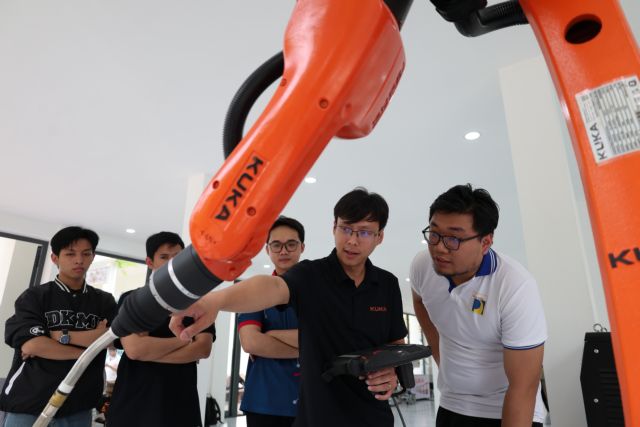
| Students get a close look at an AI-powered robotic arm at a robotics and AI research centre in the central city of Đà Nẵng. — VNA/VNS Photo |
Each of the key economic sectors would develop at least one specialised AI agent or cluster of agents to handle operations, coordination, analysis, alerting, optimisation or process automation.
The strategy also calls for at least 10 Vietnamese AI brands to achieve regional or international recognition, and at least 100 AI start-ups to reach a valuation of US$1 million or bring commercial products to regional markets.
Looking to 2045
The draft's longer horizon is more expansive. By 2045, Việt Nam aims to rank among the top 10 countries in Asia for AI research, development and national transformation, with AI embedded as the primary operating layer of the State, the economy and society.
By that point, the strategy envisions a data- and AI-driven national governance system, a competitive AI economy and an AI business ecosystem with regional and global standing.
The long-term goal, as the draft states, is for Việt Nam to become a significant regional and global innovation centre for AI products, services and solutions. — VNS
Society
 Society
 Society
 Society
 Society
 Society
 Society
 Society
 Society
 Society
 Society
 Society
 Society
 Society
 Society