 Society
LOAN Foundation awards scholarships to disadvantaged students on 10th anniversary
1.
|
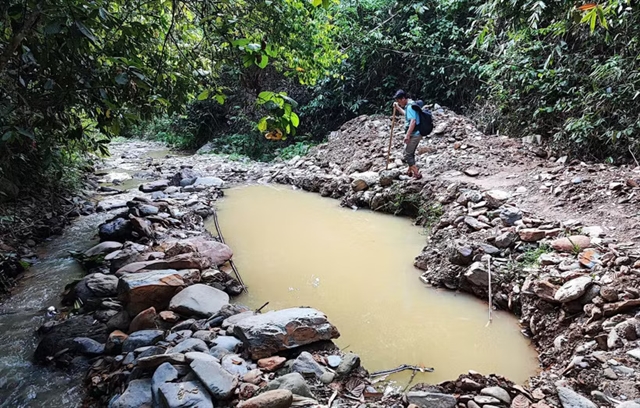
| Gold mining pits have diverted the Huổi Lúc Stream from its natural course. — VNA/VNS Photos |
NGHỆ AN — Rumours of exposed gold in the Huổi Lúc ravine in central Nghệ An Province have drawn hundreds of people into a frenzy for overnight riches, leaving jagged pits, torn forest and buried rice fields.
In early June, Hạt Village and nearby settlements in Yên Na Commune saw residents and visitors gripped by a sudden fever to change their fortunes. The craze began with unverified talk of big finds after floods in late 2025. No authority has confirmed the claims, VietnamPlus online newspaper reported.
For months, crowds have streamed into the heart of Yên Na’s protected forest. Along more than two kilometres of the upper Huổi Lúc Stream, deep holes and undercut scars at the foot of the mountains mark the work of illegal miners.
At noon on one June day, Hạt Village falls silent as stilt-house doors stay shut; only elders and children remain, while most adults head into the forest to hunt for gold.
Hands once used to ploughs and sickles now turn over soil and churn gravel, day and night, in search of a one-night windfall.
“Phanh went at night to dig at the foot of the slope in Huổi Lúc and used a detector to hit a very big nugget. Since then, he goes every day,” said H., a local resident.
Vi Văn N., another local resident, added: “Phanh got a little, not like Kím. I held Kím’s nugget when he weighed it; it was fist-sized. Here it’s nuggets, not alluvial gold.”
This type of word of mouth has fuelled the rush. The wave has spread to nearby villages and communes, including Yên Hòa, with groups of up to 15 people heading for the ravine every day.
|
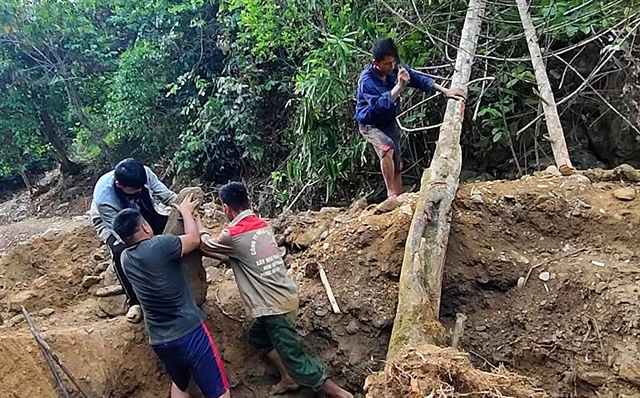
| Large trees have been felled and their roots torn up on the belief that gold lies beneath. |
In early afternoon on the slope to Huổi Lúc, convoys of motorbikes roar in, carrying men and women with hoes, shovels, crowbars, backpacks, food and flashlights, straight to the stream. Drivers drop them, then leave. Others stash bikes under nearby stilt houses.
“In the evening, many people go. After police seized dozens of motorbikes, outsiders came by car, dropped people at the top of the slope and they walked in. Inside, they work all night, digging until dawn. Sometimes a hundred people are there for months,” said H.
Farmers to gold diggers
Residents long used to fieldwork now rush into rocky crevices despite danger, without procedures or protective gear, risking collapse.
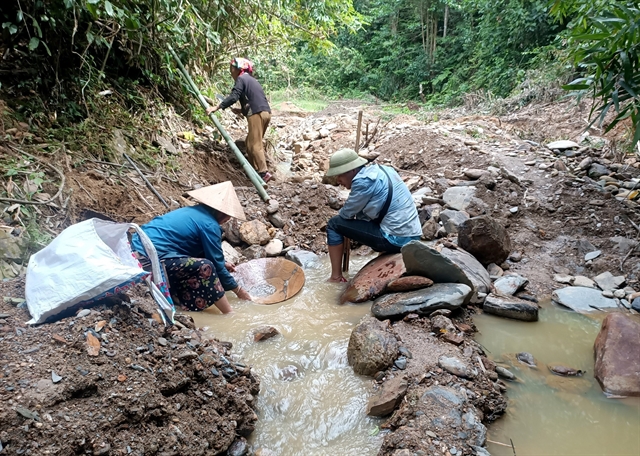
At the muddy stream, an elderly woman pans the fringe with a bent blade and wooden tray, finding only sludge after an hour. Those left behind feel resentment, not condemnation.
“We’re upset to see them go, upset that we don’t have the strength to look for gold like they do,” one resident said.
At night, locals say the forest turns into a lawless land for hundreds of gold seekers.
“The situation greatly affects livelihoods,” said Nguyễn Hữu Huề, head of Yên Na Commune’s economic office.
“People neglect livestock, rice paddies and upland fields. Those once diligent see others go for gold and follow, sharply reducing the local workforce.”
“Our village security team and elders went in to persuade people to stop,” said Lương Văn May, Hạt Village Party cell secretary.
“When the team went in, miners went out; when the team left, people went back in. Our team has only three people. We reported to the commune police and People’s Committee. They intervened, but people still sneak in. Recently, the police confiscated motorcycles, but we don’t know how many.”
|
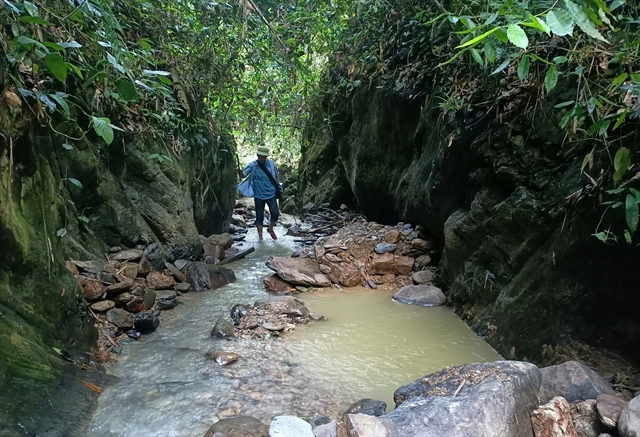
| A narrow rocky chokepoint is a bottleneck preventing motor vehicles from entering the Huổi Lúc ravine. |
After months of digging, damming and moving rocks, the Huổi Lúc waterway has changed shape. The stream bed is pocked with deep holes and the water is turbid.
At an illegal dig site in the ravine, household rubbish lies everywhere – bottles, coffee sachets and makeshift stoves for miners’ hurried meals. Blue and red tarpaulins flap over gaping pits in the scorching sun. Clothes hang on poles along the stream.
Taleo symbols, sacred woven bamboo lattice talismans that form part of the local Thai ethnic belief system, are planted thickly across the stream bed. They serve as boundary markers under a self-declared law of the jungle, designating territory and staking claims to avoid clashes between rival groups.
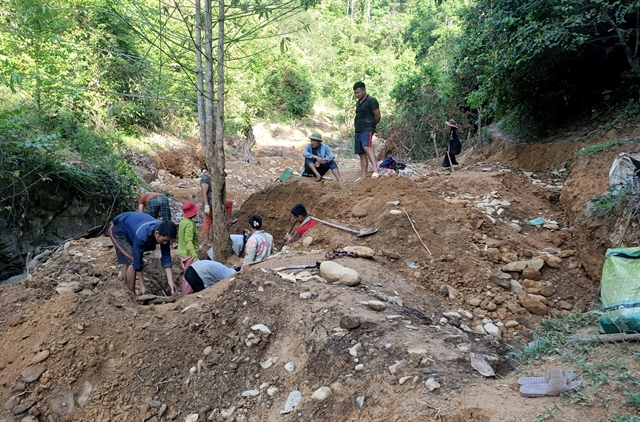
Deeper into the vulnerable heart of the protected forest, the destruction intensifies. Teams labour in slick mud at the bottom of pits, and people shout as they pry up boulders with crowbars.
After stripping the stream bed, miners have pushed into the hillsides. Large tree roots are torn out, leaving undercut cavities poised to collapse, the damage driven by people's hunches that there could be gold under the roots. Along the banks, metal detectors sweep nonstop, their beeps tearing through the silence of the forest.
As afternoon falls, more people move toward the headwaters. Speaking in the local tongue, they shoulder tools and hurry into what resembles a mass operation to plunder nature.
|
| A group of illegal miners search for gold in the Huổi Lúc ravine. |
Floods in late 2025 had already scoured the Huổi Lúc area. Before nature’s wounds could heal, a human-made disaster followed. For months, the stream bed has been churned up, rocks overturned and the water's flow repeatedly forced into new channels.
VietnamPlus reporters said that during a five-hour survey of more than two kilometres upstream, not a single intact metre of stream remained. Deep pits and undercut walls bite into the foothills of the protected forest, signalling erosion, landslide risks and a severe weakening of the forest’s natural defences.
Wildlife is losing shelter, aquatic life is suffocating in silt and hundreds of downstream households face collapsing farm livelihoods.
“Illegal, small-scale gold mining has been seriously impacting the protected forest and stream water sources,” Huề said.
Miners have also moved onto privately owned fields, turning people’s means of production into deep, barren craters. Local security has shifted to red alert, with tensions between landowners and mining crews threatening to flare.
“They dug for gold right into my daughter’s rice field. My child works in a factory down in the lowlands – when she comes back, how will she live, how can she rebuild her livelihood?” Hạt Village resident Lâm Thị Hạnh, 68, asked.
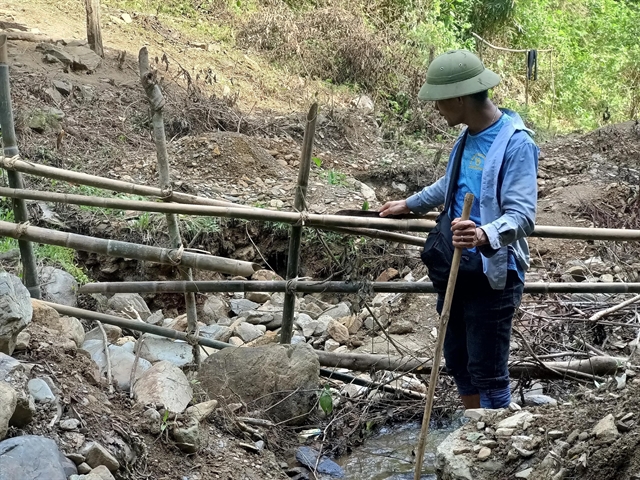
To guard what remains, she has fenced the plot and keeps vigil day and night, a sharp machete by her pillow. “I have a blade. I’m not afraid. I won’t go back to the village until they stop mining.”
.jpg)
|
| Deep pits scar the protected forest after illegal gold mining. |
As a response, commune police have conducted inspections and sweeps and confiscated motorbikes left by miners under villagers’ stilt houses. It's a solution to deter people from joining the rush, Huề said.
Illegal mining has now spread beyond the Huổi Lúc ravine and Hạt Village, according to Nguyễn Sỹ Hiếu, deputy head of the Tương Dương Protected Forest Management Board.
From March to May, patrols logged illicit digs in Na Cáng and Huồi Pai villages.
On June 4, rangers reported some households were still using rudimentary tools to extract gold inside the forest. Nighttime digging and lookouts warning when officials approach have hampered enforcement.
“There will be no compromise with anyone involved in illegal gold mining,” Hiếu said, adding that stations have been ordered to coordinate with the commune for regular patrols, and extra staff have been deployed to hotspots.
Yên Na Commune Chairman Thái Lương Thiện said the stance is “zero tolerance”.
“Absolutely prohibited. Any small scavenging is insignificant. Where there are signs, police are ordered to prevent and handle it by all means,” he said.
Huề said the People’s Committee, police and militia have patrolled, inspected and campaigned to stop people returning to Huổi Lúc. Guards have been posted to block manual mining that threatens security and the environment.
But staffing is thin after an administrative merger placed more duties on the commune, Huề noted.
The People’s Committee lacks 19 personnel, and most offices have just three to four staffers. Police, military, and village security have been mobilised for joint patrols.
|
| Residents carry tools to scavenge for gold along the Huổi Lúc stream. |
Despite official resolve, the protected forest is still being torn up and taleo markers planted to carve up territory. Asked if any formal reports had been sent up the chain about Hạt Village, Huề replied: “No, we have not, it is being handled.”
That silence contrasts with thick on-site records compiled in March, April, May and June by Yên Na forest stations and the Tương Dương board, raising questions about transparency.
The area holds substantial gold reserves, including 1,300 tonnes of raw gold ore at Pu Phen Mountain. For locals, the gold feels like a curse. Many recall the illegal gold rush from 2007 to 2008, which resulted in hacked up hills, makeshift tunnels and deadly cave-ins. In one week, two collapses killed three people, and the influx of miners brought more social ills to the rural area.
Chemicals from illicit pits polluted streams, stunted vegetation and left cattle that drank tainted water unable to reproduce.
In 2024, when authorities sought opinions on an underground gold project in the Yên Na–Yên Tĩnh area by Thủ Đô Construction and General Trading JSC, 100 per cent of respondents opposed it, despite promises to share profits.
It is time for Nghệ An Province to clarify responsibility and act decisively to end Yên Na’s gold rush. — VNS
|
| Residents have erected fences to protect their land from encroaching illegal gold miners. |
Society
 Society
 Society
 Society
 Society
 Society
 Society
 Society
 Society
 Society
 Society
 Society
 Society
 Society
 Society

.jpg)