 Society

Top leader’s visit to open new chapter in Việt Nam–Denmark relations
1.
|
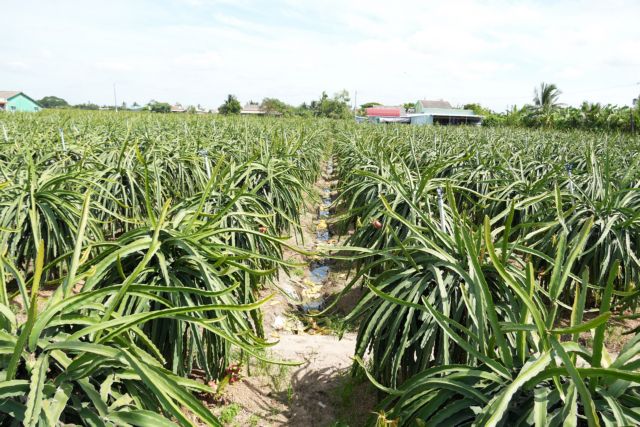
| A dragon fruit orchard in Tân Thuận Bình Commune, Đồng Tháp Province, where growers are facing falling prices during the peak harvest season. — VNA/VNS Photo |
ĐỒNG THÁP — Dragon fruit growers in Đồng Tháp Province are seeing incomes shrink as the ongoing harvest and sluggish demand, between them, drive prices down sharply.
Farmgate prices have fallen sharply in the last few weeks at the province's largest dragon fruit-growing area in Tân Thuận Bình Commune and neighbouring localities in the Gò Công freshwater zone.
Triệu Văn Tôn, a farmer in Tân Thành Hamlet, said his family recently harvested and sold nearly two tonnes of dragon fruit for VNĐ8,000 (US$0.31) per kilogramme, down about VNĐ5,000 ($0.19) from less than a fortnight earlier.
He said growers are now earning only modest profits as rising costs of fertilisers, crop protection products, and labour squeeze margins.
Another farmer, Nguyễn Văn Phúc of Tân Thuận Bình Commune, recently sold more than 400 kilogrammes of the fruit at an average price of VNĐ10,000 ($0.38) per kilogramme.
He said the price is acceptable for fruit harvested during the main season because costs are lower than in the off season, when farmers must use artificial lighting to stimulate flowering.
But farmers who hire workers to harvest their orchards are earning little or no profit, and even losses, he added.
Traders attributed the price decline to a sharp increase in supply as the crop enters its peak harvest period.
Since flowering and fruit setting occur naturally during the main season, many growers reduce investment in orchard care, resulting in inconsistent fruit quality and a lower proportion of premium-grade produce.
Most harvest only a few hundred kilogrammes during each picking in the main season, compared with several tonnes in the off season.
The main dragon fruit season in Đồng Tháp runs from March to mid-September.
|
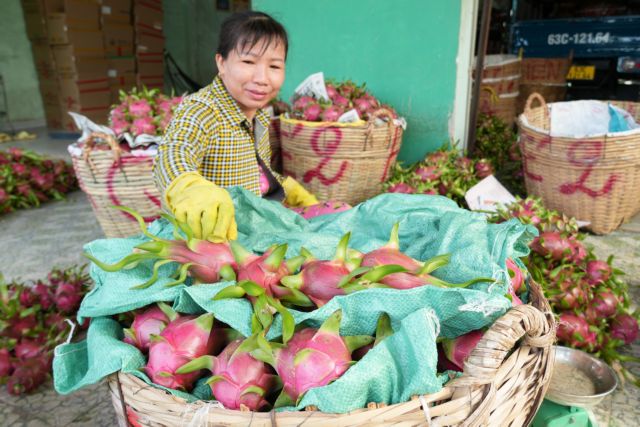
| Workers sort dragon fruit by grade at a collection facility in Đồng Tháp Province before the fruit is supplied to domestic and export markets. — VNA/VNS Photo |
After harvesting ends, farmers typically focus on orchard maintenance before preparing for off-season production to meet stronger demand towards the end of the year.
In response to volatile prices, local agricultural authorities have advised farmers not to expand cultivation areas without careful planning and encourage them to adopt standards such as VietGAP and GlobalGAP to improve fruit quality and meet export requirements.
The province is also strengthening market connections through domestic distribution networks, e-commerce platforms, and fruit processing enterprises to diversify sales channels and reduce dependence on traditional markets.
Trần Trung Quý, director of the Hưng Thịnh Phát Cooperative in Tân Thuận Bình Commune, said the co-operative has been upgrading the quality of its red-flesh dragon fruit to GlobalGAP standards over some 1,000 hectares.
The fruit has received a four-star OCOP certificate and is exported to demanding markets including the US, Japan, and South Korea.
The co-operative exports around 300 tonnes of fruit each month.
Its entire cultivation area has official growing area codes, and its produce is processed and packed at certified facilities to ensure full traceability. It is also developing an additional 450ha of GlobalGAP-certified orchards.
According to the Đồng Tháp Department of Agriculture and Environment, the province has more than 8,500ha of export-oriented orchards that produce over 296,000 tonnes of the fruit annually. More than 2,300ha have GAP certification.
It has growing area codes for 5,493ha for exports to China, and for 1,271ha for selling to Japan, the US, South Korea, and Australia.
Though dragon fruit remains one of Đồng Tháp's key agricultural products and an important source of income for farmers, seasonal price fluctuations highlight the need for stronger value-chain linkages, improved product quality, greater investment in processing, and broader market diversification to avoid recurring bumper-crop, price-slump cycles. — VNS
Society
 Society
 Society
 Society
 Society
 Society
 Society
 Society
 Society
 Society
 Society
 Society
 Society
 Society
 Society